

TL;DR: Identity document verification at customer onboarding is the single highest-leverage checkpoint for stopping fraud before it enters the system. AI-generated document fraud increased nearly 5x between April and December 2025, according to Inscribe's 2026 report, and most onboarding platforms still rely on OCR and template matching that these forgeries routinely pass. Multi-layer verification — metadata analysis, issuer cross-reference, AI artifact detection — must happen at onboarding speed, adding seconds rather than minutes to the process.
Where Fake Documents Enter the System
Onboarding is the front door. Every customer relationship begins with document submission — a government-issued ID, a proof of address, a bank statement, a certificate of incorporation. KYC and KYB processes exist to verify that these documents are genuine and that the person or entity behind them is who they claim to be. When a fraudulent document clears this checkpoint, every downstream decision inherits that risk.
The scale of the problem has shifted. Shufti Pro's 2026 Deepfake Identity Fraud Index projects document deepfakes to rise nearly 3,900% year-over-year in 2026, making it the fastest-growing category of AI-powered fraud. Sumsub's data from 2024 already showed forged documents accounting for 50% of all fraud attempts. And AU10TIX's Q1 2026 benchmark confirmed that AI-generated identity fraud has now surpassed physical document forgery for the first time on record.
The consequences compound. A synthetic identity that passes onboarding verification can open accounts, execute transactions, and operate for months before triggering downstream alerts. By that point, the institution has already extended credit, processed payments, or filed compliance documentation based on a fabricated foundation. The cost of catching fraud at onboarding is a fraction of catching it downstream — but only if the verification layer can actually detect what fraudsters are now producing.
FinCEN recognized this trajectory. Its November 2024 alert warned financial institutions about deepfake media used to circumvent customer identification programs, describing specific typologies where AI-generated documents and biometric spoofing bypass identity verification at the point of account opening. The alert signals that regulators view onboarding as the primary vulnerability — and expect institutions to treat it accordingly.
Why OCR and Template Matching Are No Longer Enough
Most onboarding platforms verify documents through a two-step process: OCR extracts text fields from the submitted document, and template matching compares the layout, fonts, and security features against a library of known-good templates. This approach worked when forged documents were physically altered or manually assembled. It does not work against generative AI.
AI-generated documents do not alter existing templates — they create new ones from scratch. A diffusion model trained on thousands of real driver's licenses or bank statements produces outputs that match the font metrics, layout proportions, and visual security features of genuine documents with high fidelity. OCR extracts the text correctly because the text is well-formed. Template matching finds the expected layout elements because the model learned to place them accurately. The forgery passes both checks because it was engineered to pass both checks.
The SDB-26 benchmark, which evaluated how well vision AI models detect AI-generated documents, found that leading models classify synthetic documents as genuine with 90-100% confidence. The models are not failing — they are doing exactly what they were trained to do: recognize documents that look right. The problem is that looking right is no longer a sufficient signal of being right.
Screenshots compound the problem. When applicants submit photos or screenshots of documents rather than native files, metadata is stripped entirely. Creation timestamps, software signatures, EXIF data — all the digital provenance signals that could distinguish a genuine scan from a generated image disappear. The verification system receives only pixels, and those pixels are increasingly indistinguishable from the real thing.
Inscribe's 2026 data underscores a related vulnerability: 85.6% of fraud leaders cite bank statements as the most concerning document type for fraud. Bank statements lack the physical security features of government IDs — no holograms, no watermarks, no embedded chips. They are text-heavy, template-driven, and trivially reproducible with generative models. Yet they remain a standard requirement in business onboarding workflows and customer due diligence requirements.
What Multi-Layer Verification at Onboarding Looks Like
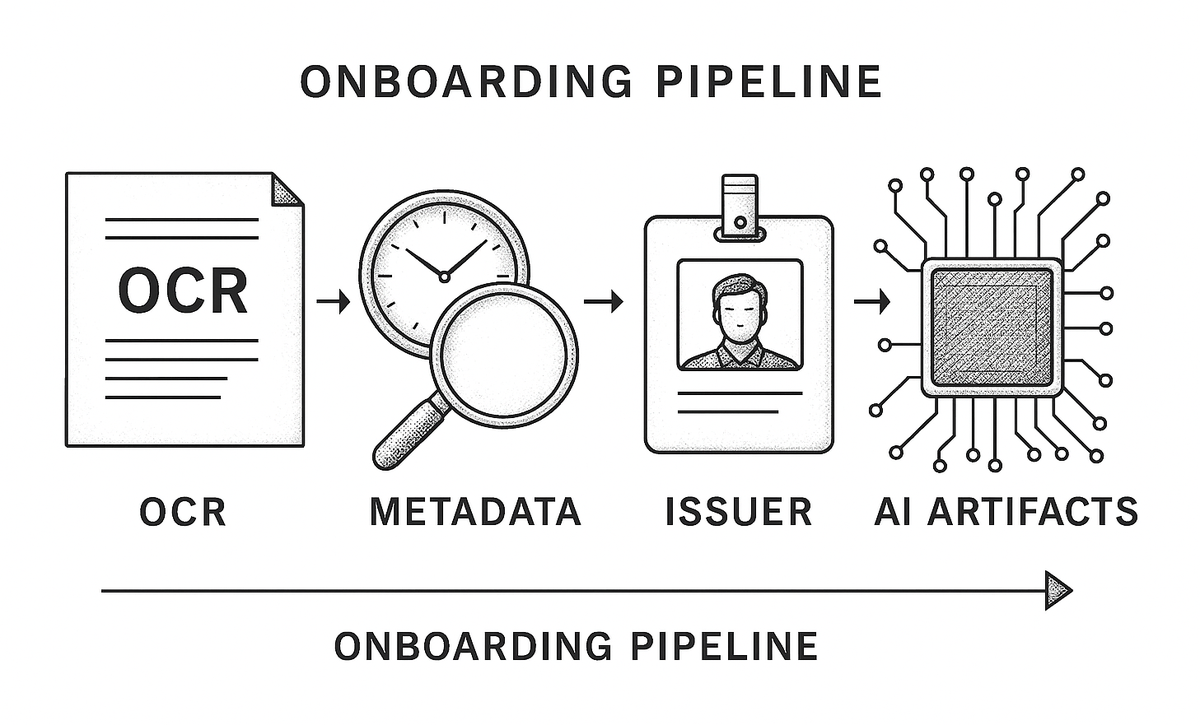
Catching AI-generated documents requires moving beyond what the document looks like and into what the document actually is. Multi-layer verification adds dimensions that generative models have not yet learned to replicate — not because they cannot in theory, but because current-generation tools do not address them by default.
The first layer is metadata analysis at intake. Before the document reaches OCR, the system inspects the file's metadata: creation timestamp, modification history, software used to generate the file, compression artifacts, and color profile consistency. A genuine bank statement exported from an online banking portal carries different metadata signatures than one generated by a diffusion model and saved through an image editor. When metadata is present, it provides a fast, low-cost signal.
The second layer is issuer cross-reference. The system checks extracted data points — document numbers, issuing authority codes, format patterns — against known registries and issuer databases. A fake driver's license might have a plausible layout but an invalid license number format for the stated jurisdiction. A forged certificate of incorporation might list a registration number that does not exist in the relevant corporate registry. These checks are database lookups, not visual analysis, and they catch forgeries that pass every visual test.
The third layer is AI artifact detection. Generative models leave computational fingerprints — subtle patterns in pixel distributions, noise profiles, and frequency-domain characteristics that differ from photographs or scans of physical documents. Dedicated detection models trained on both genuine and AI-generated documents can identify these artifacts even when the visual output appears flawless. Resistant AI's 2026 report noted that while fully synthetic AI document fraud did not take off until late 2025, the signal is now clear and accelerating.
The fourth layer is cross-document consistency. When onboarding collects multiple documents — an ID, a proof of address, and a bank statement — the system cross-references data across all submitted files. Names, addresses, dates, and formatting should be internally consistent but not suspiciously identical. Documents generated by the same AI pipeline sometimes exhibit uniformities in font rendering or layout spacing that real documents from different issuers would never share.
The critical constraint is speed. These checks must integrate into existing onboarding workflows without blowing out the SLA. Sub-second metadata analysis and database lookups run inline. AI artifact detection can execute asynchronously in parallel with other onboarding steps, returning results before the application reaches a human reviewer. The goal is verification that adds seconds, not minutes — and certainly not hours. Institutions that deploy modern fraud detection methods across the customer lifecycle should apply the same latency discipline to document verification at the front door.
Balancing Security and Conversion
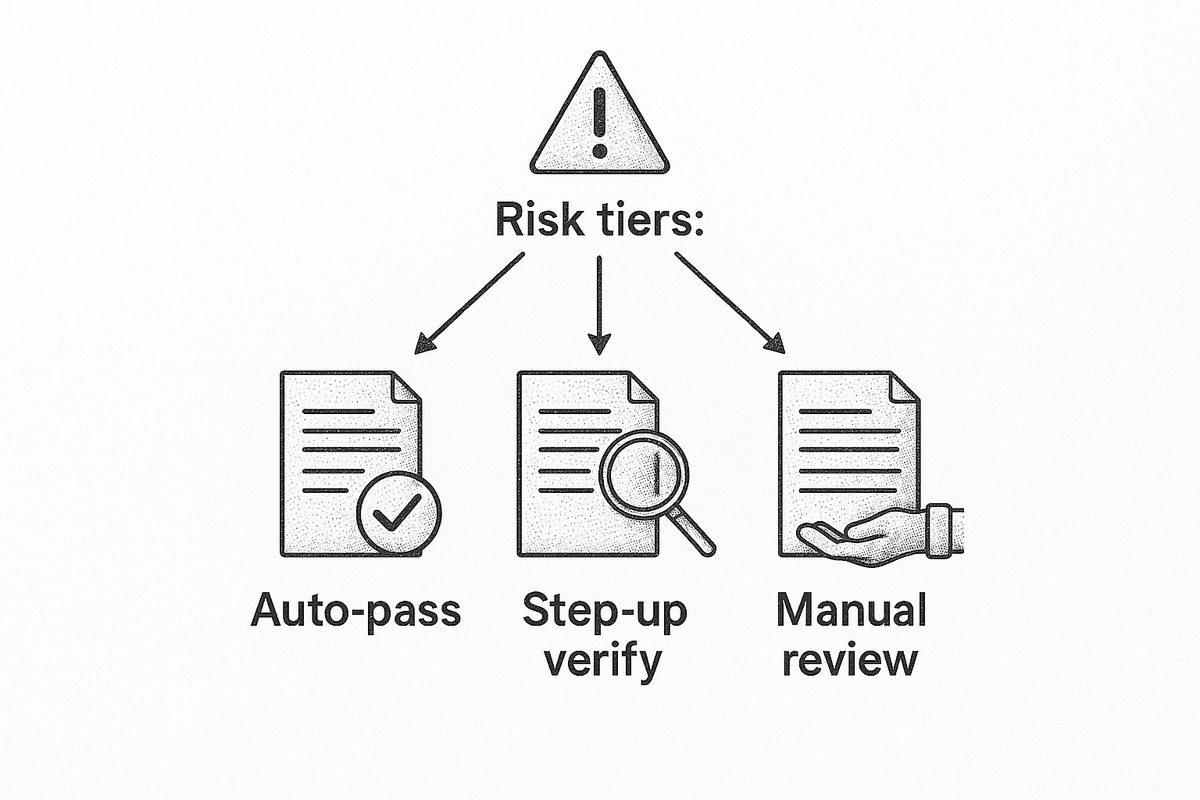
The real tension in onboarding document verification is not technical — it is commercial. Every additional verification step adds friction, and friction kills conversion. An applicant who encounters a rejected upload, a request for additional documents, or a multi-day review delay is an applicant who may abandon the process entirely. For fintechs and digital banks competing on onboarding speed, this trade-off is existential.
Risk-based tiering resolves the tension by applying friction proportionally to risk. Not every application warrants the same level of scrutiny. A low-risk document submission — native file with intact metadata, data points that match issuer records, no AI artifact flags — can auto-pass with sub-second checks. The applicant never knows the verification happened.
Medium-risk submissions trigger step-up verification. The system might request a second document, initiate a liveness check, or run an additional cross-reference against an alternative data source. The applicant experiences a brief additional step but is not rejected outright.
High-risk submissions — stripped metadata, AI artifact flags, issuer mismatches — route to manual review. A human analyst examines the flagged document with full context from the automated checks, making a judgment call that the system surfaces but does not automate. This is where FRAML convergence matters: the same document that triggers a fraud flag may also require an AML assessment, and routing both through a unified workflow avoids duplicate reviews.
Async review for borderline cases preserves the applicant experience. Rather than blocking the onboarding flow, the system can provision a limited account while the review completes in the background. The applicant gets access to basic functionality immediately; full account activation follows once the document clears review. This pattern — common in modern KYC platforms — keeps conversion rates intact without waiving verification standards.
LexisNexis's July 2026 data adds urgency to getting this balance right: one in every 11 new account creations in 2025 was a fraud attack, and one in every 100 failed identity checks now contains a deepfake. The volume means that blunt-instrument approaches — rejecting anything that looks slightly off — will produce unacceptable false positive rates. Precision matters as much as detection.
Where Sphinx Fits
Sphinx operates downstream of the document verification checkpoint, handling the compliance work that onboarding triggers. When a document passes verification and a customer is onboarded, Sphinx's AI agents manage the ongoing compliance lifecycle — screening, monitoring, alert triage, and case review — with full audit trails for every decision. For institutions building multi-layer document verification into their onboarding flows, Sphinx ensures that the compliance processes that follow are equally rigorous, documented, and audit-ready.
Frequently Asked Questions
What types of documents are most vulnerable to AI-generated fraud?
Bank statements are the most frequently cited concern, with 85.6% of fraud leaders identifying them as the most vulnerable document type according to Inscribe's 2026 report. Bank statements lack the physical security features of government-issued IDs — no holograms, watermarks, or embedded chips — making them easier to replicate with generative AI tools. Tax documents and certificates of incorporation are also high-risk due to limited verification infrastructure.
Can OCR-based verification detect AI-generated documents?
Generally, no. OCR extracts text from documents and verifies that the content matches expected patterns. AI-generated documents produce well-formed text in accurate layouts, so OCR processes them the same way it processes genuine documents. Detection requires additional layers — metadata analysis, issuer cross-reference, and AI artifact detection — that examine dimensions beyond visual appearance.
How does document deepfake detection differ from facial deepfake detection?
Facial deepfake detection analyzes biometric liveness signals — natural facial movements, lighting consistency, and depth cues — to distinguish live faces from synthetic ones. Document deepfake detection examines file-level metadata, pixel-level noise patterns, frequency-domain artifacts, and cross-document consistency. The two are complementary but use entirely different detection methods and models.
What did FinCEN's November 2024 alert say about deepfake documents?
FinCEN's alert warned financial institutions about fraud schemes using deepfake media to circumvent customer identification programs. It described typologies including AI-generated identity documents and manipulated biometric data used during account opening. The alert included red flag indicators and reminded institutions of their reporting obligations under the Bank Secrecy Act when they detect deepfake-related fraud.
How can onboarding teams add document verification without slowing down the process?
Risk-based tiering applies verification intensity proportionally to risk. Low-risk submissions with intact metadata and matching issuer records auto-pass in sub-second checks. Medium-risk submissions trigger step-up verification with one additional check. High-risk submissions route to manual review. Async review for borderline cases allows provisional account access while verification completes in the background, preserving conversion rates without compromising detection.
.png)