

TL;DR: Community banks with $1 billion in assets generate 8,000-25,000 AML alerts per year, and 90-98% of them are false positives. With compliance teams of two to five people and annual spending between $400,000 and $700,000, the current model does not scale. The institutions gaining ground are deploying AI triage tools that integrate with existing core banking platforms, reduce false positive rates, and produce the audit trails that FinCEN's new effectiveness-based framework rewards.
The Community Bank Compliance Squeeze
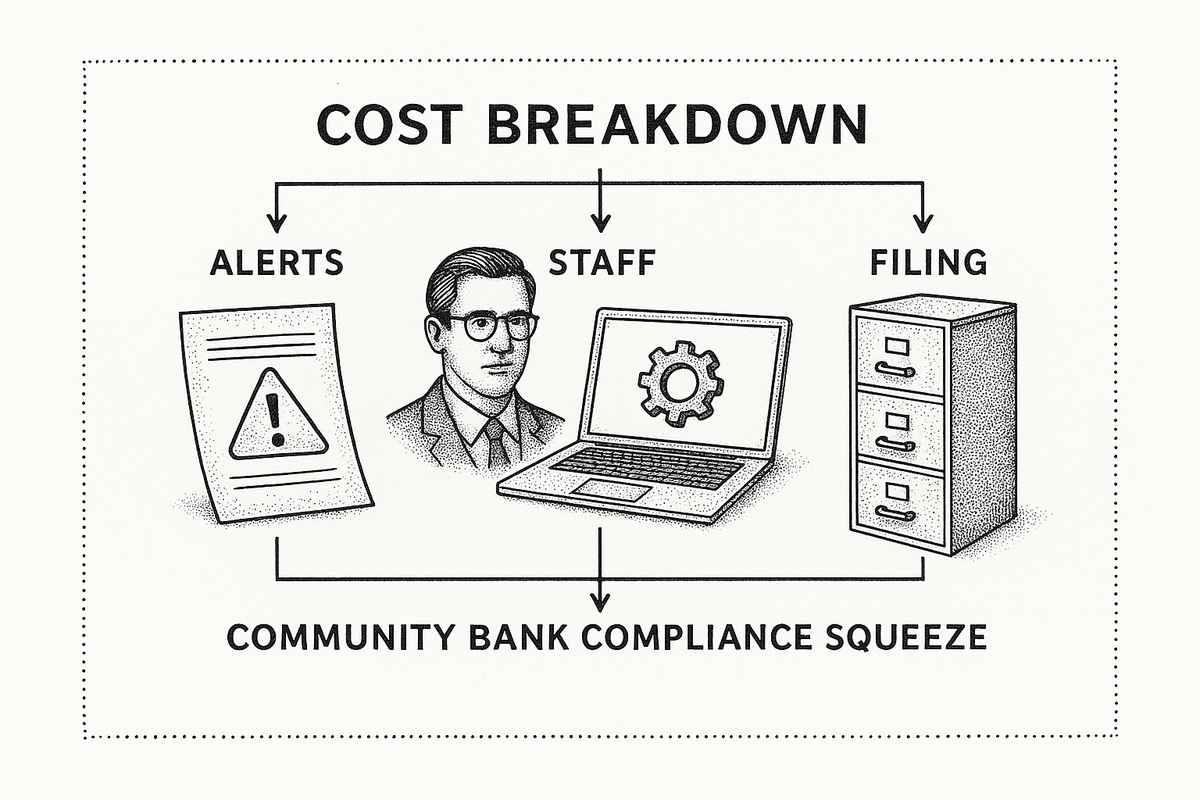
Community banks operate under the same BSA/AML regulatory requirements as institutions ten times their size. A community bank with $1 billion in assets generates between 8,000 and 25,000 alerts per year — roughly 3,000 per month flowing into a compliance team of two to five people. The math breaks down quickly.
Industry research consistently places false positive rates between 90% and 98% across the community banking sector. According to Zusman Partners, the typical alert-to-SAR ratio sits at 50:1, meaning for every SAR filed, 49 alerts consumed analyst hours and produced no actionable outcome. At a BSA officer's desk in a $2 billion community bank, 60-80% of team hours go to clearing false positives — time that could be spent on the investigations that actually matter.
The cost compounds. An ai.advalorem.io report estimates that a community bank with $1 billion in assets spends $400,000-$700,000 per year on compliance operations. At $25-$75 per alert review, each false positive that reaches an analyst erodes a budget already stretched thin. SAR filings reached 2.6 million in fiscal year 2024, an 18.5% increase between July 2023 and December 2024. The volume of regulatory output is climbing while community bank resources remain flat.
This creates a specific kind of operational risk. Community banks cannot absorb the compliance infrastructure of a $50 billion regional bank, but they face the same examination standards. The result is a compliance function that operates at capacity during normal periods and falls behind during surges — new product launches, regulatory updates, or seasonal transaction spikes.
What the Effectiveness Rule Changes
Two regulatory developments in early 2026 shifted the compliance landscape for community banks in ways that matter more than most headline coverage suggests.
In April 2026, FinCEN issued a proposed rule that would replace the BSA's decades-old, process-driven AML/CFT framework with an effectiveness-based standard. Under the current regime, examiners evaluate whether a bank follows prescribed procedures — checking boxes, maintaining documentation volumes, processing alerts through defined workflows. Under the proposed rule, the question shifts to whether the program actually detects and deters illicit finance. Treasury Secretary Scott Bessent framed it directly: financial institutions should be measured by their ability to stop threats, not by the volume of paperwork they produce.
For community banks, this reframing carries real operational implications. The effectiveness-based standard explicitly permits institutions to allocate resources away from lower-risk areas and toward higher-risk ones — provided the reallocation is grounded in documented risk assessments. A community bank that can demonstrate its program effectively identifies suspicious activity, even with a smaller team and fewer filings, occupies stronger regulatory ground than one that processes high volumes of low-value alerts.
In February 2026, the OCC released updated Community Bank BSA/AML Examination Procedures tailored to the size and risk profile of smaller institutions. These procedures acknowledge what community bankers have long argued: a $1 billion bank with a straightforward deposit and lending portfolio does not require the same examination approach as a multinational correspondent banking operation. The updated procedures evaluate community bank programs against the institution's actual risk profile rather than against a one-size-fits-all standard.
Together, these developments create a regulatory environment where community banks are evaluated on outcomes, not on the size of their compliance apparatus. Examiners will assess whether the program works — whether it identifies material risks, generates useful information for law enforcement, and allocates resources proportionate to actual threats. This shifts the value proposition of compliance technology from "process more alerts" to "produce better outcomes with fewer resources."
What to Look for in AML Technology
Community banks evaluating AML technology face a different set of constraints than large banks or fintechs. The technology must work within existing infrastructure, produce results within months rather than years, and deliver cost economics that make sense at community bank volumes. Six evaluation criteria separate solutions that work at this scale from those designed for institutions with fundamentally different operating models.
Core banking integration
Community banks run on a small number of core banking platforms — primarily Jack Henry, FIS, and Fiserv. Any AML solution that requires custom integration work, middleware layers, or parallel data infrastructure introduces cost, risk, and timeline that community banks cannot absorb. The first filter in any evaluation should be whether the vendor has production integrations with the institution's specific core banking system. Products like Jack Henry Financial Crimes Defender and FIS compliance solutions demonstrate how tightly coupled AML technology and core banking data need to be. A solution that cannot ingest transaction data, customer profiles, and account structures directly from the core system adds friction that undermines the efficiency gains it promises.
False positive reduction
At a 95% false positive rate and 20,000 alerts per year, a community bank's compliance team spends the equivalent of 2.5 full-time employees clearing noise. Reducing that rate to 70% — still high by any standard — recovers thousands of analyst hours annually. The evaluation question is not whether a vendor claims to reduce false positives but how. Contextual entity resolution, behavioral analytics, and machine learning models trained on community bank transaction patterns produce different results than rule-tuning overlays applied to legacy detection systems. Ask for false positive reduction metrics from deployments at institutions with comparable asset sizes and customer profiles.
Implementation timeline
Community banks in the $1 billion to $3 billion range deploy AI-driven alert triage in four to eight months — a governance speed advantage over large banks where enterprise procurement and model risk management cycles can stretch implementations to 18 months or longer. This timeline advantage only materializes if the vendor's deployment model matches the institution's capacity. A solution requiring dedicated IT project managers, data engineering resources, and months of model training imposes costs that exceed the technology itself. Community bank implementations should involve configuration, not construction.
Cost per alert at community bank volumes
Enterprise AML platforms often price on transaction volume or user seats in ways that produce favorable unit economics at scale but punish smaller institutions. A community bank processing 20,000 alerts per year needs pricing that reflects its volume, not a discounted version of an enterprise tier designed for 500,000 alerts. Evaluate total cost of ownership including implementation, annual licensing, and the internal labor required to maintain and tune the system. The right benchmark is whether the technology reduces the all-in cost per alert below the current fully loaded cost of manual review.
Audit trail quality
Under FinCEN's proposed effectiveness-based framework, the ability to demonstrate why a decision was made becomes as important as the decision itself. AML technology should generate structured, timestamped audit trails as a byproduct of every alert disposition — not as a separate documentation step that analysts perform after the fact. Evaluate whether the system captures the data reviewed, the rules applied, the rationale for escalation or closure, and the analyst actions taken at each stage. Audit trails that satisfy examiners and external auditors without additional manual effort are a direct cost reduction.
SAR workflow automation
SAR preparation and filing consume disproportionate analyst time at community banks. A single SAR narrative can take two to four hours to draft, review, and file. At an alert-to-SAR ratio of 50:1, a community bank filing 400-500 SARs per year dedicates 800-2,000 analyst hours to the filing process alone. Technology that automates narrative drafting, pre-populates FinCEN fields from case data, and routes filings through approval workflows compresses that timeline without sacrificing quality. The key evaluation criterion is whether the automated narrative is examination-ready or whether it creates a new editing burden.
Where Sphinx Fits
Sphinx deploys AI agents that integrate directly with community bank workflows to triage alerts, document decisions, and generate audit-ready output at every step. For institutions running on Jack Henry, FIS, or Fiserv, Sphinx connects to existing data sources without requiring middleware or parallel infrastructure. Community banks using Sphinx have reduced alert review time by up to 99% while producing the interpretable, auditable decision trails that the effectiveness-based framework rewards. More detail on how Sphinx compares to other AML platforms is available in the 2026 AML software comparison.
Frequently Asked Questions
How many AML alerts does a typical community bank generate per year?
A community bank with $1 billion in assets generates approximately 8,000-25,000 alerts per year, or roughly 3,000 per month. The exact volume depends on the institution's product mix, customer base, and monitoring rule calibration. With false positive rates between 90% and 98%, the vast majority of these alerts require analyst review but produce no SAR filing.
What does AML compliance cost a community bank annually?
Direct compliance costs for a community bank with $1 billion in assets range from $400,000 to $700,000 per year, covering personnel, software licensing, audit fees, and filing costs. The fully loaded cost — including engineering time for system maintenance and the opportunity cost of compliance bottlenecks — is typically higher. These costs scale with asset size and regulatory complexity but rarely scale with the resources available to manage them.
How does FinCEN's proposed effectiveness rule affect community banks?
FinCEN's April 2026 proposed rule shifts AML/CFT program evaluation from procedural compliance to outcome-based effectiveness. For community banks, this means examiners will assess whether the program actually identifies material risks and generates useful information for law enforcement — not whether it processes a specific volume of alerts or maintains a particular staffing ratio. The OCC's February 2026 community bank examination procedures reinforce this by tailoring examination approaches to institution size and risk profile.
Can community banks deploy AI-driven AML tools faster than large banks?
Yes. Community banks in the $1 billion to $3 billion range typically deploy AI-driven alert triage in four to eight months. Large banks face longer timelines — often 12 to 18 months — due to enterprise procurement cycles, model risk management requirements, and more complex integration landscapes. Community banks benefit from simpler governance structures, fewer integration points, and faster decision-making authority within the compliance function.
What core banking integrations should community banks require from AML vendors?
Community banks should require production-tested integrations with their specific core banking platform — most commonly Jack Henry, FIS, or Fiserv. The integration should ingest transaction data, customer profiles, account structures, and historical activity directly from the core system without requiring middleware, manual data exports, or parallel databases. Vendors that cannot demonstrate live deployments on the institution's core platform introduce implementation risk and ongoing maintenance costs.
.png)