

TL;DR: Account takeover fraud detection is the practice of identifying when a legitimate customer's account is being operated by someone other than the customer, and stopping the money before it leaves. According to Javelin Strategy & Research's 2026 Identity Fraud Study, account takeover cost more than $15 billion in 2025 and hit 6 million U.S. consumers, an 18 percent increase in victims year over year. The login itself is rarely the tell. Detection works when institutions correlate device, behavior, account-maintenance, and payment signals across the full session, then route the proceeds side of the case into the AML program rather than closing it as a reimbursed loss.
What Account Takeover Actually Is
Account takeover (ATO) is unauthorized access to and control of an existing customer account, typically followed by changes to contact details or credentials and the movement of funds to accounts the criminal controls. The account is real, the customer is real, and the balance is real. What changes is who is at the keyboard.
That distinction separates ATO from the two fraud types it is most often confused with. In authorized push payment fraud, the genuine customer initiates the transfer themselves after being deceived, which means authentication passes cleanly and the fraud lives entirely in the intent behind the payment. In synthetic identity fraud, there is no genuine customer at all; the account was opened with a fabricated identity and was always under criminal control. ATO sits between them: a real customer who did not authorize the activity, on an account that passed onboarding honestly.
The classification matters operationally. APP fraud is a payment-intent problem, synthetic identity is an onboarding problem, and ATO is a session and account-maintenance problem. The controls differ accordingly.
How Accounts Get Hijacked
Every ATO starts with a credential, a device, or a person being compromised. The vectors have multiplied, but they fall into a small number of families.
Credential stuffing is the volume play. Attackers take username and password pairs from prior breaches and replay them at scale against banking and fintech logins, betting on password reuse. Kasada's 2025 Account Takeover Attack Trends Report documented 22 credential-stuffing crews that together targeted 1,027 large organizations and compromised 6.2 million customer accounts.
Phishing and one-time passcode interception are the targeted play. Modern phishing kits proxy the real banking site in real time, so when the victim types a one-time code into a lookalike page, the attacker relays it to the bank before it expires. SIM swap and number porting move this to the telecom layer: the attacker convinces a carrier to port the victim's number, and every SMS code lands with the criminal. Session hijacking skips credentials altogether by stealing an authenticated session token through infostealer malware on a compromised device.
Then there is the human layer. Call-center social engineering targets the bank's own staff, using stolen personal data to pass knowledge-based verification and request a password reset or a new card. Deepfake voice has raised the ceiling on this vector. Pindrop's 2025 Voice Intelligence and Security Report found deepfake-enabled fraud rising to almost 2 percent of agent-handled fraud calls in Q4 2024, with synthetic voices used to manipulate representatives rather than to defeat voice biometrics directly. FinCEN's November 2024 alert on deepfake media flagged the same pattern and asked institutions to reference the key term FIN-2024-DEEPFAKEFRAUD in related SAR filings.
One number frames why authentication alone cannot solve this. Sift's Q2 2026 Digital Trust Index estimates that more than 65 percent of breached accounts had multi-factor authentication enabled at the time of compromise. MFA raises the cost of an attack. It does not close the door.
The Signals That Give It Away
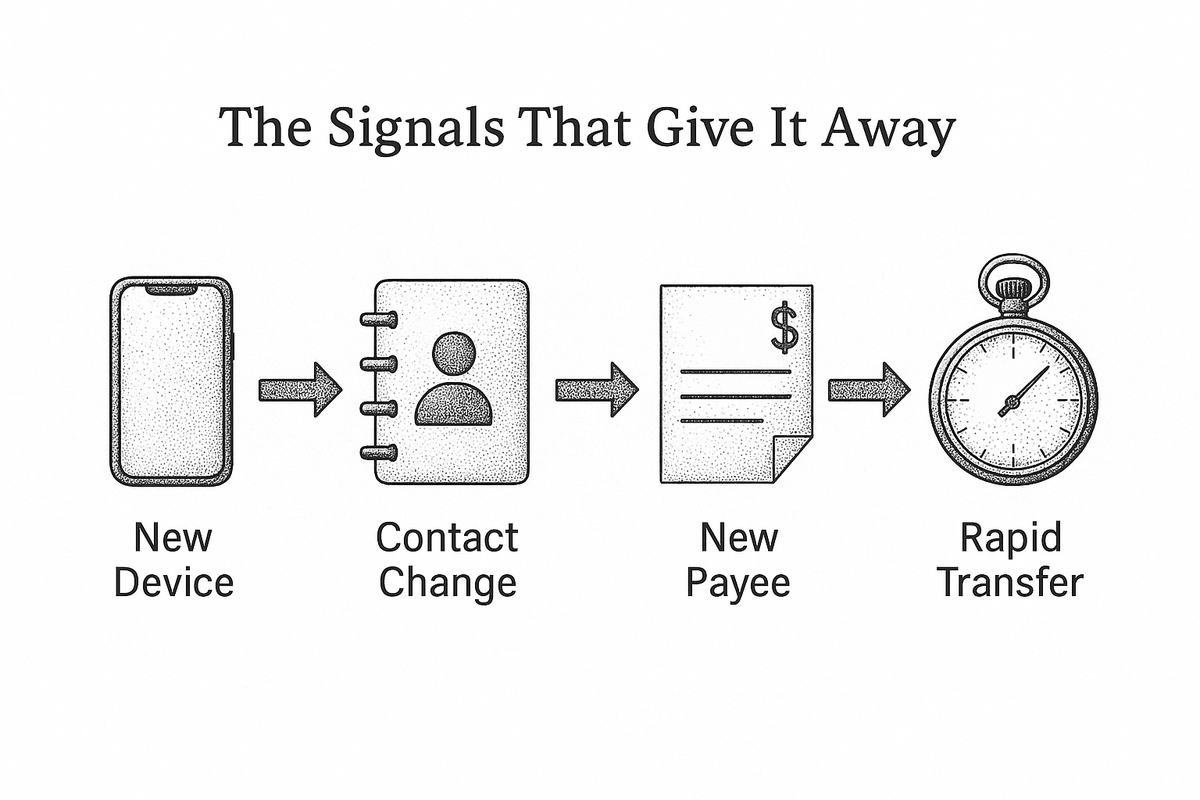
ATO is detectable because the attacker has to do several things in sequence that the genuine customer almost never does together. The individual signals are weak. The sequence is strong.
The first cluster is at login. A device fingerprint the account has never seen, a browser or OS combination inconsistent with the customer's history, a geolocation that would require impossible travel from the last session, and login velocity that suggests automation are all standard inputs. Failed-login spikes across many accounts from shared infrastructure point to credential stuffing before any single account is breached.
The second cluster is behavioral biometrics during the session. Typing cadence, mouse movement, touchscreen pressure, how a user navigates to the transfer screen, and whether they paste rather than type an account number all differ between a customer who has used the app for three years and an attacker seeing it for the first time. These signals are hard to fake at scale because the attacker does not know what normal looks like for this customer.
The third cluster is account maintenance. Changes to email, phone number, mailing address, or notification settings are the attacker's attempt to lock out the customer and suppress alerts. A password reset followed by a contact-detail change followed by a new payee is one of the most reliable ATO signatures in banking. FinCEN's deepfake alert lists access from an IP inconsistent with the customer's profile, rapid transactions, and withdrawals structured to be hard to reverse as indicators warranting further due diligence.
The fourth cluster is the payment itself. A newly added payee that receives a transfer within minutes, an amount near the daily limit, a first-ever international wire, a shift to instant rails, or funds moving to a digital-asset exchange the customer has never used are downstream confirmations. By the time these fire, the institution is in recovery rather than prevention, which is why the earlier clusters carry the most value.
Effective detection scores these clusters together. A new device alone generates unacceptable false positives because customers buy phones. A new device plus a phone-number change plus a new payee plus a maximum-value transfer inside a 20-minute window is a case, not an alert.
Where ATO Becomes an AML Problem
The money stolen through account takeover does not disappear. It lands in a mule account, usually at another institution, and is moved on within hours. That makes ATO a two-sided problem: the victim institution has a fraud loss, and the receiving institution has a mule account laundering the proceeds of wire fraud or bank fraud. Both have suspicious activity reporting obligations.
The reporting volume reflects this. The Federal Reserve's Fed360 fraud mitigation briefing from February 2026 notes that account takeover reports in SARs filed with FinCEN rose more than 36 percent in 2024 compared with 2023. Institutions that treat ATO purely as a fraud-operations matter, reimburse the customer, and close the case without a filing are underreporting, and examiners have started to notice.
The regulatory anchor for the prevention side is the FFIEC's 2021 guidance on Authentication and Access to Financial Institution Services and Systems, which replaced the 2005 and 2011 internet-banking authentication guidance. It states plainly that single-factor authentication, alone or with layered security, is inadequate in many situations, and it expects layered controls including monitoring processes, transaction limits, and account-maintenance controls commensurate with the risk of the activity. An institution whose ATO controls stop at the login screen is not meeting the spirit of that guidance.
This is the practical case for fraud and AML convergence. The session data that stops the outbound transfer is the evidence that populates the SAR narrative, and the mule account that received the funds is the lead for the receiving institution's investigation. When the fraud team and the BSA team share a case record, both sides of the ATO get worked.
How to Evaluate ATO Detection Approaches
Buyers tend to over-weight login-time controls because they are easy to demo. These questions separate approaches that catch the sequence from approaches that only harden the front door.
Vendor benchmarks are less useful than they appear. A detection rate measured on a vendor's own consortium data says little about how the model behaves against an institution's specific customer base and payment rails. Ask for a back-test on the institution's own confirmed-fraud history before committing. The broader landscape of tools is covered in Sphinx's review of fraud detection platforms.
Where Human Investigation Still Matters
Automated detection is good at stopping the transfer. It is weaker at three things that follow.
The first is separating the customer from the attacker in the gray zone. A customer traveling abroad who buys a new phone, updates their email, and sends money to a relative will trip every signal cluster. Outbound contact through a channel the attacker is unlikely to control, and an analyst who knows what a coached victim sounds like, still resolve these cases better than any model.
The second is tracing the proceeds. Following the funds into the mule network, judging whether the receiving account belongs to a witting participant or a recruited victim, and coordinating a recall across institutions is investigative work. FinCEN's June 2026 update to the 314(b) fact sheet, which permits real-time sharing about fraud and money-mule activity, makes this more feasible, but someone still has to make the request and act on the reply.
The third is the filing decision. Whether an ATO warrants a SAR, what typology terms belong in the narrative, and whether the account should be closed or monitored are judgment calls that regulators expect a person to own. The detection system's job is to make those decisions well-documented and fast, not to make them.
Where Sphinx Fits
The gap most institutions describe is not a lack of ATO signals. It is that the signals land in a fraud queue, the proceeds land in an AML queue, and nobody has the capacity to connect them and write it up. Sphinx's agents work inside the case management, core banking, and screening systems analysts already use, assemble the session evidence and the downstream fund flow into a single documented case, and draft the SAR narrative with every step of the reasoning recorded for review. The analyst decides whether the customer is a victim or a participant, whether to file, and what to do with the account. The reconstruction that used to take the rest of the afternoon does not.
Frequently Asked Questions
What is the difference between account takeover fraud and authorized push payment fraud?
In account takeover, a criminal gains control of a genuine customer's account and moves money without the customer's knowledge or consent. In authorized push payment fraud, the genuine customer makes the payment themselves after being deceived, so authentication and behavioral signals look normal. ATO is caught through device, session, and account-maintenance anomalies; APP fraud is caught through payee risk, customer coaching, and payment-intent friction.
Which signals are most reliable for detecting account takeover?
No single signal is reliable on its own. The strongest indicator is a sequence: a new or unrecognized device, followed by a password reset or change to email or phone number, followed by a new payee and a rapid, near-limit transfer within a short window. Behavioral biometrics that compare in-session typing and navigation patterns against the customer's own baseline add a layer that is difficult for attackers to fake at scale.
Does a bank need to file a SAR for account takeover fraud?
Account takeover typically involves wire fraud, bank fraud, or unauthorized computer access, all of which are specified unlawful activities, and the proceeds generally pass through a mule account at another institution. Where the activity meets the SAR threshold, both the victim institution and the receiving institution have reporting obligations. FinCEN's deepfake alert asks filers to include the key term FIN-2024-DEEPFAKEFRAUD when synthetic media was involved.
Why does multi-factor authentication not stop account takeover?
Modern attacks bypass MFA rather than break it. Real-time phishing kits relay one-time codes before they expire, SIM swaps redirect SMS codes to the attacker's device, and session hijacking steals an already-authenticated token. Sift's Q2 2026 Digital Trust Index estimates that more than 65 percent of breached accounts had MFA enabled, which is why the FFIEC's 2021 authentication guidance calls for layered controls that extend beyond the login event to monitoring and transaction limits.
How should compliance teams evaluate account takeover detection vendors?
Ask whether the system correlates signals across the whole session rather than scoring events in isolation, how it treats sessions that have already passed MFA, whether it ingests call-center activity, and what evidence it hands to the investigator when it fires. Request a back-test against the institution's own confirmed-fraud history rather than relying on consortium-wide detection rates, and confirm the output can flow into the AML case record without re-keying.
.png)