

TL;DR: A mule account is a bank or payment account used to receive, layer, and move the proceeds of fraud or money laundering on behalf of criminals. BioCatch documented nearly two million mule accounts flagged across 257 financial institutions in 2024 alone, yet the FCA found that only 37% of offboarded mule accounts were reported to shared fraud databases. Detecting mule accounts requires a combination of velocity analysis, device and behavioral signals, and network-level investigation rather than relying on KYC checks that were never designed to catch post-onboarding abuse.
How Mule Accounts Work
A mule account is a bank, payment, or e-money account that functions as a conduit for illicit funds. The account holder may be a willing participant recruited through social media or messaging apps, a coerced individual who does not fully understand the consequences, or a victim whose credentials were stolen outright. In every case, the account serves the same purpose: receiving money from fraud victims or criminal sources, then dispersing those funds quickly enough to outpace detection and recovery.
The mule account lifecycle follows a predictable sequence. The account passes KYC at onboarding, either because the identity is genuine or because a synthetic identity was constructed to clear document verification thresholds. After onboarding, the account enters a warm-up phase: a series of low-value, unremarkable transactions designed to train the institution's risk engine to treat the account as normal. Once the account has established a credible baseline, the operator activates it for fraud. Large credits arrive, followed immediately by full withdrawals or rapid dispersal across dozens of downstream accounts. By the time the original fraud is reported by the victim, the funds have already moved.
BioCatch identifies five distinct mule personas that compliance teams encounter. The peddler hands over account credentials to a criminal who then operates the account directly, producing behavioral inconsistencies between the original account holder and the new operator. The accomplice is a genuine account holder who willingly facilitates transfers, maintaining normal interaction patterns but exhibiting transaction velocity and incoming payment amounts that diverge sharply from any reasonable personal baseline. Other personas include coerced individuals, synthetic identity accounts, and compromised accounts where the original holder has no knowledge of the activity. Each persona requires a different detection approach, which is why static rules alone fail to cover the full spectrum of mule behavior.
Detection Signals That Surface Mule Activity
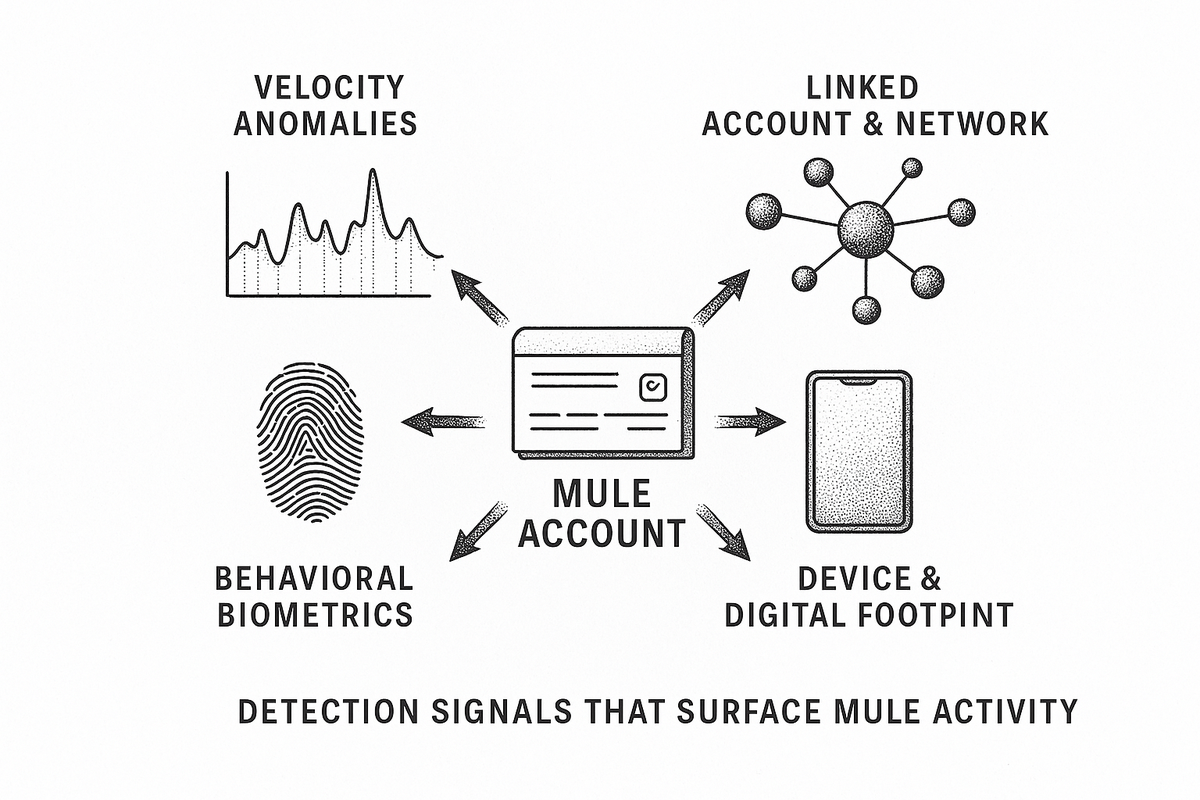
Mule accounts do not generate the kind of obvious anomalies that traditional transaction monitoring was built to catch. The identity may be genuine. The device may be clean. The account may have months of normal history. The defining characteristic of a mule account is that nothing looks obviously wrong until the moment it does, and by then the funds are gone.
Effective detection evaluates signals across multiple categories simultaneously. No single signal is sufficient on its own.
Velocity anomalies are among the earliest indicators. A dormant account that suddenly processes a spike in transaction volume, large credits immediately followed by full withdrawals, round-number transactions with no apparent commercial purpose, or a sharp increase in new beneficiaries added within a short window all point to mule activation. The warm-up pattern, where clean transactions precede a sudden flood, is visible in velocity data before the fraud event peaks, but only if the right monitoring rules are in place. A rule comparing transaction volume over the last 72 hours against the prior 30-day average can surface this shift in real time.
Linked account and network signals reveal mule rings that single-account monitoring misses entirely. An account receiving funds from multiple unrelated sources and rapidly dispersing to others is a graph-level signal, not a single-account signal. Shared device fingerprints across multiple accounts, shared IP addresses, or shared card hashes connect seemingly independent accounts to a common fraud infrastructure. According to UK Finance, the average mule network involves 15 accounts moving funds between accounts at more than three different banks, which means any institution looking at its own accounts in isolation sees only a fragment of the picture.
Behavioral biometrics detect changes in who is operating the account. Typing rhythm, navigation patterns, and session behavior reveal whether the person using the account today is the same person who opened it. BioCatch research found that 79% of confirmed mule accounts were highly active for 90 days before an incoming fraudulent payment, appearing entirely clean during that period. The behavioral shift at the moment of activation, such as a different typing cadence, unfamiliar navigation, or a new device in a new geography, is often the first detectable signal that something has changed.
Device and digital footprint signals add another layer. Multiple account openings from the same device, post-activation sessions arriving from a device different from the one used at onboarding, newly created email addresses with no digital history, and phone numbers with no carrier history all indicate accounts that were set up for a purpose other than legitimate banking. These signals are most powerful when combined. A single device change is normal behavior; a device change combined with an email change, a velocity spike, and an inbound payment from an unrelated source is a pattern that warrants immediate review.
Investigation Steps for Compliance Analysts
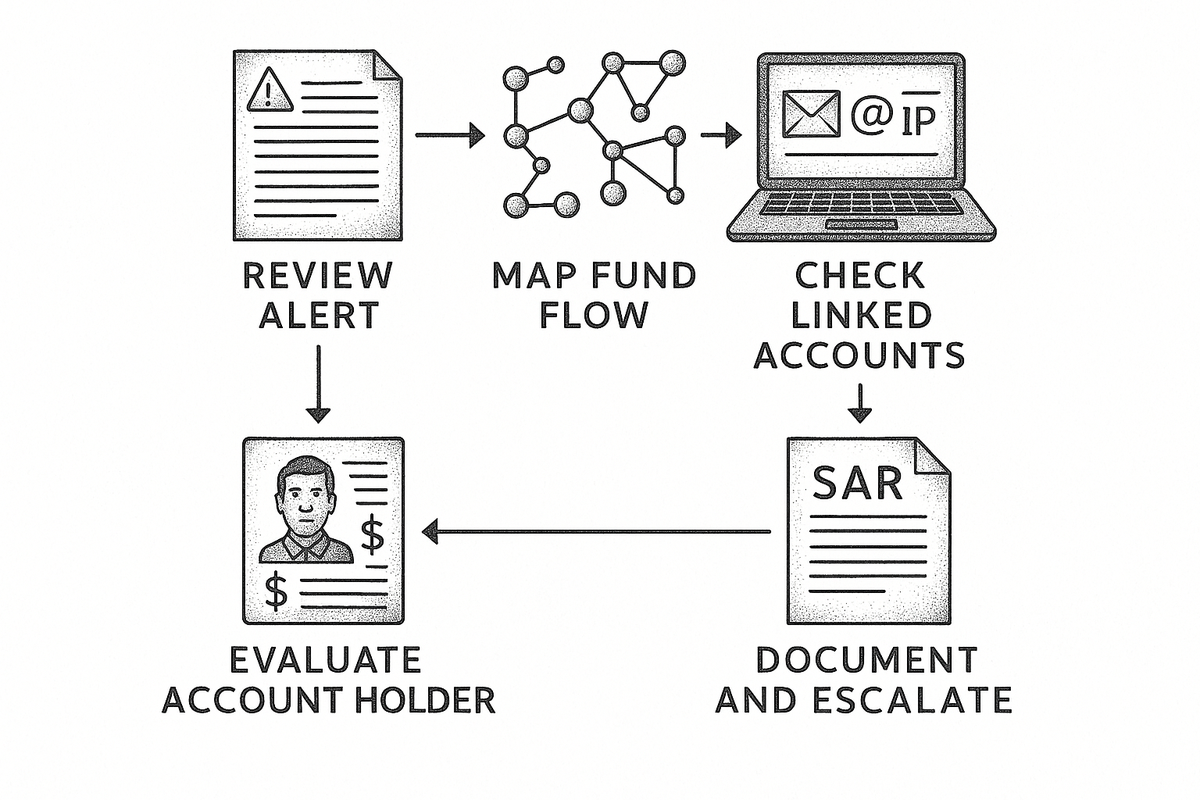
When a mule account alert fires, the investigation workflow needs to answer two questions: Is this account being used to move illicit funds? And can the institution demonstrate, with documented evidence, the basis for its conclusion? The SAR narrative that follows depends on the quality of the investigation that precedes it.
Step 1: Review the triggering event in context. Pull the full transaction history, not just the alert. Look at the account's baseline behavior over the prior 30, 60, and 90 days. Identify when the pattern changed. A sudden departure from established behavior, especially one that coincides with an identity update or a new device, is more significant than an isolated high-value transaction.
Step 2: Map the fund flow. Trace inbound funds to their source and outbound funds to their destination. Are the senders unrelated to each other? Are the recipients accounts at multiple institutions? Does the account receive and disperse within a narrow time window, often hours or even minutes? Rapid fund movement through an account that serves as a pass-through, with no economic rationale for the transactions, is the central behavioral pattern of a mule account.
Step 3: Check for linked accounts. Cross-reference the account's device fingerprint, IP address, email, phone number, and physical address against other accounts at the institution. A single match might be coincidental. Multiple shared attributes across accounts that also exhibit unusual transaction patterns indicate a coordinated network. This is where modern fraud detection methods that incorporate network analysis outperform row-by-row transaction review.
Step 4: Evaluate the account holder's profile. Does the transaction activity match the customer's stated income, occupation, and account purpose? A personal checking account receiving hundreds of thousands in inbound transfers from unknown third parties has no legitimate explanation unless the customer can provide one. Check whether the customer's identity documents, employment details, or contact information changed shortly after account opening, which may indicate the account was activated for mule use after clearing initial onboarding checks.
Step 5: Document and escalate. If the investigation supports a finding of mule activity, file a SAR with FinCEN (in the United States) or a Suspicious Transaction Report with the relevant FIU in other jurisdictions. The FCA's January 2025 multi-firm review found that institutions were generally strong at filing SARs for confirmed mule cases, but weaker at reporting offboarded mule accounts to shared fraud databases like the UK's National Fraud Database. Of 194,084 mule accounts offboarded by 25 UK firms between January 2022 and September 2023, only 37% were reported to the NFD. That gap means intelligence that could help other institutions identify the same mule network never reaches them.
Why Mule Detection Is Getting Harder
The scale of the problem is growing. An Incognia survey of more than 500 fraud and risk professionals across the United States and Europe found that 81% of institutions reported an increase in mule account handovers over the prior 12 months. Yet only 16% of institutions catch mule account handovers proactively, before suspicious transactions occur. The remaining 84% detect mule activity reactively, after funds have already moved or after the money is gone entirely.
Three structural factors make mule detection increasingly difficult. First, mule networks are cross-border. Incognia's research found that 64% of institutions suspect or have confirmed cross-border mule account cases, and 72% say at least half of their cases involve some form of coercion or manipulation of the account holder. Second, traditional FRAML convergence efforts are still maturing at most institutions, meaning fraud and AML teams may each see part of the mule pattern without recognizing the full picture. Third, mule account handovers trigger more false positives than other fraud types. According to the Incognia survey, 53% of institutions report that mule detection generates higher false positive rates, which erodes analyst capacity and slows response times.
The cost of inaction is not limited to direct fraud losses. Forrester Research finds that financial crime compliance costs can consume as much as 19% of a financial institution's annual revenue, with mule accounts at the core of that burden. Mule accounts consume resources across customer service, branch operations, technology infrastructure, regulatory compliance, and investigative teams. When one large bank mapped mule risk across its organization, it identified 16 to 17 internal teams involved at different stages of the mule account lifecycle. The cost is real, but it is diffuse and fragmented, which is precisely why it goes unaddressed until regulators or enforcement actions force the issue.
Where Sphinx Fits
Sphinx automates the investigative workflow that sits between alert generation and SAR filing. When a transaction monitoring system or behavioral analytics platform flags a potential mule account, the compliance analyst still needs to pull transaction histories, trace fund flows, check for linked accounts, evaluate the customer profile, and write a SAR narrative. That manual process is where bottlenecks form, where analyst burnout compounds, and where mule accounts continue operating while cases sit in queue.
Sphinx surfaces the relevant evidence for each alert, automates the structured analysis, and drafts SAR narratives grounded in the documented facts. The platform integrates with existing transaction monitoring and screening systems, which means institutions do not need to replace their detection infrastructure. Instead, Sphinx resolves the gap between detection and action, cutting the time from alert to disposition and ensuring that mule cases receive consistent, auditable investigation regardless of analyst workload. For teams dealing with rising mule alert volumes and high false positive rates, that reduction in manual effort translates directly into faster case resolution and more complete regulatory reporting.
Frequently Asked Questions
What is a mule account?
A mule account is a bank, payment, or e-money account used to receive, transfer, and layer the proceeds of fraud or money laundering on behalf of criminals. The account holder may be a willing participant, a coerced individual, or a victim of identity theft. The account functions as a pass-through, moving illicit funds quickly to obscure their criminal origin before the original fraud is detected.
How do banks detect mule accounts?
Banks detect mule accounts through a combination of transaction velocity analysis, behavioral biometrics, device fingerprinting, network-level link analysis, and digital footprint checks. No single signal is sufficient. Effective detection combines multiple data points: sudden transaction spikes from dormant accounts, shared device attributes across multiple accounts, behavioral changes indicating a different person is operating the account, and fund flow patterns where money arrives from unrelated sources and disperses rapidly to multiple destinations.
What are the red flags of a mule account?
Common red flags include a dormant account that suddenly processes high volumes of transactions, large inbound credits immediately followed by full withdrawals, round-number transactions with no apparent purpose, multiple new beneficiaries added in rapid succession, identity or contact information changes shortly after account opening, and shared device or IP address attributes with other flagged accounts. A warm-up pattern of small clean transactions followed by a sudden surge in volume is also a strong indicator.
What happens when a mule account is identified?
When a financial institution identifies a mule account, the typical response involves restricting or freezing the account, conducting an internal investigation to document the suspicious activity, filing a SAR with FinCEN or the relevant FIU, and reporting the account to shared fraud databases such as the UK National Fraud Database. The FCA has emphasized that institutions should report offboarded mule accounts promptly, as delays allow the same mule network to operate across multiple banks undetected.
Can someone unknowingly become a money mule?
Yes. Criminals recruit money mules through job advertisements, social media offers, and romance scams, often without disclosing the true nature of the activity. The Incognia 2026 survey found that 72% of institutions report that at least half of their mule cases involve some form of coercion or manipulation. Individuals who allow their accounts to be used for transferring funds, even unknowingly, can face criminal prosecution, account closure, and long-term damage to their ability to access financial services.
.png)