
TL;DR: Compliance orchestration is the layer that routes customer data, risk decisions, and cases across the KYC, KYB, sanctions screening, and transaction monitoring tools a financial institution already runs, so one customer is handled as one record rather than five vendor outputs. It exists because the stack is fragmented: an Everest Group survey of 50 Tier 1 banks published in December 2025 found that around half work with two to four AML transaction monitoring providers and a quarter with four to six. The architecture choice, API hub, workflow engine, or agent layer, decides how much integration work the institution ends up owning.
The Layer Between the Tools
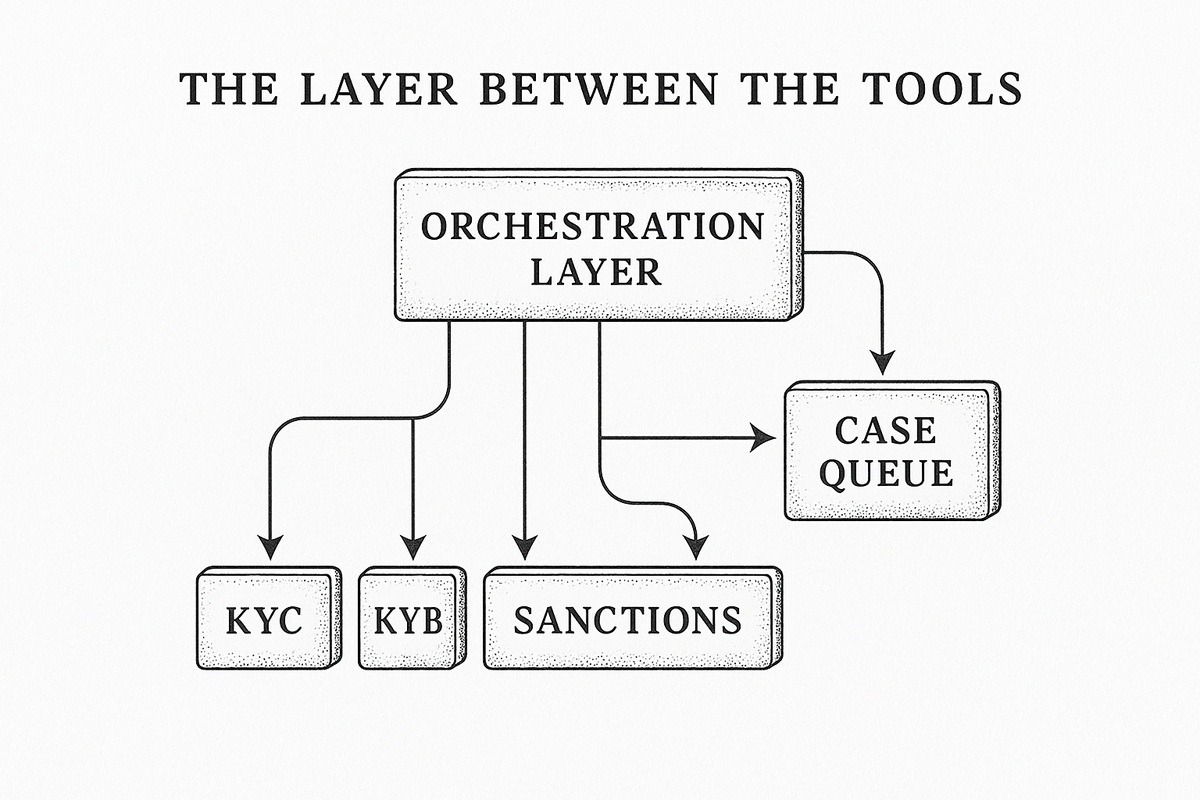
Compliance orchestration is the coordination layer that sits above an institution's point tools and moves data, decisions, and cases between them. A screening engine produces a match score. An identity vendor produces a document verdict. A monitoring system produces an alert. None of those tools knows what the others concluded about the same customer. Orchestration is the part of the stack that does. It decides which check runs when, passes the output of one tool into the input of the next, applies the institution's policy to the combined result, and opens, routes, and closes the case that follows.
What orchestration is not matters as much. It does not screen names, verify documents, or detect structuring; it relies on the tools that do. It owns the sequence and the decision logic while leaving detection to specialists.
Business onboarding shows the difference. Verifying a company means pulling the registry record, identifying beneficial owners, running individual KYC on each of them, screening every name against sanctions and PEP lists, assigning a risk rating, and recording expected activity so transaction monitoring has a baseline. Those are separate KYC and KYB workflows served by separate vendors, and without an orchestration layer an analyst does the handoffs by hand, copying identifiers between tabs and re-keying results into a case system none of the tools can see.
Why the Stack Fragmented in the First Place
Most compliance stacks were assembled one procurement cycle at a time. A screening vendor arrived after a sanctions finding, an identity vendor after a fintech partnership, a monitoring system with the core, and a case manager when spreadsheets stopped scaling. The accumulated result is a set of tools that each have their own data model, their own queue, and their own audit log.
The two conventional answers both have costs. Point solutions are strong at one task and blind to everything else; the institution owns every integration and every reconciliation between them. Monolithic suites offer one contract and one audit trail, but the weakest module sets the ceiling for the program and the vendor's roadmap becomes the institution's roadmap. Sphinx's guide to API-first compliance platforms covers how the vendor market has split along this line.
The data underneath is the real constraint. PwC's EMEA AML Survey 2026, covering 531 institutions, found data quality cited by up to 89 percent of respondents as the top barrier to AI adoption, and confidence in transaction monitoring roughly halved since 2024, from as high as 75 percent to below 30 percent. Nasdaq Verafin's 2026 Global Financial Crime Report found 74 percent of institutions naming AI implementation as their biggest AML challenge, with integration and change management, not the technology itself, as the bottleneck. Orchestration became the third option: keep the specialists and add a layer that makes them behave like one system.
Three Ways to Build the Layer
Orchestration layers are built in three architectural patterns, and the pattern determines who does the integration work, where the logic lives, and which systems get left out.
An API hub normalizes vendor interfaces behind a single internal API and lets engineers compose workflows in code. Swapping a screening vendor becomes a configuration change rather than a rewrite. The limits are that every tool in the chain needs a usable API, engineering owns the maintenance as vendor endpoints change, and compliance staff depend on a ticket queue to adjust logic.
A workflow engine moves the logic to a visual builder that compliance operations can edit: branching by risk tier, jurisdiction, or product, queues, approvals, and a case record that collects every vendor response. The trade is that the engine tends to become the system of record, so lock-in shifts from the vendors to the orchestrator, and it still reaches systems only through connectors. A core banking platform or legacy case manager with no API stays outside the workflow, which is the integration problem Sphinx examined in its piece on connecting AML and KYC tooling to core banking systems.
An agent layer takes a different route to the same outcome. AI agents log into the existing systems through their user interfaces, the way an analyst does, pull what they need, apply the institution's procedures, and write dispositions back. No system needs an API, so legacy platforms are covered on day one, and the tools that already hold the audit record keep holding it. The governance burden is higher: every action the agent takes must be logged, its reasoning must be readable, and thresholds for handing decisions to a human must be explicit. Sphinx has written about what agentic compliance means in practice; the agent operates the stack rather than replacing it.
What to Ask Before You Buy One
Five questions separate an orchestration layer that survives an exam from one that creates a new finding. Sphinx's comparison of compliance automation platforms applies them vendor by vendor.
Can you read the logic behind each decision?
Decisioning transparency means that for any given outcome, the institution can produce the rule, threshold, or reasoning that generated it, in language an examiner accepts. The federal banking agencies' revised Model Risk Management guidance, issued April 17, 2026, superseded SR 11-7 and the 2021 BSA/AML model risk statement. It keeps the expectation that institutions understand a vendor model's conceptual soundness, design, and development data, and it places generative and agentic AI outside its scope while stating that an institution's own risk management practices should govern those tools anyway. A vendor that cannot show the logic per decision leaves the institution to carry that gap.
Does the audit trail cover the orchestrator itself?
Point tools log their own outputs. The orchestration layer has to log itself: which data it pulled, from where, at what time, which policy it applied, what it decided, and who overrode it. That record should be anchored to the case, not to the vendor, and exportable in a format the institution controls. The 2023 interagency guidance on third-party relationships is explicit that using a third party does not diminish an institution's responsibility to meet its obligations as if the work were done in-house. A gap in the orchestrator's log is the institution's gap.
What leaves with you when you leave?
Vendor lock-in in orchestration is less about contract terms than about where the history lives. If case records, decision logs, and workflow configurations exist only inside the orchestrator's database, exiting means rebuilding the audit record. The EBA's Guidelines on outsourcing arrangements require documented, tested exit plans and the ability to transfer activities and data to another provider or back in-house without disrupting compliance. Ask which artifacts export, in what format, and what a vendor swap at a single workflow step costs in practice.
Where does customer data go when a check runs?
Every orchestration call moves personal data to a vendor. Data residency questions cover whether the layer stores copies, in which region, for how long, and whether a check for a customer in one jurisdiction can be routed to a provider in another. The same EBA guidelines require a risk-based assessment of data location and the laws of the jurisdictions where data is processed. With the EU AML Package applying from July 2027 and, per PwC, only about one-third of EU institutions expecting to be ready, an orchestrator that cannot constrain routing by jurisdiction will be replaced before it has paid for itself.
Which decisions does a human still make?
Human-in-the-loop is a design decision, not a slogan. The layer should let the institution set which outcomes auto-close, which route to an analyst, and which escalate, by risk tier and decision type, with those thresholds versioned and reviewable, and overrides captured with the analyst's reasoning. Sphinx's guide to automating AML and KYC processes covers where judgment still has to sit with a person. An orchestrator that treats every case identically is either too conservative to reduce workload or too permissive to defend.
Where Sphinx Fits
Sphinx builds the agent-layer version of orchestration. Its AI compliance agents log into the screening, monitoring, case management, and onboarding systems analysts already use, gather the data a procedure requires, apply the institution's policy, and write the disposition back, with no API integration required. The Interpretable Agentic Framework records every step and cites the data behind every conclusion, so the audit trail covers the layer as well as the tools underneath it. Across customers including Equals Money, Alviere, and Conduit, 98 percent of cases are resolved the same day and case review time falls by 80 percent; Sphinx is SOC 2 Type II certified and GDPR compliant.
Frequently Asked Questions
What is compliance orchestration in financial services?
Compliance orchestration is the coordination layer that routes customer data, risk decisions, and cases across an institution's KYC, KYB, sanctions screening, transaction monitoring, and case management tools. It controls the sequence of checks, applies the institution's policy to the combined results, and maintains a single record of what happened, without performing the detection itself.
How is compliance orchestration different from a compliance platform or suite?
A suite replaces the point tools with one vendor's modules; orchestration keeps the point tools and coordinates them. Orchestration is the better fit when an institution wants to retain specialist vendors or cannot replace a core or legacy system, while a suite suits teams that would rather trade flexibility for a single contract and data model.
Does compliance orchestration require API integrations?
It depends on the architecture. API hubs and workflow engines reach each tool through an API or prebuilt connector, so systems without one stay outside the workflow. Agent-layer orchestration operates existing systems through their user interfaces instead, which covers legacy platforms without an integration project but requires stronger logging and governance of the agent's actions.
Is an orchestration layer a model under U.S. model risk guidance?
Deterministic rule-based workflows fall outside the definition of a model in the April 2026 revised interagency guidance, and generative and agentic AI are outside its scope entirely. Institutions are still expected to govern those tools through their own risk management practices, so the practical bar is the same: document the logic, validate outcomes, and monitor performance over time.
What should an orchestration layer's audit trail contain?
For each case it should record the data retrieved and its source, the time of each step, the policy or reasoning applied, the decision reached, and any human override with the analyst's rationale. The record should be anchored to the case rather than to a specific vendor and exportable in a format the institution controls, so it survives a vendor change and an examiner request.
.png)