

TL;DR: API-first compliance software embeds screening, monitoring, and verification directly into product workflows through programmatic interfaces rather than standalone dashboards. For fintechs and banks building digital products, the integration model determines how fast compliance capabilities deploy, how well they scale, and how much engineering overhead they require. This guide compares leading API-first platforms and explains what to evaluate.
What API-First Means in Compliance
API-first compliance software is designed to be consumed programmatically. Instead of logging into a separate compliance dashboard to review customers or screen transactions, the compliance logic runs inside the institution's own product — triggered by an API call during onboarding, payment processing, or account activity.
This matters because compliance is not a standalone function for modern financial products. A neobank that screens a customer during onboarding, monitors their transactions in real time, and files SARs when anomalies surface needs compliance capabilities embedded in the product flow — not bolted on as a separate system that analysts check periodically.
The alternative — enterprise compliance platforms that require dedicated infrastructure, custom integrations, and months of implementation — works for tier-one banks with dedicated compliance technology teams. It does not work for fintechs shipping product weekly or banks launching digital channels alongside legacy systems.
What to Evaluate in API-First Platforms
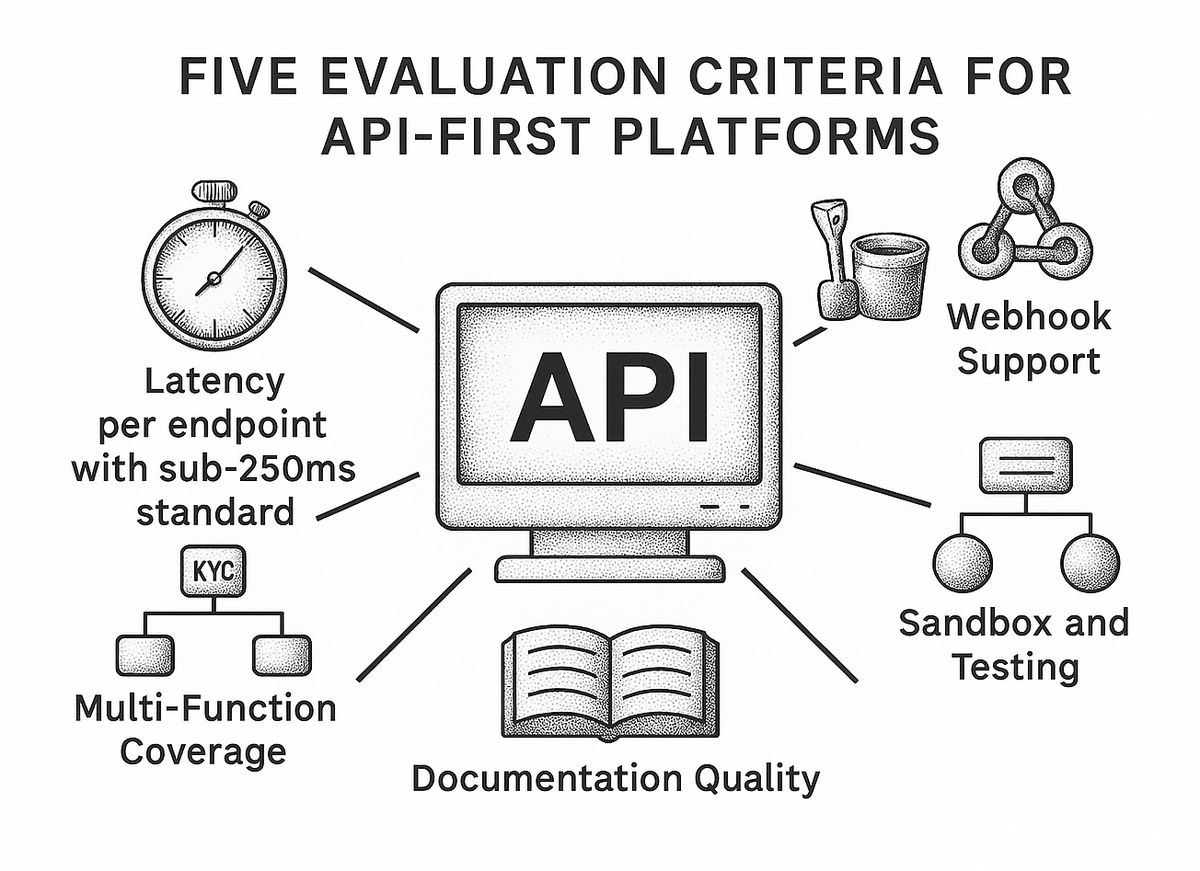
Not every platform with an API qualifies as API-first. The distinction lies in whether the API is the primary interface (designed for developers, documented for self-service integration) or a secondary access layer added to a dashboard-first product.
Latency per endpoint. Compliance API calls sit in critical product paths — onboarding flows, payment authorization, account updates. A screening call that adds 800ms at low volume and eight seconds at peak breaks the user experience. The standard to hold vendors to: sub-250ms response times at the 99th percentile across all endpoints. Ask for latency numbers at your projected peak volume, not averages at baseline load.
Sandbox and testing environments. API-first platforms provide sandbox environments where developers can test integrations with realistic data before going to production. This includes backtesting for transaction monitoring rules — the ability to run new detection logic against historical data and measure false positive rates before deployment. Platforms that require production testing for compliance rules create unnecessary risk.
Webhook support and event-driven architecture. Real-time compliance requires the platform to push events to your systems — not just respond to polling requests. Webhook support for alert creation, screening status changes, risk score updates, and case disposition enables compliance automation that runs without manual monitoring of dashboards.
Documentation quality and developer experience. Self-service integration depends on clear, complete documentation. Evaluate the API reference, code samples, SDKs for your stack, and community support. A platform that requires a solutions engineer for every integration question is not genuinely API-first.
Multi-function coverage on a single API. The most valuable API-first platforms unify multiple compliance functions — KYC, KYB, AML screening, transaction monitoring, and case management — under a single API with a shared data model. This eliminates the integration overhead of connecting separate tools and the audit trail fragmentation that comes with data handoffs between systems.
How Leading API-First Platforms Compare
ComplyAdvantage is the benchmark for API-first compliance in fintechs. Sub-second API response times, a visual rule builder requiring no engineering resources, and continuous risk intelligence integrated into monitoring flows. Deployment timelines of 2-4 weeks are realistic for standard implementations. The platform covers sanctions screening, PEP checks, adverse media, and transaction monitoring with false positive reduction of 60-80%. ComplyLaunch provides startup pricing with up to 12 months free.
Unit21 provides a no-code rule management platform with API-native architecture. The differentiator is the AI Investigation Agent that handles full L1 triage autonomously — ingesting alert context, checking watchlists, and drafting investigation narratives before analyst review. Graph-based rules detect entity relationships and shared information patterns useful for identifying mule account networks. Reports up to 85% false positive reduction.
Alloy positions itself as an identity decisioning orchestration layer. It aggregates data from 190+ sources into automated workflows through a single API. The no-code workflow builder lets compliance teams configure decisioning rules without engineering. Strong for KYC and KYB orchestration, though transaction monitoring is less sophisticated than purpose-built AML platforms. Best suited for US-centric operations.
Didit takes transparency to an extreme with published per-transaction pricing ($0.02/transaction) and no minimums, contracts, or setup fees. A single API covers KYC, KYB, AML, transaction monitoring, and wallet screening. The platform includes a closed-loop re-verification flow — when a transaction trips a rule, the system can automatically trigger a fresh KYC step rather than just freezing the account. Strongest for developer-first fintechs that prioritize pricing transparency.
Sumsub offers global identity verification and compliance across 220+ countries through an API that covers KYC, KYB, AML screening, transaction monitoring, and travel rule compliance. Document verification supports 14,000+ document types with liveness detection. The breadth of coverage makes it a fit for fintechs operating across multiple jurisdictions and customer types.
When API-First Is Not the Right Choice
API-first platforms optimize for developer experience and integration speed. They are not always the right choice.
Large institutions with complex, multi-jurisdictional requirements often need the scenario depth and regulatory coverage that enterprise platforms like NICE Actimize or SAS provide. These platforms are not API-first — they are designed for deployment by dedicated compliance technology teams. The trade-off (longer implementation, higher cost, more configuration) buys breadth of coverage that API-first platforms may not match.
Institutions with legacy core banking systems that cannot consume modern APIs face a different constraint. An API-first compliance platform is only as useful as the systems that call it. If the core banking system cannot make real-time API calls during transaction processing, the integration model breaks.
For these scenarios, overlay solutions offer a middle path. Sphinx, for example, works inside existing compliance tools rather than requiring API integration — agents log into the same platforms analysts use and operate at the workflow level rather than the API level. This approach delivers automation without requiring infrastructure changes.
Where Sphinx Fits
Sphinx operates differently from API-first platforms. Instead of providing an API that institutions integrate into their product flows, Sphinx deploys agents that work inside existing compliance systems — screening platforms, case management tools, monitoring dashboards. This means institutions get automation without engineering integration work. Equals Money automated 87.3% of compliance reviews. Conduit dispositions risk alerts 99% faster. No API integration required.
Frequently Asked Questions
What does API-first mean in compliance software?
API-first compliance software is designed to be consumed programmatically through APIs rather than through a standalone dashboard. The compliance logic — screening, monitoring, risk scoring — runs inside the institution's own product flow, triggered by API calls during onboarding, payments, or account activity. This embeds compliance into the product experience rather than operating it as a separate system.
How fast should a compliance API respond?
The standard for leading platforms is sub-250ms response times at the 99th percentile. Compliance API calls sit in critical paths like onboarding and payment authorization. A screening call that adds noticeable latency breaks the user experience and can cause transaction abandonment. Ask vendors for latency numbers at your projected peak volume, not averages at baseline.
Can API-first platforms replace enterprise compliance suites?
For many fintechs and digital banks, yes. API-first platforms deploy in weeks rather than months and offer self-service configuration without dedicated compliance technology staff. For large institutions with complex multi-jurisdictional requirements and deep scenario libraries, enterprise platforms like NICE Actimize may still be necessary for coverage breadth.
What is the advantage of unified compliance APIs?
Unified APIs that cover KYC, KYB, AML screening, transaction monitoring, and case management under a single interface eliminate the integration overhead of connecting separate tools. They also maintain a shared audit trail across all compliance functions, preventing the data fragmentation that creates gaps during regulatory examinations.
How does Sphinx differ from API-first compliance platforms?
Sphinx deploys agents that work inside existing compliance systems rather than providing an API for institutions to integrate. This means automation without engineering work — agents log into screening platforms and case management tools directly. This approach is best for institutions that already have compliance tools in place and want to automate the operational workflow without replacing their infrastructure.
.png)