
TL;DR: Entity resolution for beneficial ownership decides whether "J. Petrov," "Ivan Sergeevich Petrov," and "PETROV IVAN" in three registries are one person, so an ownership graph can be built on them and traversed to compute who ultimately owns what. The graph does the arithmetic through layered holding companies and circular structures; resolution decides whether it is about the right people. Both are capped by registry quality: Open Ownership and the Tax Justice Network found that 20 percent of the 6.1 million entities on the UK PSC register list no individual beneficial owner at all.
Why the Same Owner Shows Up as Five Different Records
Entity resolution is the process of deciding which records, across registries, filings, and internal systems, refer to the same legal person or natural person. A beneficial ownership chain rarely lives in one dataset, and the records that make it up share no common identifier.
The variation is structural. Transliteration from Cyrillic, Arabic, or Chinese produces several legitimate Latin spellings of one name. Corporate suffixes appear as Ltd, Limited, or not at all. Free-text fields accumulate noise: Open Ownership's review of the UK register found over 500 spellings of "British" in the nationality field. We have covered how name matching algorithms score these variants for screening; ownership work uses the same tools with less tolerance, because a wrong merge fabricates an ownership link and a missed merge hides one.
Deterministic Rules, Probabilistic Scores, and Blocking in Between
Deterministic matching links records that agree on a defined key: an LEI, a registration number plus jurisdiction, a passport number. Probabilistic matching handles the remainder. The standard framework comes from Fellegi and Sunter's 1969 work, summarized in a 2020 review of record linkage methods in the International Journal of Environmental Research and Public Health: each field comparison contributes a weight based on how likely agreement is among true matches versus random pairs, and two thresholds split the summed scores into links, non-links, and a middle band for human review.
Neither approach can compare every record to every other record. Blocking, also called indexing, restricts comparison to candidates that share a cheap key: the same phonetic code for a surname, or the same jurisdiction and incorporation year. Blocking is where most silent recall loss happens: a transliteration that changes the first letter of a surname drops the pair out of the block before any scoring occurs.
We run deterministic rules first, probabilistic scoring on what remains, and route the middle band to an analyst. The scoring layer must treat a missing field as no evidence rather than a mismatch, because public registers omit dates of birth too often for absence to count against a link.
Turning Resolved Entities into an Ownership Graph
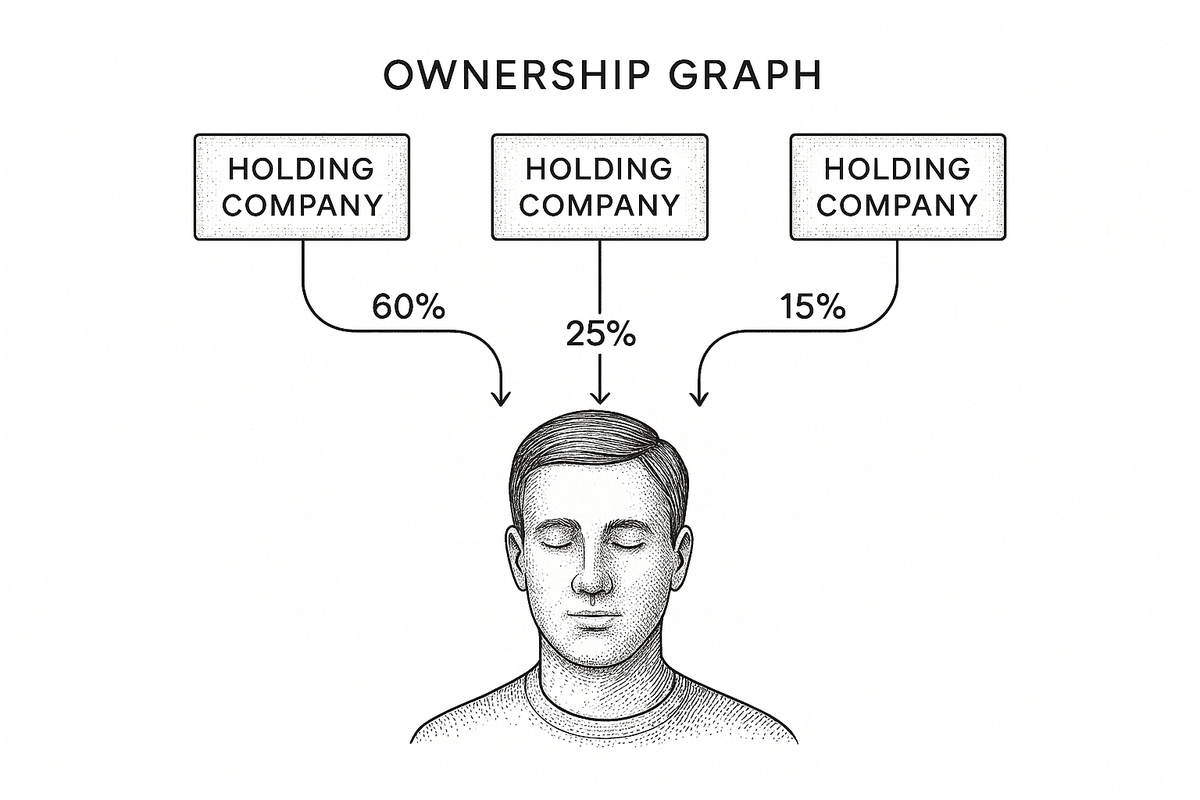
Once records are resolved, each real-world party (entity, natural person, or trust) becomes a node and each relationship a directed edge. Edges carry a type and a weight: shareholding with a percentage, voting rights, a directorship, a trustee or settlor role, or a control right such as the power to appoint the board. Ownership edges and control edges stay distinct: a directorship says something about control, and nothing about equity.
Edge provenance matters as much as edge weight. A UK PSC statement gives shareholding only in bands of 25 to 50, 50 to 75, or 75 to 100 percent, so an edge built from it carries an interval, not a number; a customer's shareholder register gives an exact figure but is self-reported. Merging both without recording the source overstates the certainty of the resulting UBO percentage.
Computing Indirect Ownership Through Layers and Loops
Indirect ownership is computed by multiplying percentages along each path from a person to the target and summing across paths. FinCEN's CDD Rule FAQs give the example: Company A and Company B each own half of the customer. Allan owns 60 percent of A, so he holds 30 percent indirectly. Betty owns 40 percent of A and a third of B, giving her 20 plus 16⅔, or 36⅔ percent. Carl and Diane each own a third of B and stop at 16⅔ percent. Betty qualifies only because two paths were added together.
A graph traversal generalizes this: walk every incoming ownership edge upward from the target, carrying the running product, until a natural person or an unresolvable terminal is reached, then aggregate by resolved person. Open Ownership found 71,774 UK companies with ownership chains of five or more observable layers, each of which needs exactly this walk.
Circular ownership breaks naive traversal: if A owns 60 percent of B and B owns 10 percent of A, a depth-first walk loops forever. The correct treatment, formalized in a Bank of Italy paper on ownership graph reasoning, is that shares an entity holds in itself through a cycle are removed from the pool available to outside shareholders, whose effective stakes rise proportionally. That is a convergent geometric series, or equivalently a matrix inversion over the strongly connected component. Researchers applying the α-ICON algorithm to 4.2 million UK companies isolated cycles into a small core and recovered more than 96 percent of known ultimate controllers in their evaluation set.
What the 25 Percent Threshold Does and Does Not Settle
The threshold converts a computed percentage into a regulatory answer, and it is only half the definition. Under the FinCEN CDD Rule, a beneficial owner is each individual who directly or indirectly owns 25 percent or more of the equity interests, plus one individual with significant responsibility to control, manage, or direct the entity. The prongs are independent: an entity always yields at least one beneficial owner under the control prong even when nobody crosses 25 percent, and the FAQs state that a nominee or straw man is not an acceptable answer.
FATF's standards push the same direction. Recommendation 24, revised in March 2022, and its March 2023 guidance describe a cascade: natural persons with a controlling ownership interest first, then persons exercising control through other means such as shareholder agreements, and only then senior managing officials. The guidance names multi-layered structures, nominee shareholders and directors, and bearer shares as the mechanisms most used to obscure ownership, and calls for a multi-pronged approach that combines company-held information, registry data, and other sources. Recommendation 25 and its March 2024 guidance extend the logic to trusts, where nobody holds shares.
The graph computes the ownership prong and surfaces control-prong candidates. It cannot decide whether a 24 percent shareholder with a board seat and an unfiled shareholder agreement is exercising control, which is why UBO identification remains a due diligence process rather than a query.
Registry Data Sets the Ceiling
No algorithm recovers information that was never filed or was filed falsely. The UK PSC register is the best studied in the world, which makes its defects instructive. Open Ownership and the Tax Justice Network's 2025 analysis of 6.1 million entities found 20 percent with no registered individual beneficial owner, most with no beneficial ownership record of any kind. A February 2026 review by CompanyPulse of 7.2 million PSC statements found 3.8 percent naming a corporate owner whose company number was dissolved, struck off, or never existed, which severs the chain at that node, and 1.1 percent of companies with duplicate entries for one person under different spellings.
Outside the UK the ceiling is lower. Many jurisdictions have no public register, so a chain that reaches a company there terminates at a corporate node with nothing above it. Nominee directors appear in registry data as ordinary directors; the nominee relationship is usually recorded nowhere. A director resolved to 200 other entities is a signal, not proof, and the red flags for shell companies apply to intermediate nodes as much as to customers. Inputs are improving: UK Companies House began mandatory identity verification for directors and PSCs on 18 November 2025, and the EU Tax Observatory's September 2026 evaluation found verification rates among affected PSCs rose by 46.2 percentage points. Better inputs raise the ceiling. They do not remove it.
Where the Analyst Still Decides
Each layer hands off to a human at specific points. Matching produces a middle band of pairs someone has to inspect. Traversal produces terminals that are not natural persons: a company in an opaque jurisdiction, a trust with an undisclosed settlor, a corporate PSC that resolves to a dissolved company. The control prong requires reading articles of association and shareholder agreements, and whether shared directors across a cluster indicate a corporate services firm or a nominee network takes context. An analyst who receives a resolved graph with every edge sourced and every unresolved terminal flagged is judging evidence; an analyst who receives four PDFs and a spreadsheet is doing entity resolution by hand. We covered the operational side in UBO mapping automation; the layer described here is what makes that automation trustworthy rather than merely fast.
Where Sphinx Fits
Sphinx Atlas is our interactive KYB research tool, and it runs the layers above. Agents pull filings from the registries an analyst would visit, resolve entities with deterministic rules first and scored matching second, build the graph with provenance on every edge, and traverse it to compute indirect ownership against the 25 percent threshold. Where a match is uncertain or a chain ends without reaching a person, Atlas says so and shows the evidence. The analyst makes the call, and every step is logged so the determination can be reconstructed for an examiner.
Frequently Asked Questions
What is entity resolution in beneficial ownership analysis?
Entity resolution is the process of determining that records in different registries, filings, and internal systems refer to the same legal or natural person despite name variants, transliteration, and missing identifiers. It is the prerequisite for an accurate ownership graph, because a wrong merge fabricates an ownership link and a missed merge hides one.
How is indirect beneficial ownership calculated through multiple holding companies?
Multiply the ownership percentages along each path from the individual to the target entity, then sum across all paths that reach the same person. In FinCEN's CDD Rule FAQ example, an individual holding 40 percent of one intermediary and one third of another, each owning half the customer, holds 36⅔ percent and qualifies although neither path alone reaches 25 percent.
How do graph algorithms handle circular ownership?
Shares an entity holds in itself through a cycle are treated as unavailable to outside shareholders, whose effective stakes are scaled up proportionally. Computationally this is a convergent geometric series or a matrix inversion over the cycle, which is how algorithms such as α-ICON process loops without hanging.
Does the 25 percent threshold alone identify the beneficial owner?
No. Under the FinCEN CDD Rule and FATF Recommendation 24, ownership is one prong; a control prong independently requires identifying at least one individual with significant responsibility to control, manage, or direct the entity. An entity with no individual above 25 percent still has a beneficial owner under the control prong.
Why do beneficial ownership tools still need human review?
Because the inputs are incomplete and the control test is interpretive. Registers omit or misstate data, many jurisdictions have no public register, and deciding whether someone exercises control through a shareholder agreement requires reading documents. Automation should resolve entities, compute percentages, and flag gaps so the analyst judges evidence.
.png)