

TL;DR: UBO mapping automation replaces manual ownership tracing — spreadsheets, registry lookups, analyst-driven chain resolution — with systems that reconstruct corporate ownership graphs programmatically. Fenergo research found that average annual AML/KYC operations spend now stands at $72.9 million per financial institution, with over half of review tasks still completed manually. For compliance teams onboarding corporate clients across multiple jurisdictions, automating UBO mapping is no longer a workflow improvement — it is an operational prerequisite.
What UBO Mapping Is and Why Manual Processes Break Down
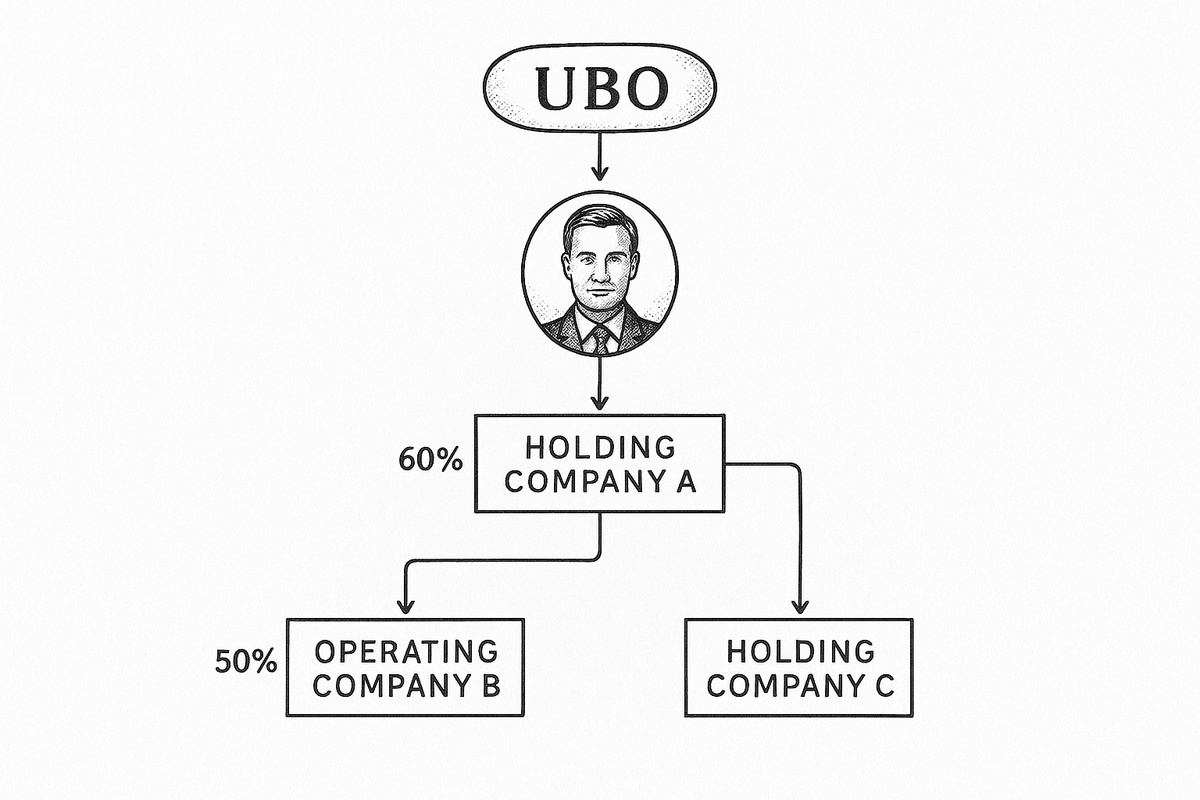
UBO mapping is the process of reconstructing the full ownership chain of a legal entity — from the operating company, through every intermediate holding company, trust, or nominee arrangement — until reaching the natural persons who ultimately own or control it. The word "mapping" is specific. It refers to building a structured graph of relationships, not just identifying a name on a form. Each node in the graph is an entity or individual, each edge represents an ownership or control relationship, and the percentages dilute at every layer.
A straightforward example: Person X owns 60% of Holding Company A, which owns 50% of Operating Company B. Person X's indirect ownership of Operating Company B is 30% — above the standard 25% threshold used in most FATF-member jurisdictions. That calculation is simple with two layers. Add four jurisdictions, a discretionary trust, a nominee shareholder, and a dissolved intermediate entity, and the same calculation requires source documents from multiple registries, legal analysis of control mechanisms, and cross-referencing against the entity's own declaration.
Manual UBO mapping breaks down on three axes. First, data fragmentation: corporate registry formats differ by jurisdiction, some are digitized and queryable via API, others require written requests with multi-week turnaround. Second, analytical complexity: the ownership-versus-control distinction requires judgment at every layer — voting agreements, board appointment rights, and shareholder pacts can confer UBO status without any equity. Third, volume: a mid-size bank may onboard thousands of corporate clients annually, each requiring its own ownership resolution. Fenergo's 2025 Financial Crime Industry Trends report found that average annual AML/KYC operations spend is $72.9 million per institution, and automation of periodic KYC reviews averages roughly one-third across respondents. The rest is analyst time.
The fundamentals of UBO identification — thresholds, control tests, fallback rules — are well established. The challenge is applying them consistently at scale, across jurisdictions, without the process degrading into a bottleneck that delays onboarding and accumulates risk.
The Regulatory Push Toward Automated UBO Mapping
Regulators have not mandated specific technology for UBO mapping. What they have done is set expectations for accuracy, timeliness, and documentation that are increasingly difficult to meet without automation.
FATF Recommendation 24, substantially revised in 2022, introduced a multi-mechanism model for beneficial ownership transparency. Countries must ensure that accurate, current ownership information is available to competent authorities through a combination of company registries, regulated institutions, and the entities themselves. No single source is treated as sufficient. For compliance teams, this means ownership data must be corroborated across multiple independent sources — a task that scales linearly with entity complexity when done manually, but can be parallelized through automation.
In the United States, the regulatory landscape shifted materially in 2025. FinCEN's March 2025 interim final rule exempted all U.S.-formed domestic companies and U.S. persons from Beneficial Ownership Information reporting under the Corporate Transparency Act. Only foreign entities registered to do business in a U.S. state remain in scope. The BOI registry — originally designed to be an authoritative verification source — now covers a fraction of its intended population. Financial institutions that had planned to use registry data as a primary verification source must now reconstruct ownership from state-level records, commercial databases, and client declarations. That reconstruction is precisely the workflow that UBO mapping automation addresses.
The EU's framework is heading in the opposite direction — toward stricter requirements. The 2024 AML Regulation (2024/1624) and the forthcoming Anti-Money Laundering Authority (AMLA), expected to begin operations by 2027, will harmonize supervision across member states and raise expectations for beneficial ownership verification. Several member states have already tightened access rules to UBO registers following the 2022 European Court of Justice ruling on privacy, which means automated systems must be configured to access data through authorized channels rather than public lookup.
The convergence point across all frameworks is clear: institutions must maintain current, verified, multi-source UBO data across every business relationship. The KYB process has always required this in principle. Automation is what makes it operationally achievable.
How to Evaluate UBO Mapping Automation
Not all UBO mapping tools solve the same problem. Some automate registry lookups. Others reconstruct ownership graphs. A few handle the full chain from entity resolution through screening and documentation. Evaluating them requires clarity about where manual work currently concentrates in your ownership resolution workflow.
Data source coverage
The foundation of any automated UBO mapping system is the breadth and depth of its data connections. Evaluate how many corporate registries the platform accesses directly, whether it covers the jurisdictions where your clients operate, and how it handles registries that lack API access. Some vendors connect to 175+ registries; others rely on aggregated commercial databases. The distinction matters because registry data is a primary source — commercial databases are secondary, and their freshness and accuracy vary. A platform that reaches registries in real time will resolve ownership more reliably than one that depends on periodic data snapshots.
Entity resolution and graph construction
Entity resolution is the process of determining whether \"ABC Holdings Ltd\" in Bermuda and \"ABC Holdings Limited\" in the Cayman Islands are the same entity or two different ones. This is a prerequisite for accurate ownership mapping — without it, the graph fractures. Look for systems that apply fuzzy matching, jurisdiction-aware logic, and cross-reference resolution across multiple data sources. The output should be a structured ownership graph, not a flat list of shareholders.
Threshold calculation and control logic
The system must calculate diluted ownership percentages through every intermediate layer and apply the correct threshold for each jurisdiction. A 25% threshold in one jurisdiction may be 10% in another. Beyond percentage-based ownership, the platform should identify control mechanisms — voting rights, board appointment authority, trust arrangements — that confer UBO status without equity. This dual test (ownership and control) is what separates a useful tool from a simple registry scraper.
Graph visualization
Ownership structures are inherently graphical. A platform that can render interactive ownership trees — with percentage labels, jurisdiction flags, and risk indicators at each node — gives analysts the context they need to review complex structures efficiently. Visualization also matters for regulators and auditors, who need to understand the ownership chain at a glance. Flat tabular output does not convey the same information.
Screening integration
Every identified UBO must be screened against sanctions lists, PEP databases, and adverse media sources. A match on a beneficial owner is functionally a match on the business relationship. Systems that integrate screening into the ownership resolution workflow — rather than requiring a separate handoff — reduce the gap between identification and risk assessment. Where UBOs present elevated risk, the workflow should route directly to Enhanced Due Diligence without requiring the analyst to re-collect documents or rebuild the ownership structure.
Ongoing monitoring and event-driven refresh
Ownership structures change. Shareholders sell stakes, new investors enter, parent companies restructure. A platform built for point-in-time onboarding but lacking perpetual KYC capabilities forces the compliance team to re-run the full analysis manually on a calendar cycle. Event-driven monitoring — triggered by registry changes, adverse media, sanctions updates, or corporate actions — keeps ownership data current without requiring scheduled full reviews.
Audit trail and explainability
Every step of the UBO resolution process must produce a documented trail: what data was collected, from which sources, what logic was applied, and what the system concluded. This is not optional. Regulators expect institutions to demonstrate their reasoning, and examiners will ask to see the work behind an ownership determination. Systems that produce a structured, timestamped audit record — with source attribution at every node — are materially easier to defend than those that output a result without showing how they arrived at it.
Where Sphinx Fits
Sphinx operates at the analyst layer of UBO mapping workflows — the investigation, resolution, and documentation work that sits between raw data collection and a defensible compliance decision. Sphinx's AI agents review ownership documentation, resolve screening alerts against identified UBOs, assemble structured case files, and generate audit trails through the Interpretable Agentic Framework, which logs every reasoning step for regulatory examination.
For compliance teams processing high volumes of business onboarding, the bottleneck is rarely the initial data retrieval. It is the analyst capacity to review complex ownership chains, resolve screening matches against beneficial owners, and produce documentation that survives regulatory scrutiny. Sphinx agents handle that resolution layer — clearing case queues and reducing review time while maintaining full audit readiness on every decision.
Frequently Asked Questions
What is UBO mapping automation?
UBO mapping automation refers to systems that programmatically reconstruct the ownership chain of a legal entity — from the operating company through every intermediate holding entity to the natural persons who ultimately own or control it. These systems replace manual registry lookups, spreadsheet-based ownership tracing, and fragmented analyst workflows with structured, repeatable processes that calculate diluted ownership percentages, apply jurisdiction-specific thresholds, screen identified UBOs, and generate audit-ready documentation.
Why can't compliance teams rely on government UBO registers alone?
Government registers vary dramatically in coverage, accuracy, and accessibility. The OECD found that only 3 of 24 jurisdictions maintain beneficial ownership registers with satisfactory effectiveness. In the U.S., FinCEN's March 2025 interim final rule exempted all domestic companies from BOI reporting, leaving the federal registry applicable only to foreign entities. EU member states have restricted public access following a 2022 European Court of Justice privacy ruling. FATF Recommendation 10 requires institutions to identify and verify UBOs independently of whether a national registry has been correctly populated — registry data is one corroborating source, not the definitive answer.
What ownership threshold defines a UBO?
Most FATF-member jurisdictions use 25% direct or indirect ownership of equity or voting rights as the standard threshold. Some jurisdictions apply lower thresholds for high-risk sectors — 10% or 15% in certain EU member states. Ownership percentage is only one test. Control without ownership also qualifies: an individual who exercises effective control through board appointment rights, veto powers, shareholder agreements, or trust arrangements is a UBO regardless of their equity stake. When no natural person meets either the ownership or control threshold, AML frameworks designate the senior managing official as the fallback UBO.
How does automated UBO mapping handle multi-jurisdictional structures?
Automated systems connect to corporate registries across multiple jurisdictions, pull shareholder and director data in each, and recursively resolve the ownership chain through every layer — holding companies, investment vehicles, trusts, and nominee arrangements. Diluted ownership percentages are calculated at each level, and the correct threshold is applied per jurisdiction. Where registry data is unavailable or incomplete, the system flags the gap and generates a targeted document request rather than guessing. Cross-border entity resolution — determining whether similarly named entities in different jurisdictions are the same — is handled through fuzzy matching and jurisdiction-aware logic.
What role does ongoing monitoring play after initial UBO mapping?
Initial UBO mapping provides a point-in-time snapshot. Ownership structures change through share transfers, new investments, restructurings, and corporate actions. Ongoing monitoring detects these changes through event-driven triggers — registry updates, adverse media, sanctions list additions, corporate filings — and initiates re-verification without requiring a full manual review. This approach aligns with perpetual KYC principles and satisfies regulatory expectations that beneficial ownership information be maintained as current, not just collected at onboarding.
.png)