

TL;DR: Customer risk rating in AML is the process of scoring each customer's money laundering and terrorist financing risk, typically into low, medium, and high tiers, using customer type, geography, products, delivery channel, and transaction behavior. The score sets how much due diligence a customer receives, how closely their activity is monitored, and how often the relationship is reviewed. Regulators expect the rating to stay current, yet the 2026 AML Tech Barometer found 45 percent of institutions surveyed still rely on primarily static or manual reassessment.
What a Customer Risk Rating Actually Measures
A customer risk rating is an institution's documented judgment about how likely a specific customer relationship is to be used for money laundering, terrorist financing, or other illicit activity. The FFIEC BSA/AML Examination Manual calls this the customer risk profile and notes the concept "is also commonly referred to as the customer risk rating." Under 31 CFR 1020.210, banks must have risk-based procedures for ongoing customer due diligence that develop these profiles, detailed enough to distinguish meaningful variations in risk across the customer base.
The rating is a relative measure, not an accusation. A high-risk rating means the combination of who the customer is, where they operate, what products they use, and how they transact warrants closer attention than the institution's baseline. The FFIEC manual is explicit that no customer type is automatically high risk and no single indicator should be determinative. Two money services businesses can carry different ratings if one has a documented, stable transaction pattern and the other does not.
Most institutions express the output as a tier or as a numeric score mapped to tiers. The FFIEC confirms there are no required categories. What matters on exam is whether the methodology is documented, consistently applied, and produces ratings that actually change how the customer is treated.
The Five Risk Factors That Feed the Score
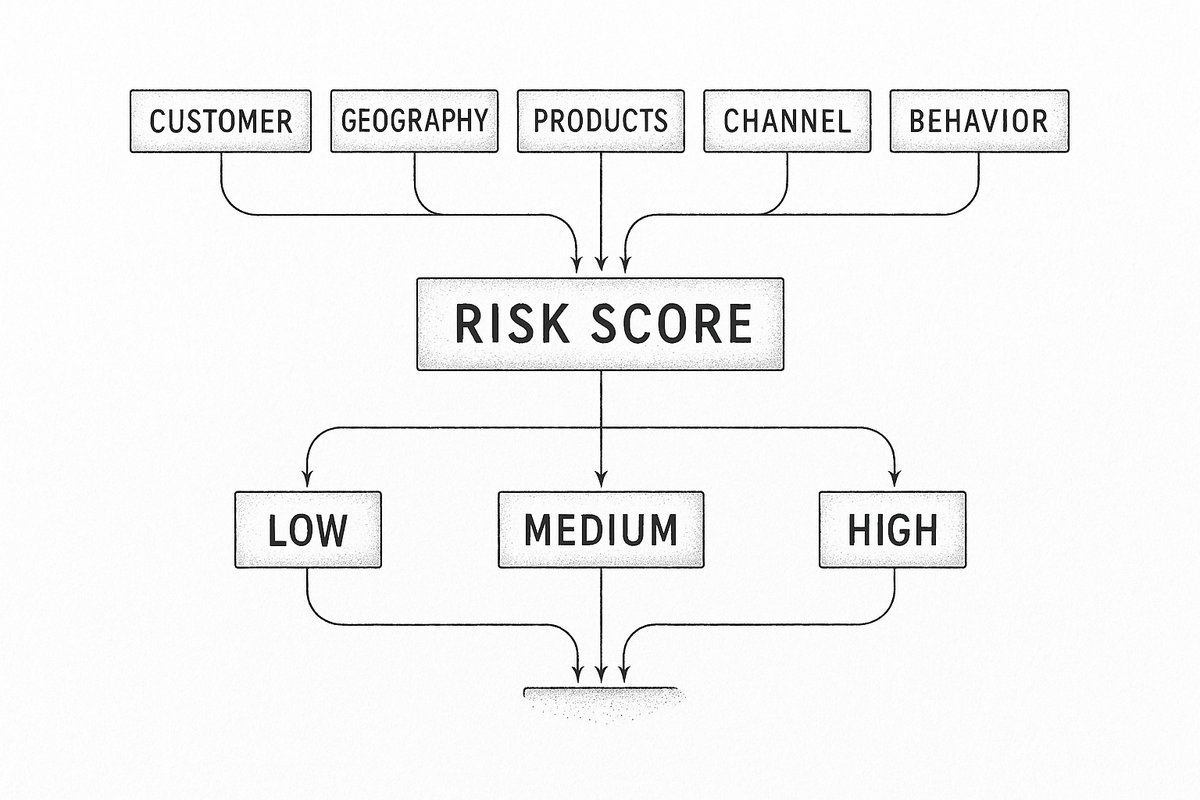
Customer risk rating models draw on five categories of input. The Wolfsberg Group's guidance on digital customer lifecycle risk management groups them as customer factors, geographic factors, product and transactional behavior, and delivery channel. Most practitioners separate products from behavior.
Each factor is decomposed into scored sub-variables, weighted, and aggregated. The FFIEC manual allows institutions to weight some factors more heavily than others, provided the weighting is documented. Weights are where models encode judgment, and where a validator will spend most of their time.
Static vs. Dynamic Risk Rating
A static rating is assigned at onboarding and reviewed on a fixed calendar, commonly annual for high-risk customers and every three to five years for lower tiers. A dynamic rating updates whenever a relevant input changes: a new beneficial owner, a shift in transaction pattern, an adverse media hit, a change in country risk. The dynamic approach applied across the full customer lifecycle is known as perpetual KYC.
Regulatory language has moved toward the dynamic model. The FFIEC manual describes the update requirement as event-driven: when material information changes, the bank should reassess the rating. FinCEN's April 2026 proposed AML/CFT program rule would require risk assessment processes to be updated promptly upon any change the institution knows or has reason to know significantly alters its risk. The UK FCA reached the same conclusion in its November 2025 multi-firm review, naming a "static approach to assessment" as poor practice because it leaves outdated risk profiles driving control design.
Adoption lags the guidance. The 2026 AML Tech Barometer, a NICE Actimize survey of 133 financial crime professionals across Asia-Pacific, found only 15.5 percent of institutions run an advanced perpetual KYC model, 39.5 percent run a hybrid with automated triggers, and 45 percent remain on static or reactive manual processes. The same survey recorded institutions describing their systems as "advanced" falling from 37.6 percent to 23.1 percent year over year, which the report attributes to explainability pressure from regulators.
Most institutions that call their approach dynamic are running a hybrid: a periodic cycle plus triggers that force an out-of-cycle reassessment. That design is sound. It fails when triggers fire into a manual queue nobody clears.
How the Score Drives EDD and Monitoring Intensity
A customer risk rating is only useful if it changes something downstream. Appendix K of the FFIEC manual lays out the expected relationship: as customer risk rises, the depth of due diligence, the frequency of review, and the sensitivity of suspicious activity monitoring rise with it. A rating that alters none of the three is decorative.
The first effect is due diligence depth. Top-tier customers receive enhanced due diligence: source of wealth and funds, deeper beneficial ownership analysis, senior management approval, and adverse media review. Medium-risk customers get standard customer due diligence. Low-risk customers may qualify for simplified measures where the jurisdiction permits. The FATF's risk-based approach guidance for the banking sector frames this as a two-way dial: enhanced measures where risk is higher, simplified measures where the institution can demonstrate risk is low.
The second effect is review cadence. The third, and the one most often disconnected in practice, is monitoring calibration. A well-integrated program feeds the tier into the transaction monitoring system so thresholds, scenario coverage, and alert prioritization differ by tier. A structuring scenario might fire at a lower dollar threshold for a high-risk cash business than for a salaried retail customer. When the rating and the monitoring engine do not talk to each other, uniform monitoring runs across a non-uniform customer base, producing missed activity at the top and false positive volume at the bottom. The rating also governs approvals: onboarding a high-risk customer typically requires senior sign-off, and a mid-relationship move into the top tier should trigger a documented decision to retain, restrict, or exit.
What Regulators Expect From the Model
Customer risk rating models sit in an uncomfortable position. Most are simple enough that they do not resemble the statistical models SR 11-7 was written for, yet consequential enough that examiners treat them as models when things go wrong. FinCEN's April 2026 NPRM acknowledged this, stating it "is aware of and shares industry concerns about the appropriateness of applying Model Risk Management Principles to AML/CFT programs" and committing to work with the banking agencies on the issue. Until that arrives, the practical expectation is validation discipline proportionate to the model's complexity and consequence. Examiners and auditors look for the following.
The FFIEC manual offers a protection here. It directs examiners to focus primarily on whether the bank has an effective process for developing risk profiles, and states that a bank following its own effective process should not be criticized for individual rating decisions absent bad faith or an impact on the overall program. FinCEN's effectiveness-based program rule extends the same logic by distinguishing design failures from implementation failures.
Where Risk Rating Models Break
The same defects surface in exam findings, consent orders, and independent testing reports year after year.
Stale ratings are the most common. A customer is scored at onboarding on anticipated activity and declared purpose, and the rating is never revisited because the periodic review was deferred, the trigger did not fire, or the review was completed without touching the score. The account behaves nothing like the profile, but the profile still governs monitoring thresholds.
Over-weighted geography is the second. Country risk is easy to source, score, and defend, so models lean on it. The high-risk tier fills with customers whose only elevated attribute is a passport or registered address, while a domestic customer with complex ownership, cash-intensive operations, and erratic transactions sits in medium. When geography alone can push a customer into the top tier, EDD resources go to the wrong relationships.
Unexplainable scores are the third and increasingly the most consequential. As institutions layer machine learning onto risk rating, a customer can land at 82 out of 100 with no articulable reason. A compliance officer cannot defend that score to an auditor, and the institution cannot defend it to an examiner. The Barometer's finding that institutions are retreating from systems they describe as "advanced" reflects this pressure. A score that cannot be decomposed into its drivers will eventually be overridden or ignored.
How to Evaluate a Customer Risk Rating Approach
Whether the subject is an internally built model, a vendor platform, or a risk assessment tool under evaluation, the same questions apply.
A moderately accurate model that is explainable, current, and connected to monitoring will outperform a highly accurate one that is opaque and stale, both operationally and on exam.
Where Sphinx Fits
Sphinx does not replace a customer risk rating model. Its agents work inside the systems compliance teams already use and take on the work that keeps a rating accurate: pulling refreshed KYC data, running adverse media and screening checks when a trigger fires, documenting what changed, and drafting the reassessment for analyst review with the reasoning visible. When a periodic review queue or a backlog of triggered reassessments is the reason ratings go stale, that is the work Sphinx clears. The judgment about where a customer sits, and whether to retain a relationship that has moved into the top tier, stays with the compliance team.
Frequently Asked Questions
What is the difference between a customer risk rating and a customer risk profile?
In US regulatory usage they are the same thing. The FFIEC BSA/AML Examination Manual uses "customer risk profile" as the term from the CDD rule at 31 CFR 1020.210 and notes the concept is commonly referred to as the customer risk rating. Institutions tend to use "profile" for the full set of customer information and "rating" or "score" for the tier or number derived from it.
How often should a customer risk rating be reviewed?
No regulation sets a fixed interval. Common practice is annual review for high-risk customers, every two to three years for medium, and three to five years for low, combined with event-driven reassessment whenever material information changes. The FFIEC manual describes the update requirement as event-driven, and FinCEN's 2026 proposed program rule would require prompt updates upon significant changes, so a calendar alone is no longer sufficient.
Does a high customer risk rating mean the customer is suspicious?
No. A high rating means the customer's attributes and activity warrant enhanced due diligence and closer monitoring relative to the institution's baseline. Suspicion is a separate determination made through transaction monitoring and investigation. The FFIEC is explicit that no customer type is automatically high risk and that banks are not expected to decline entire categories of customers.
Do customer risk rating models have to be validated under SR 11-7?
The question is currently unsettled. FinCEN's April 2026 proposed AML/CFT program rule acknowledged industry concerns about applying model risk management principles to AML programs and committed to work with the banking agencies on it. In the meantime, institutions are expected to apply validation discipline proportionate to the model's consequence: documented methodology, pre-deployment testing, back-testing against outcomes, override governance, and periodic review.
What is perpetual KYC and how does it relate to customer risk rating?
Perpetual KYC is an operating model in which customer information and the customer risk rating are refreshed continuously in response to triggers rather than on a fixed schedule. It is the fully dynamic end of the static-to-dynamic spectrum. According to the 2026 AML Tech Barometer, only 15.5 percent of institutions surveyed had reached an advanced perpetual KYC model, with most running a hybrid of calendar reviews and automated triggers.
.png)