
Today we're launching Atlas, a KYB research agent that does the investigating business onboarding teams never have enough hours for.
Most of KYB is research. Who actually owns the company, is the website a real business, is the address an office or a mailbox, has anyone behind it been in the news. Almost all of it is public. Finding it takes hours per case, and when the queue is long, those are the hours that get skipped.
KYB was never a lookup problem
Here's a case we see over and over. A business lists a single owner at 100%. The documents are real, and the case gets approved. Weeks later someone pulls the registry filing: the shares belong to a holding company with a second owner nobody disclosed. None of it was hidden. It would have taken an analyst a few hours to find, and nobody had a few hours.
The tools haven't fixed this. Verification databases confirm a company exists and return what's on file; they can't tell you the storefront doesn't complete a checkout. Deep-research chatbots come back with confident summaries, often without sources and occasionally with a director who doesn't exist. Either way, the investigating still falls to a person.
A KYB search returns a query. An investigation tests the storefront and maps ownership to the people behind it.
Atlas does the investigating. Hand it a business and it goes and looks, the way your best analyst would with unlimited time, then writes up what it found with a source under every claim. It has been running with a small group of customers for three months and is available today.
How it works
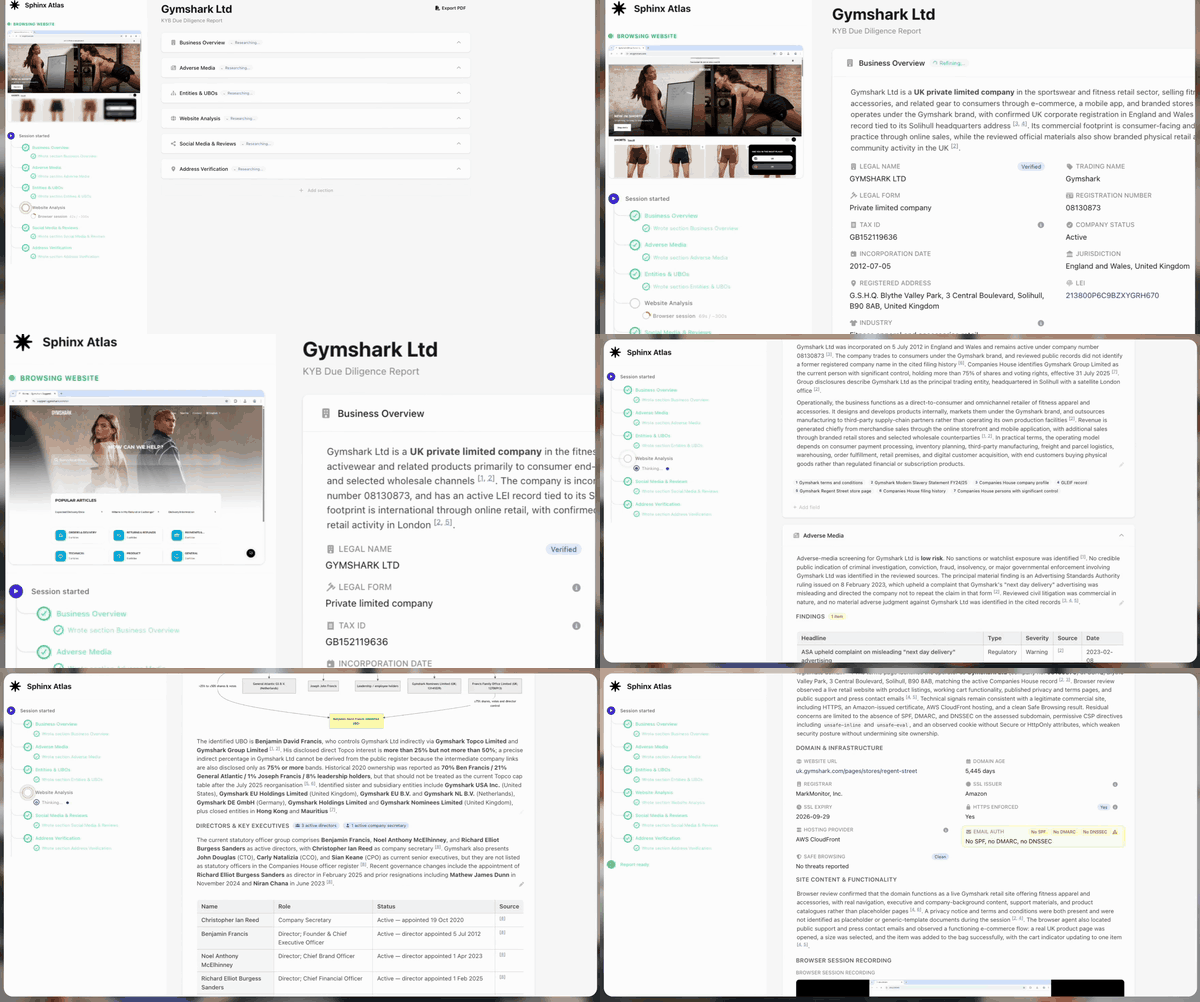
Atlas locks onto the right entity, sends agents out in parallel, and comes back in minutes with a report the analyst can act on.
- Find the entity. Legal name, registration number, status, incorporation date, jurisdiction, each with a source. You can give Atlas the jurisdiction up front; a lot of KYB errors are just the wrong entity with the right name.
- Walk the website. Atlas opens a real browser session and moves through the site like a customer: privacy policy, refund terms, support page. Then it adds a product to the cart and runs checkout to see if the store can actually take an order. The session is recorded and sits in the report. A fake storefront takes an afternoon to build; one that completes a checkout takes real effort, and most fronts don't bother.
- Trace the owners. Ownership traced up through holding entities to natural persons, with percentages at each layer, from filings, disclosures, and public records. Where the applicant's declaration and the record disagree, that's the finding.
- Check the address and footprint. Registered and operating addresses against maps and street-level imagery. Social handles and public reviews. A retailer with a 3.0 rating and a page of delivery complaints looks like a real retailer. One with no footprint, or a footprint that's three weeks old, is a different profile.
- Screen the people. Sanctions and watchlist exposure on the entity and the people behind it, plus regulatory actions, litigation, and press, each with severity, source, and date.
Atlas starts on the website, tests checkout, then branches into address validation, ownership mapping, and analyst follow-up.
Under every report there's a field: Ask about the business. Ask who the directors of the holding company are and whether any of them have run companies that were struck off, and Atlas researches it and appends the answer with sources. Analysts also paste in documents the client sent and Atlas folds them into the report.
Which sections run, and how much weight they carry, is up to you. An acquirer onboarding ecommerce merchants wants the checkout test. A bank onboarding layered operating companies wants ownership to go deep.
Results
We benchmarked against ChatGPT Deep Research, because that's what analysts were already pasting company names into. On the same KYB investigations:
- 74% more relevant information. Sourced and usable in a file.
- 63% fewer hallucinations. Registration numbers that don't exist, officers who never were.
The second number is the one we care about. A tool that's fast and occasionally invents a director is worse than no tool.
Built for scrutiny
Every claim carries its source. The website walk is a recording a reviewer can watch. When ownership can only be confirmed with documents you haven't received, Atlas flags the gap instead of guessing.
Atlas produces research; it doesn't approve or decline anyone. The report feeds the KYB case in Sphinx, where the analyst, or the Sphinx agent on the case, makes the call. A common outcome for a legitimate but under-documented business is an RFI: site and office check out, but a 25%+ owner still needs verifying. Atlas tells you which one.
See Atlas in action
The fastest way to see what it finds is to run it on a business you already onboarded. It's live today and works on top of the systems you already use, with no migration and no lift on your side.
If you're a BSA Officer, Chief Compliance Officer, Head of Financial Crime, or you run business onboarding at a bank, payments company, lender, or fintech, we'll run Atlas on your real cases with you.
– Alex & Chris
.png)