

TL;DR: Shell company red flags are the observable traits that separate a legitimate paper entity from one built to hide its owner: a registered agent address shared with hundreds of thousands of companies, nominee directors, formation weeks before account opening, no employees or web presence, and transactions with no relationship to the stated business. Shell companies are legal and most are benign, but the joint FATF-Egmont Group report on concealment of beneficial ownership found them in more than half of 106 laundering cases studied, averaging over USD 500 million per case. With the Corporate Transparency Act now permanently narrowed to foreign-formed entities, financial institutions carry the detection burden themselves.
Shell, Shelf, Holding Company, SPV: The Distinctions That Matter
A shell company is a legal entity with no independent operations, significant assets, ongoing business activity, or employees. That is the FATF definition, and it says nothing about legality. Shells are formed every day to hold intellectual property, ring-fence a real estate asset, stage a merger, or reserve a corporate name. FinCEN's advisory on shell company risks opens by stating that most are formed for legitimate reasons and that institutions are not being encouraged to refuse them.
The related structures are easy to conflate at onboarding, and each carries a different risk profile.
The practical test is not whether an entity has operations. It is whether the absence of operations has an explanation the customer can articulate and the institution can verify. A holding company whose owner cannot say what it holds is a red flag.
Why Shells Still Carry the Weight of Laundering Schemes
Shell companies remain the dominant vehicle for concealing beneficial ownership because they are cheap, fast, and indistinguishable at formation from any other new business. The FATF-Egmont Group analysis of 106 case studies from 34 jurisdictions found that more than half specifically involved shell companies. In most of those cases, at least one entity was incorporated abroad, and the beneficial owner combined layered ownership with a nominee or professional intermediary rather than relying on either alone.
The U.S. picture has shifted materially. The Corporate Transparency Act was meant to give FinCEN a beneficial ownership database covering tens of millions of domestic entities. Litigation stalled the reporting rule, and on March 26, 2025 FinCEN issued an interim final rule exempting every domestic reporting company. On August 11, 2026 FinCEN finalized that exemption permanently, effective August 14, 2026, and announced it would delete the U.S.-person data already filed. Only foreign-formed entities registered in a U.S. state still report, and they no longer report U.S.-person beneficial owners.
The Government Accountability Office flagged the consequence in 2026: state formation filings vary widely in what ownership information they collect, and Treasury's 2026 National Money Laundering Risk Assessment continued to identify shell companies as facilitators of drug trafficking proceeds, cybercrime, and fraud. A U.S. LLC opening an account in 2026 has never filed beneficial ownership information with anyone. The institution's KYB process is the only place it will be collected and verified.
FinCEN's advisories have kept pace even as the reporting regime retreated. The June 2026 advisory FIN-2026-A002 describes labor brokers forming generically named shells, opening accounts with a Commercial Mail Receiving Agency address to hide the absence of operations, and cycling employer checks through them for off-the-books payroll. FinCEN reported over $2.5 billion in suspicious activity tied to that scheme type in 2025 alone.
Red Flags at Onboarding
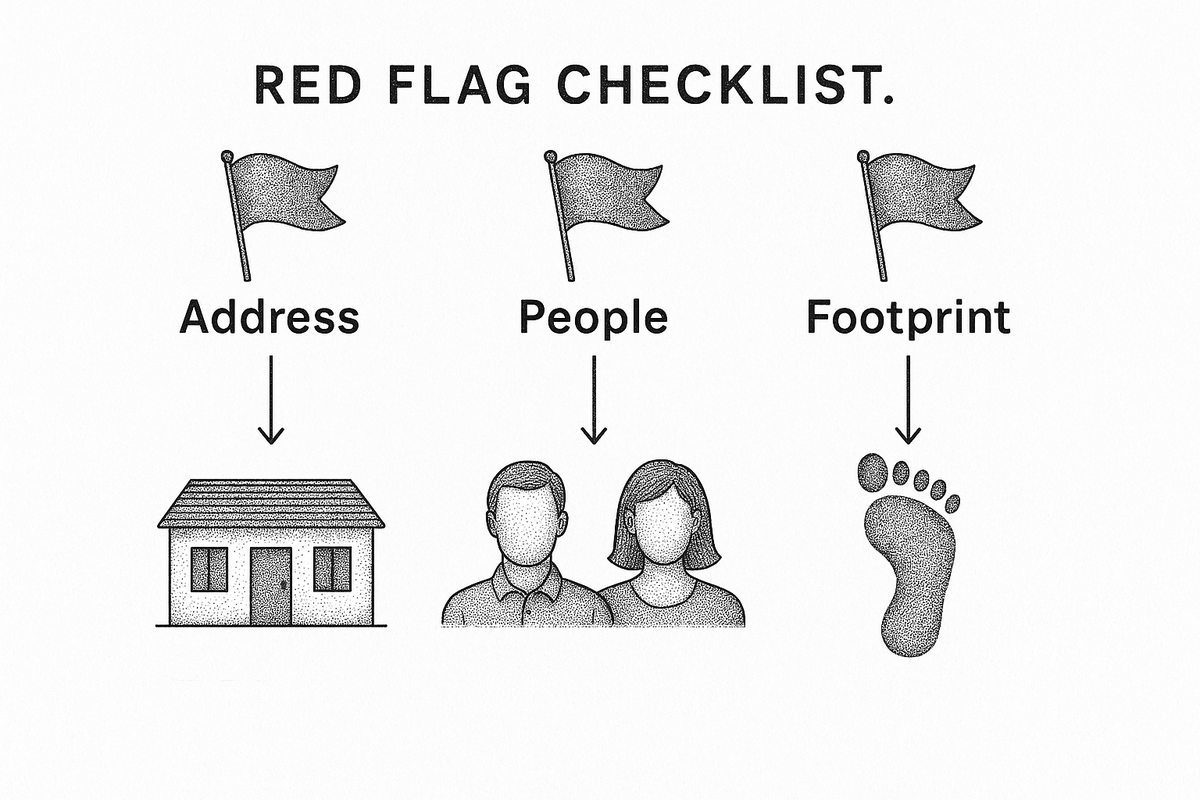
Onboarding is where shell detection is cheapest, because the institution can still decline. None of the following indicators is conclusive alone. Three or four together, without a coherent explanation, usually are.
Address and Formation Signals
The registered address is the highest-yield check. The International Consortium of Investigative Journalists found that more than 266,000 companies incorporated using the address of a single one-story storefront at 30 N. Gould Street in Sheridan, Wyoming between 2019 and 2024, over 40 percent of all new Wyoming incorporations in that period. A 2023 GAO review cited in the same reporting found that of 989 recipients of allegedly fraudulent pandemic relief loans, more than 70 percent were shell companies or fictitious entities. An applicant whose only address is a commercial registered agent, a virtual office, or a mail drop has told the institution where the business is not.
Formation timing compounds this. An entity formed within weeks of the application, in a jurisdiction where the applicant has no other footprint, deserves a direct question: why here, why now. Formation in a secrecy jurisdiction such as the British Virgin Islands or Nevis, or in U.S. states that collect no member or manager information, raises the bar for what the customer must demonstrate. It does not settle the question, since plenty of legitimate funds and holding structures are domiciled in those places.
People and Ownership Signals
Nominee directors and shareholders are the mechanism that makes shells useful for concealment, and they leave traces. The same individual appearing as director of dozens of unrelated companies is a nominee, whatever the title says. A director who cannot describe the business, a lawyer signatory acting on instruction, or a corporate director registered at the same agent address all point the same direction. FinCEN's advisory specifically describes nominee stockholders holding shares under irrevocable proxy and nominee bank signatories who relay instructions without disclosing the principal.
Ownership layering is the other half. Two or three holding entities between the applicant and any natural person, spread across jurisdictions with no commercial reason to be involved, is the pattern FATF found in most concealment cases. Tracing that chain is a discipline in its own right, covered in Sphinx's guide to UBO identification and its companion piece on automating UBO mapping. The onboarding question is narrower: does the structure have a purpose the customer can explain, and does the explanation survive a look at the registries.
Operational Footprint Signals
A real business leaves marks. Their absence, in combination, is a red flag FinCEN has cited since 2006 and repeated in June 2026: no employees, no website or a template site registered days earlier, no phone number that reaches anyone, no tax or payroll filings, and a stated purpose so generic it could describe anything. The 2026 advisory adds a profile worth building into rules: a customer less than two years old with minimal online presence and a generic name of the ABC Construction or XYZ Logistics variety.
Red Flags in Transaction Activity
Shells that clear onboarding reveal themselves through behavior with no operating logic behind it. A company with no staff, no inventory, and no premises should generate almost no transaction activity. When it generates a great deal, the pattern is the evidence.
Rapid pass-through is the defining signature. Funds arrive and leave within hours, the balance returns to near zero, and the entity retains nothing resembling margin, payroll, rent, or tax. Round-dollar wires with no invoice numbers, or references citing only a contract number, appear among the elements FinCEN's advisory lists as cited repeatedly in shell-related SARs. Real commerce produces odd numbers.
Counterparty mismatch is the next layer. A consulting company receiving payments from a seafood exporter and forwarding them to a jewelry wholesaler has no commercial narrative. FinCEN flags an unusually large number and variety of beneficiaries receiving wires from one company, high-value transfers between shells with no apparent purpose, and frequent involvement of offshore financial centers when the stated business is domestic. Several of these patterns overlap with trade-based money laundering, where shells sit on both ends of a fictitious invoice.
Volume inconsistent with profile closes the loop. An entity that told the institution to expect $50,000 a month and is moving $2 million is either a different business than it described or not a business at all. The expected-activity statement is only useful if monitoring rules compare against it.
Investigating a Suspected Shell
An investigation should establish who controls the entity, whether it does what it says, and whether the money behaves the way that business would. The sequence below is the practical order for most cases.
Where risk is high enough, the case moves into enhanced due diligence, adding source-of-funds verification, senior approval, and a shorter review cycle. Whether an unusual structure is a legitimate tax arrangement or a concealment device remains a human judgment. Good tooling gets the analyst there faster with the evidence already assembled.
What to Look for in Detection Tooling
The gap in most institutions is not knowing the red flags. It is running every one of them, on every business applicant, every time. Tooling should be evaluated on whether it closes that gap.
Where Sphinx Fits
Sphinx's agents run the investigative sequence above inside the KYB and case management systems a compliance team already uses: registry pulls, address and officer cross-referencing, ownership tracing, adverse media, footprint checks, and transaction reconstruction, with each step's evidence recorded in the case file. The agent states what it found and what it could not resolve. The analyst decides whether the entity is a holding company with a boring explanation or a shell with none.
Frequently Asked Questions
Is it illegal to bank a shell company?
No. Shell companies are legal in every U.S. state and most jurisdictions, and FinCEN's shell company advisory explicitly states it is not intended to encourage institutions to refuse them. The obligation is to understand the entity's purpose and beneficial ownership, assess the risk, and monitor activity against that understanding. Refusing all shells would exclude most holding companies, SPVs, and investment vehicles.
What is the difference between a shell company and a shelf company?
A shell company is any entity with no operations, employees, or significant assets. A shelf company is a shell that was formed and left dormant so it can be sold later with an aged incorporation date. The age can make it look established to a bank or creditor, which is why FATF treats it as a concealment technique when the change of ownership is not properly recorded.
Does the Corporate Transparency Act still apply in 2026?
Only to foreign-formed entities registered to do business in the United States. FinCEN's March 2025 interim final rule exempted all domestic reporting companies, and the final rule effective August 14, 2026 made that exemption permanent and removed the obligation to report U.S.-person beneficial owners. For domestic LLCs and corporations, the institution's own KYB process is the only beneficial ownership collection that occurs.
How many red flags justify filing a SAR on a shell company?
There is no numeric threshold. The standard is whether the institution knows, suspects, or has reason to suspect the activity involves illicit funds, is designed to evade BSA requirements, or has no apparent lawful purpose. A single indicator such as a registered agent address almost never meets that bar. Multiple indicators combined with transaction behavior that has no operating explanation typically do.
Can a registered agent address alone be a red flag?
Not alone. Nearly every entity formed outside its owner's home state uses a registered agent, and that is a legal requirement rather than a concealment technique. The red flag is when the agent address is the only address the customer can provide, when it is shared with tens or hundreds of thousands of other entities, and when it appears alongside nominee directors, recent formation, and no verifiable operations.
.png)