

TL;DR: Trade-based money laundering is the movement of criminal value through commercial trade transactions by misrepresenting the price, quantity, or quality of goods rather than by moving illicit funds through the banking system directly. Global Financial Integrity estimates that trade-related illicit financial flows average roughly 20 percent of the value of developing countries' total trade with advanced economies. Detection is structurally hard: banks see documents rather than cargo, and the Wolfsberg Group estimates that approximately 80 percent of international trade processed by financial institutions settles on open account terms, where no trade documents reach the bank at all.
Value Moves With the Paperwork, Not the Wire
Trade-based money laundering is the process of disguising the proceeds of crime and moving value through trade transactions in order to legitimize their illicit origin. The definition comes from FATF's 2006 study on trade-based money laundering, which remains the reference text for the typology. The value transfer is achieved through misrepresentation of the price, quantity, or quality of imports or exports — the invoice says one thing, the container holds another, and the difference is the laundered amount.
FATF identifies three channels criminal organizations use to move value: the financial system, the physical movement of cash, and the physical movement of goods through the trade system. Sanctions screening, transaction monitoring, and cash reporting all target the first two. The third carries the least instrumentation, and trade schemes are durable because nothing about the payment looks wrong. A wire from a Panamanian importer to a Hong Kong exporter, supported by a commercial invoice and a bill of lading, is what a correspondent bank expects to see. The anomaly sits in the gap between the documented transaction and the physical one, outside the bank's field of view.
Trade misinvoicing is the mechanism — falsifying stated prices on trade documents — and money laundering is only one of its motives, alongside duty evasion, tax avoidance, and circumventing currency controls. The same falsified paperwork serves all four, which is why trade value gap estimates should be read as risk indicators rather than counts of criminal proceeds.
The Four Core Techniques
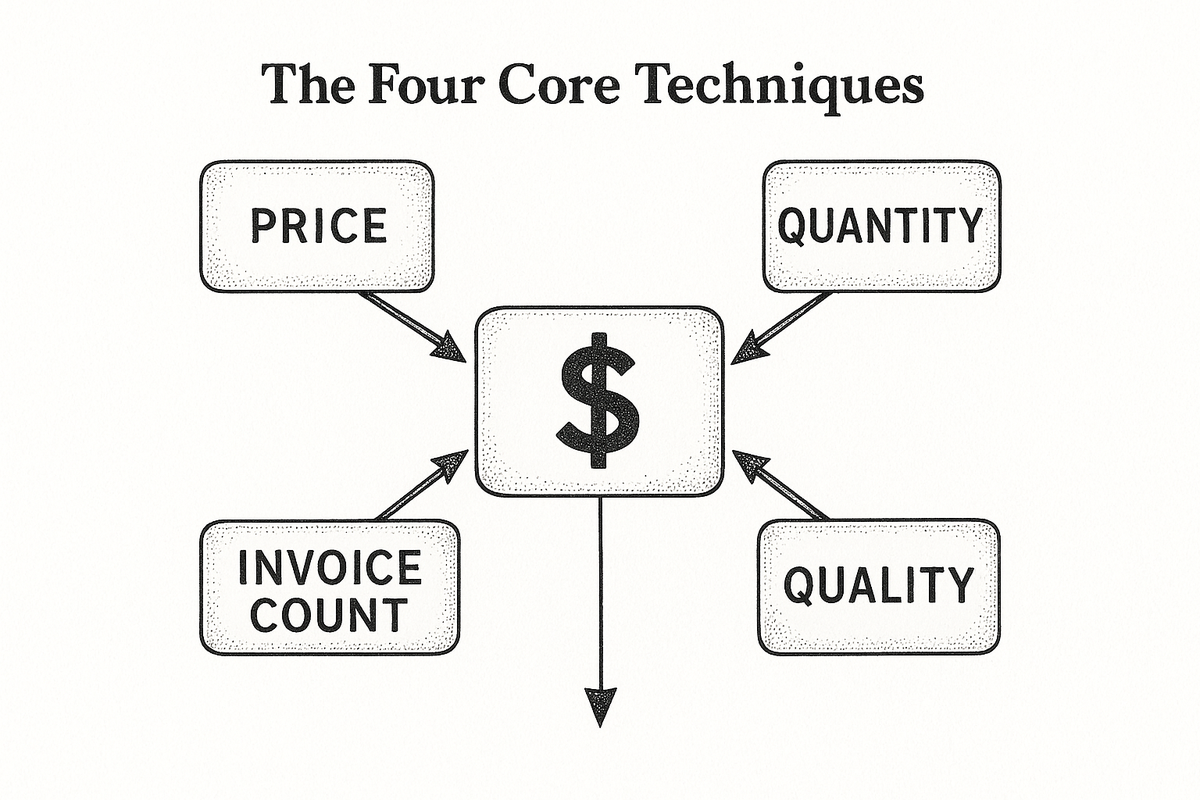
FATF's 2006 study set out four basic techniques, and the 2020 follow-up produced jointly with the Egmont Group found all four still in active use, unchanged in substance because they are flexible enough to survive shifts in global trading patterns.
Over- and under-invoicing manipulates price. An exporter invoices goods above fair market value, and the importer's overpayment transfers the excess to the exporter. Reverse the direction and the exporter invoices below market value, letting the importer resell at market price and keep the difference. HMRC's trade-based money laundering handbook notes that buyer and seller are frequently subsidiaries of the same parent, and that launderers will deliberately overpay customs duties on inflated export declarations because customs agencies scrutinize imports far more closely than exports.
Multiple invoicing manipulates the transaction count. One shipment, several invoices, several justified payments. No individual document is falsified, which is what makes the technique effective — each invoice withstands inspection on its own terms. Spread the invoices across banks in different jurisdictions and no single institution sees the duplication.
Over- and under-shipment manipulates quantity: the declared volume diverges from what actually ships. At the extreme sits the phantom shipment, also called ghost or fictitious trading, where no goods move at all and buyer and seller collude to produce a complete documentary record — invoice, packing list, bill of lading, certificate of origin — for a shipment that never existed. Banks then extend trade financing against a fabricated record.
Falsely described goods manipulates quality. Low-grade steel invoiced as specialty alloy, costume jewelry declared as precious stones. Tariff classification creates the opening, since one harmonized system code can cover items whose market values differ by an order of magnitude. Catching the substitution requires commodity expertise most compliance functions do not carry. Professional networks rarely use one technique alone — they layer them with front companies, nominee directors, and third-party intermediaries that break the visible link between counterparties.
Red Flags in Trade Finance and Open Account Trade
The most widely used red flag set for U.S. institutions comes from FinCEN advisory FIN-2010-A001, drawn from patterns in filed SARs. The FFIEC BSA/AML Examination Manual incorporates the same indicators into its trade finance examination procedures, so these are the signals examiners expect institutions to watch.
Every one of those indicators assumes the institution holds trade documents, and that assumption breaks for most of global trade. The FATF-Egmont report cites the Wolfsberg Group's estimate that approximately 80 percent of international trade processed by financial institutions is open account trading, where the bank moves a payment and never sees an invoice, a bill of lading, or a description of goods. The Wolfsberg, ICC, and BAFT Trade Finance Principles state plainly that trade-based money laundering extends beyond the documentary trade finance perimeter into ordinary account and payment activity, where detection depends on whatever transaction monitoring the institution already runs.
Open account signals are behavioral rather than documentary, which makes them weaker and noisier.
Why Banks Struggle to See It
Detection failure here is structural rather than a matter of insufficient diligence. Five constraints compound.
Banks see paper, not cargo. Where an institution cannot access customs data, the FATF-Egmont report notes, it cannot verify whether goods were actually shipped or whether their quantity and description match the contract. FinCEN made the same point in 2010: trade documents may be created by the launderers themselves, with no neutral third party available to validate them.
Fair market value is genuinely contested. Flagging over-pricing requires a defensible benchmark, and for differentiated manufactured goods, bespoke machinery, or services, no clean reference price exists. Legitimate variation across customers and contract terms is wide enough that a mispriced invoice sits inside the normal range.
Counterparty ownership is opaque. Most schemes require complicity on both sides, and often the same people control buyer and seller. Identifying that means resolving beneficial ownership for an entity that is not the bank's customer and frequently absent from any accessible registry. This is where automated UBO mapping changes what is operationally feasible, since manual tracing consumes hours per entity.
Trade operations and financial crime sit in different functions. Documentary review lives with trade finance specialists checking compliance with ICC rules; suspicious activity detection lives with financial crime teams reading payment flows. These schemes are visible only in the overlap, and the organizational seam is where signals get dropped.
The unit of analysis is wrong. Monitoring systems score transactions, while trade laundering is a pattern spread across dozens of transactions, multiple entities, and often several institutions. The reporting record shows the consequence: FinCEN found that filers clearly identified activity as trade-based money laundering or black market peso exchange in only 24 percent of the narratives it reviewed, and that 30 percent of suspected activity occurring in 2004 was not reported until the first half of 2009. A pattern reported five years late describes a network that has already moved on.
Building Detection Controls That Hold Up
A credible control framework does not price-check every transaction. It concentrates effort where risk is measurable.
Price Benchmarking on a Defined Perimeter
Automated price screening works for commodities with liquid reference markets and stable harmonized system classifications — metals, fuels, agricultural staples, bulk chemicals. Define that perimeter explicitly, benchmark unit prices against market data, and set escalation thresholds reflecting real trading variance rather than an arbitrary percentage. Outside it, rely on business-profile consistency and counterparty risk instead of pretending a benchmark exists.
Cross-Document Consistency Checks
The highest-yield documentary control compares every document in a trade set against every other: invoice, bill of lading, packing list, certificate of origin. Descriptions, quantities, weights, ports, and dates should reconcile, and where they do not, the discrepancy is the finding. Because interested parties supply those documents, the review also has to test whether they are authentic, which puts document fraud detection inside the trade control set rather than adjacent to it.
Diligence That Reaches Past the Customer
Trade risk assessment that stops at the direct customer misses the technique entirely. Higher-risk relationships warrant enhanced due diligence extended to counterparties: ownership structure, sector plausibility, corporate age, jurisdictional footprint, adverse reporting. Where sanctions evasion is a plausible motive, screening has to reach shipping agents, vessels, and intermediaries alongside the named parties.
Trade Signals Wired Into Payment Monitoring
Because most trade settles on open account, controls confined to documentary trade finance cover a minority of exposure. Trade risk indicators need to reach the layer watching payment behavior — counterparty concentration, third-party settlement, sudden onset and cessation of activity, funds arriving and leaving in matched amounts. Entity-level rather than transaction-level scoring surfaces patterns spread across many individually unremarkable payments.
Documentation That Survives an Examination
Findings here are judgment calls, defensible only when the reasoning is recorded: documents reviewed, benchmark applied, counterparty checks performed, rationale for the conclusion. FinCEN also asks institutions to tag relevant filings with the TBML or BMPE abbreviation in the narrative, which makes SAR narrative quality a direct input to law enforcement's ability to connect filings across institutions.
Where Sphinx Fits
Sphinx operates at the investigation and disposition layer, automating the analyst work that follows a trade alert. When a monitoring system or documentary review surfaces a signal, Sphinx's agents assemble the evidence — document sets, counterparty ownership, sector consistency, payment history — assess materiality, document the reasoning, and route genuine risk to human review with a complete audit trail. Every recommendation is logged, explainable, and subject to analyst override. Where trade alerts queue because each takes hours of manual reconciliation, the constraint Sphinx removes is investigative capacity rather than detection logic.
Frequently Asked Questions
How much money is laundered through trade?
No precise figure exists, and any source claiming one should be treated with caution. Global Financial Integrity estimates that trade-related illicit financial flows average about 20 percent of the value of developing countries' trade with advanced economies, and its Developing Asia analysis put estimated value gaps at roughly US$1.69 trillion in 2022. Those gaps capture duty evasion and tax avoidance alongside laundering, so they measure exposure rather than criminal proceeds.
Why is open account trade harder to monitor than letters of credit?
In documentary trade finance the bank receives invoices, bills of lading, and certificates of origin, and can check them against each other. In open account trade the bank processes a payment and receives no trade documents at all. The Wolfsberg Group estimates approximately 80 percent of international trade processed by financial institutions settles on open account, so documentary controls cover a minority of real exposure.
What does FinCEN expect institutions to do about trade-based money laundering?
FinCEN advisory FIN-2010-A001 sets out red flag indicators drawn from filed SARs and asks institutions to include the abbreviation TBML or BMPE in the narrative of relevant filings so law enforcement can identify them. The FFIEC BSA/AML Examination Manual folds those indicators into its trade finance examination procedures, so examiners expect risk-based controls, documented review, and evidence that trade risk feeds suspicious activity reporting.
Can trade-based money laundering detection be automated?
Document extraction, cross-document reconciliation, price benchmarking, counterparty ownership resolution, and pattern detection across payment flows can all be automated, and automation is the only way to apply these checks at trade volumes. Judging whether a specific pricing variance is commercially explainable requires human expertise in the relevant commodity and sector. The workable model is automated evidence assembly supporting analyst decisions, not autonomous disposition.
.png)