TL;DR: Document fraud in banking spans forged IDs, manipulated bank statements, synthetic identity packages, and AI-generated deepfakes. Forged or altered documents accounted for 50% of all fraud attempts in 2024, and AI-generated document fraud increased 5x in 2025. Detecting fake documents now requires multi-layer analysis — metadata, structural integrity, and AI artifact detection — because visual inspection alone no longer works.
What Document Fraud Looks Like Today
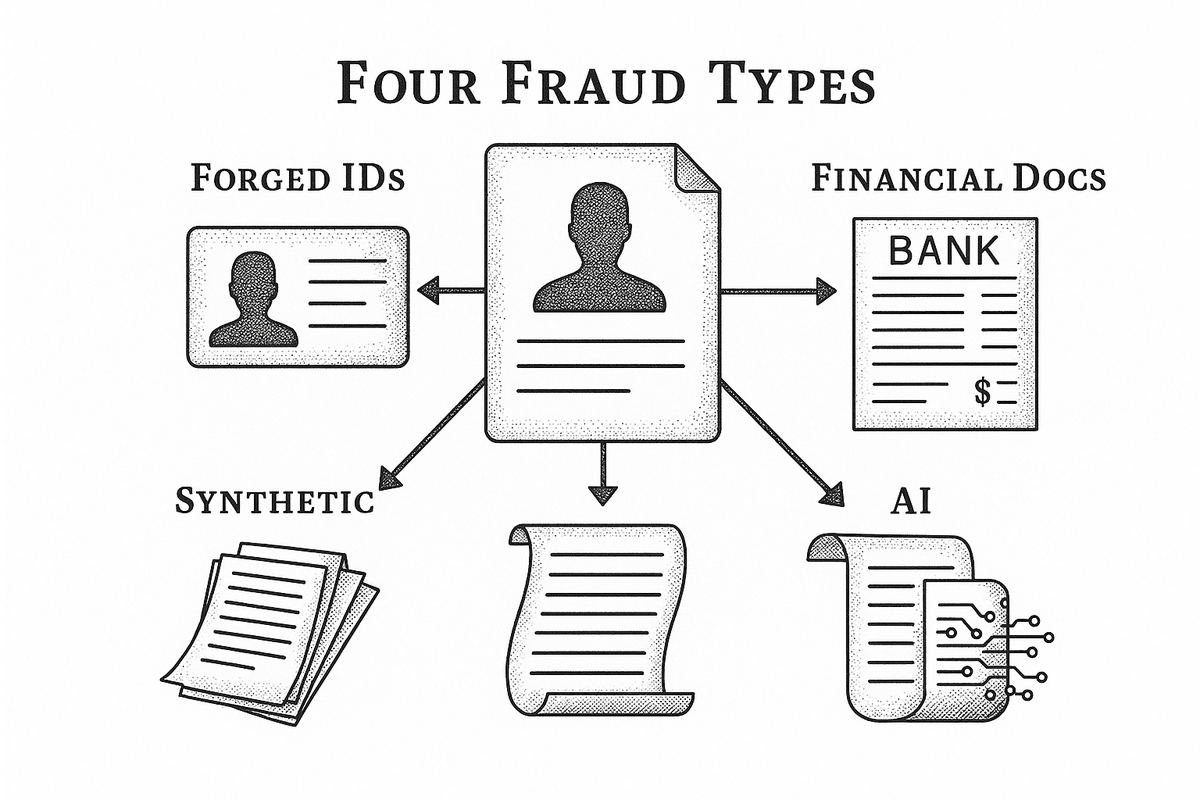
Document fraud is the creation, alteration, or misuse of documents to misrepresent identity, income, address, or financial standing. In banking, it surfaces most often during account opening, loan applications, and anywhere a customer submits documents to verify who they are or what they earn.
The taxonomy breaks into four categories, each with distinct detection challenges.
Forged Identity Documents
Fake driver's licenses, passports, and national ID cards remain the most common form of document fraud. According to the Sumsub Identity Fraud Report 2025-2026, ID cards represent roughly 72% of forged identity documents. Forged documents were the number one fraud type in 2024, accounting for 50% of all fraud attempts. These range from crude photocopies to pixel-perfect replicas that match legitimate templates in every visible detail.
Manipulated Financial Documents
Legitimate bank statements, pay stubs, and tax forms edited to alter balances, income figures, or transaction histories. Inscribe's 2026 State of Document Fraud Report found that over 91% of flagged documents include altered financial details — either alone or combined with identity changes. Bank statements are the single most concerning document type, with 85.6% of fraud and risk leaders citing them as their primary worry. The edits are often targeted: a single income figure changed, a transaction removed, a balance inflated. Because the base document is real, most of the layout, formatting, and metadata remain legitimate.
Synthetic Identity Packages
Assembled identities combining real data — often a legitimate SSN from a minor or deceased individual — with fabricated names, addresses, and supporting documents. Synthetic identity document fraud surged 311% in North America between Q1 2024 and Q1 2025. These packages are designed to pass as complete, consistent identity files. The danger is not a single fake document but a coordinated set — ID, proof of address, bank statement, employer letter — where each piece cross-validates the others.
AI-Generated Documents
Documents created entirely from scratch using generative AI tools, or legitimate documents edited with AI-level precision. AI-generated document fraud increased nearly 5x between April and December 2025, according to Inscribe. While still a small share of total document fraud, AI-generated fakes are the fastest-growing category. Shufti Pro projects document deepfakes to rise nearly 3,900% year-over-year in 2026. AI-edited documents — where a real document is modified using generative tools to change specific fields — currently pose a greater risk than fully synthetic documents because the base file passes most surface-level checks.
The distinguishing feature of modern document fraud is the package approach. Fraudsters no longer submit a single fake. They assemble coordinated sets designed to cross-validate each other and survive siloed review processes where each document is checked in isolation.
Why Legacy Detection Methods Fail
Most document verification in banking still relies on a combination of OCR, template matching, and manual review. These methods were built for an era when document fraud meant Photoshop edits and photocopied IDs.
OCR reads the text on a document. It does not verify whether the document is authentic — it assumes the document is real and tells you what it says. Template matching compares a submitted document against known layouts for a given document type. It catches crude forgeries where the format is wrong but misses sophisticated fakes that replicate the template precisely. Manual review depends on trained analysts spotting visual inconsistencies — font mismatches, alignment errors, image artifacts — but generative AI produces output that satisfies every visual heuristic an analyst has been trained to check.
The SDB-26 open benchmark for document verification systems found that vision AI models — including leading commercial systems — consistently classify high-quality AI-generated identity documents as genuine with 90-100% confidence. Template matching alone achieved only an 84.3% detection rate in controlled testing. These are not edge cases. They represent the baseline performance gap that every bank relying on legacy methods faces.
Screenshots compound the problem. When a native PDF becomes a screenshot or photo, structural and metadata signals disappear entirely: creation timestamps, embedded fonts, layer history, and source application indicators all vanish. A growing number of fraudsters use this technique deliberately — generating a document with AI, then screenshotting it to strip the forensic evidence before submission.
FinCEN's November 2024 alert on deepfake media specifically flagged the use of AI-generated documents to circumvent customer identification programs, noting that criminals combine GenAI images with stolen or fabricated PII to create synthetic identities that pass automated and manual checks alike.
An Evaluation Framework for Document Fraud Detection
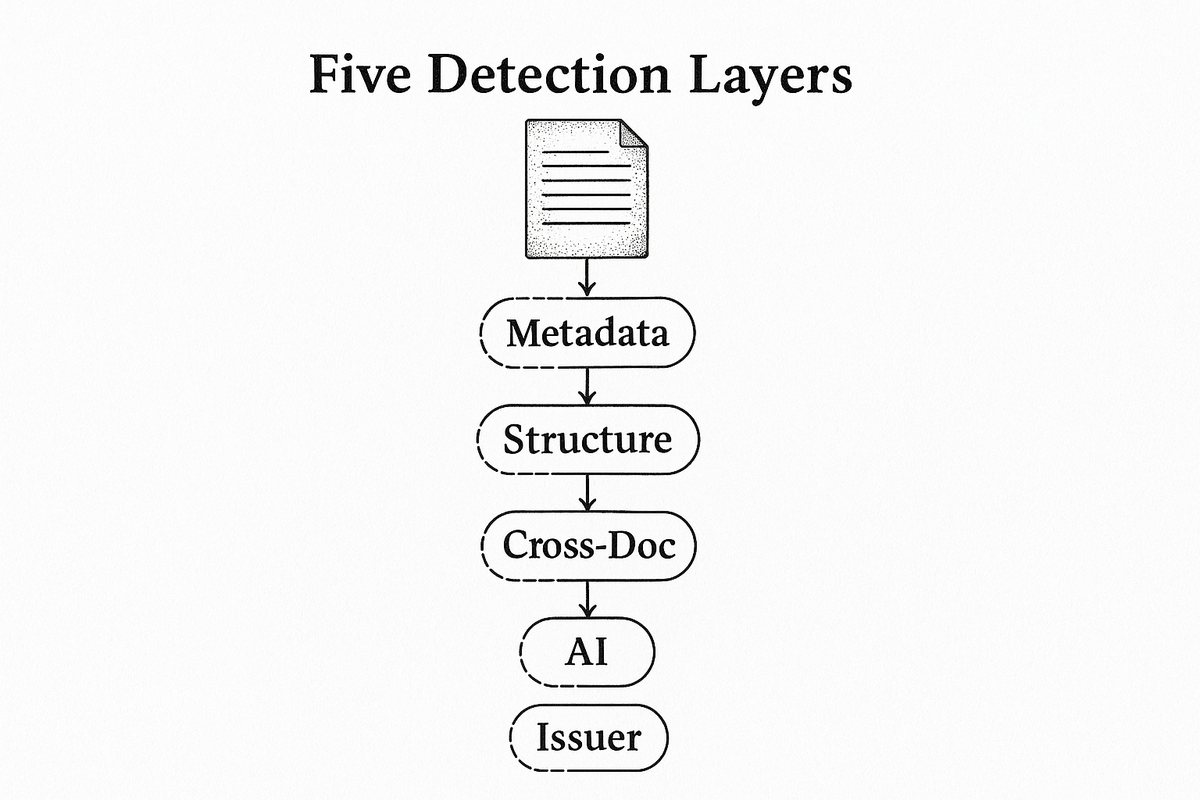
Effective detection requires moving beyond surface-level checks to multi-layer analysis. When evaluating document fraud detection capabilities — whether building internally or selecting a vendor — compliance teams should assess performance across five layers.
Metadata Analysis
The system should examine a document's embedded properties: creation timestamps, software signatures, compression patterns, and EXIF data. These properties reveal whether a document was created by the claimed issuer or generated by an AI tool. A bank statement exported from a banking platform carries different metadata fingerprints than one produced by a generative model or edited in a PDF tool. Metadata analysis is the first line of defense against AI-generated documents because the visual output may be flawless while the file properties tell a different story.
Structural Integrity
The system should validate internal consistency. Running totals in bank statements should match. Gross-to-net calculations on pay stubs should add up. Date sequences should follow logical order. Tax withholding percentages should be plausible for the stated income and jurisdiction. Financial document fraud often manipulates specific numbers while leaving the surrounding structure intact — math-based validation catches what visual review misses.
Cross-Document Consistency
The system should compare signals across the entire submitted document package. Names, addresses, employers, and income figures should align across an ID, bank statement, and pay stub submitted together. Synthetic identity packages often contain subtle inconsistencies between documents — a slightly different address format, a name spelling variation, an employer that doesn't appear in business registries — that individual document checks miss entirely.
AI-Generation Detection
The system should identify computational artifacts specific to generative AI output. Model fingerprints, frequency-domain anomalies, and compression patterns characteristic of AI-generated images are invisible to human reviewers but detectable through forensic analysis. This layer is increasingly critical as AI-generated documents pass all visual and template-based checks with high confidence scores.
Issuer Verification
The system should cross-reference documents against known issuer formats, registries, and databases. Template matching against a global library of genuine document specimens, combined with issuer registry lookups — employer databases, utility company records, government registries — adds a validation layer that pure document analysis cannot provide. A perfectly formatted bank statement loses credibility if the issuing bank's template has changed or the branch code doesn't exist.
No single layer is sufficient on its own. Template matching without metadata analysis misses AI-generated documents. Metadata analysis without structural checks misses manually edited PDFs. The standard is multi-layer detection — systems that operate across all five dimensions simultaneously and produce explanations for every flagged document.
Beyond detection capabilities, compliance teams should evaluate four operational factors:
- Integration burden — does the system work within existing onboarding flows, or does it require a platform migration?
- Explainability — does the system produce audit-ready output that documents why a document was flagged, with evidence a regulator can review?
- Format coverage — does the system handle the full range of submitted document types (IDs, bank statements, pay stubs, utility bills, tax documents) across jurisdictions?
- Latency — does detection add seconds or minutes to the onboarding SLA, and can it run asynchronously where needed?
Where Sphinx Fits
Sphinx applies multi-layer document analysis as part of its KYC/KYB onboarding workflow. Sphinx's agents analyze metadata, structural integrity, cross-document consistency, and AI-generation artifacts at the point of document intake, producing auditable explanations for every flagged document. The system integrates into existing compliance platforms — including fraud detection workflows — without requiring API rebuilds, and every decision is documented for regulatory review.
Frequently Asked Questions
What are the most common types of document fraud in banking?
The four main types are forged identity documents (fake IDs, passports), manipulated financial documents (edited bank statements, pay stubs), synthetic identity packages (assembled from real and fabricated data), and AI-generated documents (created from scratch using generative AI). Forged or altered documents accounted for 50% of all fraud attempts in 2024, according to the Sumsub Identity Fraud Report.
Can OCR and template matching detect AI-generated fake documents?
On their own, no. The SDB-26 benchmark found that vision AI models classify high-quality AI-generated documents as genuine with 90-100% confidence. Detection requires additional layers — metadata analysis, structural checks, and AI artifact detection — that operate on signals invisible to visual inspection.
Why are bank statements the most targeted document type?
Inscribe's 2026 report found that 85.6% of fraud and risk leaders cited bank statements as their most concerning document type. Bank statements contain financial details — balances, income, transaction history — that directly affect lending, onboarding, and risk decisions, making them high-value targets for manipulation.
What does FinCEN say about AI-generated document fraud?
FinCEN issued an alert in November 2024 specifically addressing deepfake media fraud, including AI-generated identity documents. The alert described how criminals use generative AI to create falsified documents to circumvent customer identification programs and outlined red flag indicators for financial institutions.
How should banks evaluate document fraud detection vendors?
Assess capabilities across five layers: metadata analysis, structural integrity checks, cross-document consistency, AI-generation detection, and issuer verification. Also evaluate integration burden, explainability of flagged decisions, document type and jurisdiction coverage, and impact on onboarding latency.
.png)