

TL;DR: Fintechs need two distinct categories of compliance automation: financial crime compliance (AML, KYC, sanctions screening) and security compliance (SOC 2, ISO 27001, PCI DSS). The best platforms in 2026 automate evidence collection, alert triage, and regulatory reporting without scaling headcount proportionally to transaction volume. This guide covers both categories and explains how to build a compliance stack that holds up under examination.
Two Categories of Compliance Automation
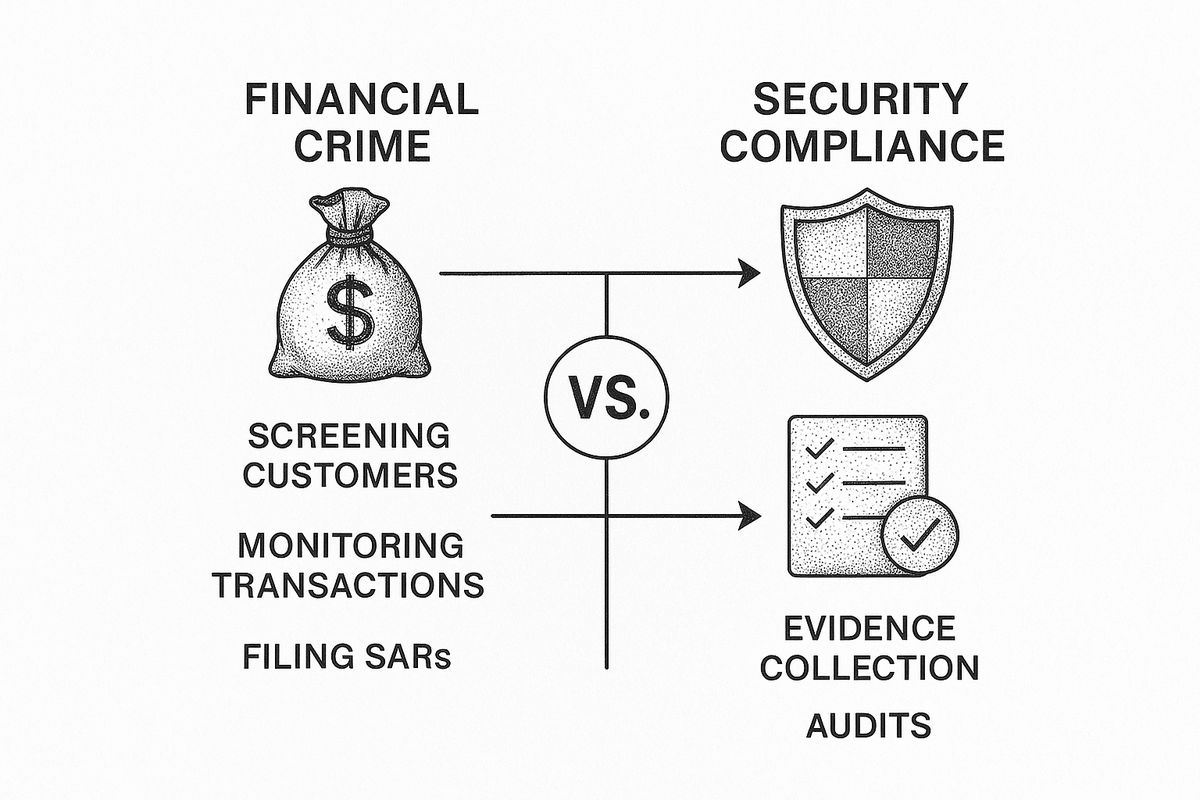
The phrase "compliance automation" means different things depending on who is buying. For a fintech's security team, it means automated evidence collection for SOC 2 or ISO 27001 audits. For a compliance officer, it means screening customers against sanctions lists, monitoring transactions for suspicious activity, and filing SARs when something looks wrong. Most fintechs need both. Few platforms cover both well.
This distinction matters because the regulatory consequences differ. A failed SOC 2 audit can delay a partnership. A failed AML program can result in enforcement action, fines, or loss of banking relationships. FinCEN's effectiveness-based AML rule makes the stakes explicit: regulators now evaluate whether your program produces effective outcomes, not just whether you have one.
The global compliance software market reached $35.82 billion in 2025, according to Grand View Research, growing at a 10.5% CAGR. Within that, the AML solutions segment alone is projected to grow at 18.01% CAGR through 2031, reflecting the urgency of financial crime compliance over security compliance frameworks.
Financial Crime Compliance Platforms
Financial crime compliance automation covers the operational work that keeps fintechs in good standing with FinCEN, FATF, the FCA, and their banking partners. The core functions are customer screening (KYC/KYB), transaction monitoring, alert investigation, and regulatory reporting.
ComplyAdvantage provides real-time AML screening, sanctions monitoring, and adverse media alerts through an API-first platform. It covers OFAC, UN, EU, and HM Treasury sanctions lists alongside PEP databases. For fintechs processing payments or onboarding business customers, ComplyAdvantage integrates directly into onboarding and monitoring workflows. The platform reports 60-80% reduction in false positives for ongoing monitoring and 33% faster remediation times. ComplyLaunch offers startup-friendly pricing with up to 12 months free for eligible companies.
Alloy operates as an identity decisioning platform, orchestrating data from 190+ sources into automated workflows for onboarding, transaction monitoring, and ongoing due diligence. The no-code workflow builder lets compliance teams create and modify decisioning rules without engineering support. Alloy excels at onboarding and identity verification but has thinner capabilities for ongoing transaction monitoring and SAR filing. Best suited for US-centric operations.
Unit21 targets growth-stage fintechs with a no-code rule management platform for transaction monitoring. Its AI Investigation Agent handles full L1 triage autonomously — ingesting alert context, pulling transaction history, checking watchlists, and drafting investigation narratives before a human analyst opens the case. Unit21 reports up to 85% false positive reduction and 44-93% reductions in handle time across customer deployments. The backtesting and shadow mode capabilities let compliance teams test new rules against historical data before deployment.
Sumsub provides global identity verification and compliance across KYC, KYB, AML screening, and transaction monitoring. Document verification covers 14,000+ document types across 220+ countries, with liveness detection and deepfake prevention. Sumsub also handles travel rule compliance for crypto businesses, making it relevant for fintechs operating across both traditional and digital asset channels.
Security Compliance Platforms
Security compliance automation handles the framework certifications that fintechs need to win enterprise contracts and satisfy banking partners. These platforms automate evidence collection, control monitoring, and audit preparation.
Vanta is the default choice for seed-to-Series B fintech teams pursuing SOC 2 Type II. It connects to cloud infrastructure, code repositories, HR systems, and identity providers, then continuously pulls evidence against SOC 2, ISO 27001, HIPAA, PCI DSS, and GDPR controls. The automation replaces the manual evidence-gathering process that previously consumed engineering time before every audit window.
Drata competes directly with Vanta and differentiates through workflow automation for policy management — tracking policy acknowledgment cadences, completion rates, and signature collection within the same platform where evidence lives. Drata holds a 4.8/5 G2 rating and covers NYDFS Part 500, directly relevant for financial services firms operating in New York.
Sprinto is built for high-growth SaaS and fintech companies, with entity-level control mapping that distinguishes which controls apply to which product lines or legal entities. This matters for fintechs operating multiple licenses or maintaining a holding company above the regulated entity.
How to Evaluate a Compliance Automation Platform
Feature lists look similar across vendors. The differences that matter show up in production. Six criteria separate platforms that deliver from those that look good in a demo.
Integration depth, not breadth. Every vendor lists hundreds of integrations. The question is whether the integrations are deep — pulling structured data into automated workflows — or shallow connectors that require manual configuration. Test the platform against your actual stack before signing. A compliance tool that requires your engineering team to build custom integrations defeats the purpose of automation.
Time to first value. Enterprise platforms like NICE Actimize take 12-18 months for full deployment. API-first platforms like ComplyAdvantage deploy in 2-4 weeks. For fintechs under pressure from banking partners to demonstrate compliance, deployment speed is a feature.
Explainability under regulatory scrutiny. When an examiner asks why you cleared an alert or escalated a case, the platform should produce the reasoning — not just the outcome. This applies equally to false positive reduction claims. A platform that suppresses alerts without documenting why creates regulatory risk.
Total cost at scale. Most compliance platforms price by volume — transactions screened, customers monitored, or frameworks certified. Model the cost at 2-3x your current volume before committing. Usage-based pricing is predictable at small scale and can spike dramatically at growth-stage volumes. Lock in expansion rates during initial negotiations when you have leverage.
Multi-framework overlap. For security compliance, a fintech holding both SOC 2 and PCI DSS benefits from platforms that map controls across frameworks, avoiding duplicate evidence collection. For financial crime compliance, a platform that handles both KYB onboarding and ongoing transaction monitoring in a single system eliminates the data handoffs that create audit gaps.
Audit trail completeness. Every consequential decision needs to show the evidence behind it. Timestamped logs, four-eyes approval workflows, and immutable decision records are the difference between a program that survives examination and one that triggers remediation.
Where Sphinx Fits
Sphinx automates the operational layer of financial crime compliance — the alert triage, case investigation, and SAR filing work that consumes analyst time. Agents work inside your existing compliance systems, reviewing the same data analysts see, and documenting every decision for audit. Conduit dispositions risk alerts 99% faster. Alviere automates 86% of compliance cases. Sphinx does not replace your screening or monitoring tools — it resolves the alerts they generate.
Frequently Asked Questions
What is the difference between financial crime compliance and security compliance automation?
Financial crime compliance automation handles AML screening, transaction monitoring, sanctions checking, and regulatory reporting — the obligations that prevent money laundering and financial crime. Security compliance automation handles framework certifications like SOC 2, ISO 27001, and PCI DSS — the controls that protect data and systems. Most fintechs need both, but they serve different regulatory requirements and different stakeholders.
Do fintechs need both types of compliance platforms?
Yes. Banking partners typically require SOC 2 or ISO 27001 certification as a condition of the relationship. Regulators require AML/KYC programs as a condition of operating. Running both on a single platform is rarely possible because the underlying compliance domains are fundamentally different. Most fintechs operate a stack of 2-3 compliance tools.
How much do compliance automation platforms cost for fintechs?
Security compliance platforms like Vanta and Drata range from $15,000-$50,000 per year for standard plans. Financial crime compliance platforms typically use volume-based pricing that scales with transactions screened or customers monitored. Some vendors like ComplyAdvantage offer startup programs with up to 12 months free. Enterprise platforms like NICE Actimize start above $500,000 annually and are generally out of reach for early-stage fintechs.
What compliance certifications do fintechs need for banking partnerships?
Most sponsor banks and banking-as-a-service providers require SOC 2 Type II at minimum. Some require ISO 27001 or PCI DSS depending on the data involved. Beyond security certifications, banking partners evaluate the fintech's AML/BSA program, including transaction monitoring capabilities, SAR filing processes, and customer due diligence procedures. NYDFS Part 500 applies to any financial services firm operating in New York.
Can AI reduce compliance costs without increasing regulatory risk?
When implemented with proper governance, yes. AI-driven platforms report 60-85% reductions in false positives and significant reductions in alert handling time. The key is explainability — every AI-assisted decision must produce reasoning that an examiner can follow. Platforms that use AI as a black box create regulatory risk regardless of how accurate the underlying model is. FinCEN's 2026 proposed rule explicitly supports technology adoption when it leads to more effective outcomes.
.png)