

TL;DR: Adverse media screening is the process of searching public news, regulatory, and judicial sources for derogatory information about a customer or counterparty as part of AML due diligence. According to Ripjar's 2026 research, 93% of financial services leaders rate it as critical to their risk frameworks, yet 58% still rely on manual internet searches. Regulators treat it as a baseline expectation for risk-based compliance programs, even where the term is not explicitly codified in statute.
What Adverse Media Screening Is and How It Works
Adverse media screening — also called negative news screening — is the systematic search of news publications, regulatory databases, court records, and other open sources for information that may indicate a customer or counterparty poses financial crime risk. The categories that matter most to compliance programs include money laundering allegations, fraud investigations, corruption charges, sanctions evasion, terrorist financing connections, and regulatory enforcement actions.
The process serves a specific function within AML programs: it surfaces risk signals that sanctions lists and PEP databases do not contain. A customer under investigation for bribery in a foreign jurisdiction may appear in local-language press months or years before any formal designation. An adverse media program that catches that reporting early is the difference between managing a risk and explaining, after enforcement, why it was missed.
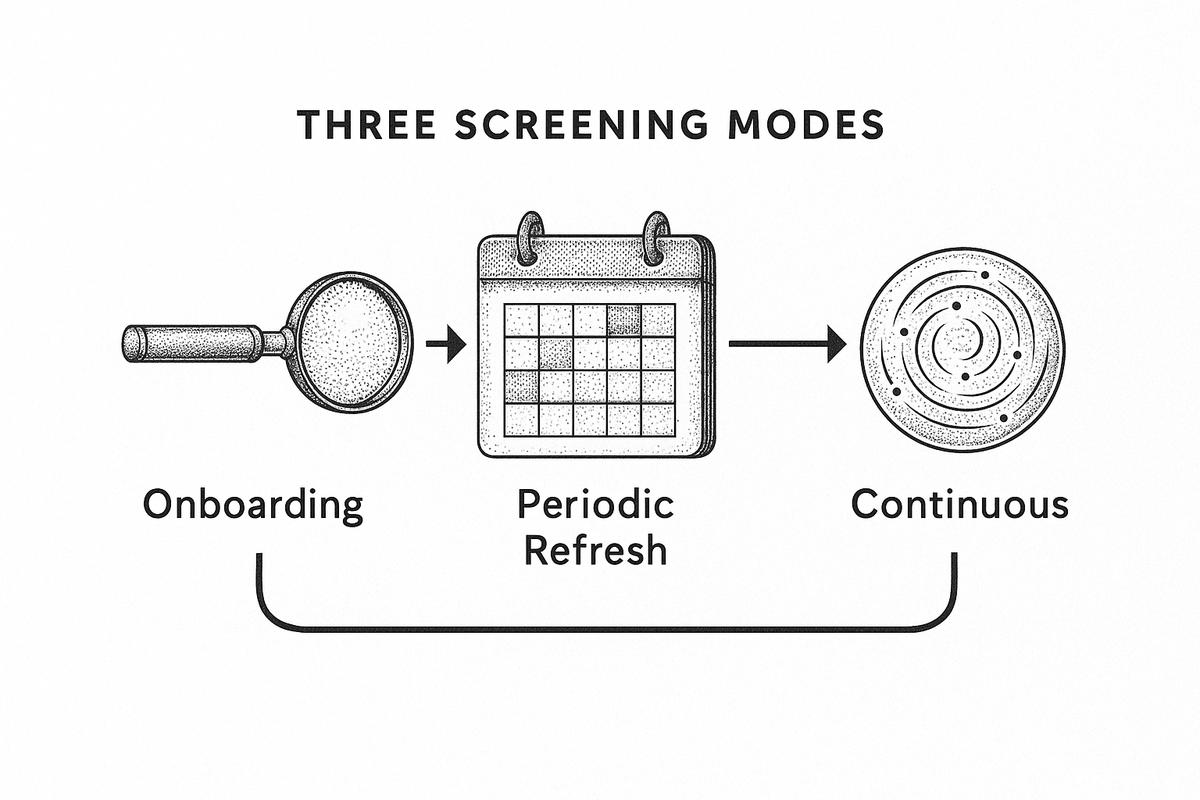
In practice, screening operates across three modes. Point-in-time screening at onboarding establishes a baseline — what is publicly known about the customer at the moment they enter the relationship. Periodic re-screening at intervals calibrated to the customer's risk tier catches developments that occurred between reviews. Continuous monitoring alerts compliance teams to new publications in near real-time. The Wolfsberg Group's 2022 Guidance on Negative News Screening treats the combination of these modes as the framework that defensible programs are built on.
The operational challenge is not finding information. It is finding the right information. Industry data puts false positive rates in adverse media screening at 85% to 95%, meaning analysts spend the vast majority of their review time on results that carry no material compliance relevance. Name collisions, syndicated duplicates of the same underlying story, and outdated allegations account for most of the noise. Effective programs address this through identity-level matching — using secondary identifiers like date of birth, nationality, and profession to disambiguate — rather than relying on name strings alone.
Why Regulators Require It
Adverse media screening sits within the global AML framework established by FATF and implemented through national regimes. While the term rarely appears verbatim in legislation, the obligation to assess publicly available information about customers is consistently interpreted by supervisors as integral to CDD and enhanced due diligence.
FATF Recommendation 10 requires financial institutions to conduct ongoing customer due diligence, including scrutiny of transactions and keeping CDD information current. FATF guidance explicitly names adverse media as an input to the risk assessment process, particularly for higher-risk customers. Mutual evaluation reports routinely cite inadequate adverse media screening as a deficiency when assessing national AML regimes.
In the United States, FinCEN's CDD Rule does not categorically require media searches for all customers. But the risk-based approach it mandates makes adverse media checks a practical requirement for higher-risk relationships. The FFIEC BSA/AML Examination Manual states that banks should have policies to determine when, based on risk, obtaining and reviewing negative media is appropriate. As Sigma360 has documented, enforcement actions have cited failures to identify publicly available negative information as evidence of inadequate AML programs — including a $390 million penalty against Capital One in 2021 that referenced failure to monitor customers despite known public risk signals.
The FCA expects UK firms to incorporate adverse media into CDD and ongoing monitoring under the Money Laundering Regulations 2017. The EU's AMLD6 expanded predicate offence coverage, and the forthcoming AMLR — directly applicable across member states without national transposition — will further standardize expectations under the EU Anti-Money Laundering Authority. AMLA, operational since 2025, treats a 95% false-positive rate not as an operational constraint but as a control deficiency. MAS Notice 626 in Singapore requires financial institutions to consider adverse media as part of customer risk assessment and has been particularly explicit that English-only screening is insufficient for institutions operating across Asian markets.
The regulatory trajectory is clear. AML penalties against banks worldwide jumped 522% in 2024, reaching $3.65 billion according to Ripjar's research. Across the largest enforcement cases, the pattern is the same: adverse signals existed in the open for years before action landed. What was missing was not the data but the ability to surface it continuously and act on it in time.
How to Evaluate an Adverse Media Screening Program

Five capabilities separate adequate programs from those that draw supervisory criticism. Evaluating a screening program — whether internal or vendor-provided — against these dimensions reveals where the gaps are.
Source Coverage and Language Breadth
Risk signals routinely appear first in local-language reporting. A customer's business activity in Brazil may be covered by Portuguese-language regional press months before any English-language outlet picks it up. Single-language screening is a structural blind spot, and regulators increasingly treat it as such. An adequate program covers the languages and jurisdictions relevant to the customer base, including non-Latin scripts where transliteration and cross-script name matching add complexity.
Identity Resolution and False Positive Management
Common names generate volumes of irrelevant alerts that overwhelm analyst capacity. The Wolfsberg guidance is explicit: auto-discounting logic using secondary identifiers — date of birth, nationality, profession, residence — is the remedy. The discipline is identity screening, not name screening. Programs still running keyword-based name matching without secondary-identifier disambiguation will produce alert fatigue, missed signals, and supervisory criticism. According to Ripjar's 2026 study, 58% of institutions still use manual internet searches as part of their adverse media process, rising to 70% in the United States.
Deduplication and Temporal Awareness
A single story reported by dozens of outlets in multiple languages should surface once in the analyst's queue, not ten times. Echo deduplication — grouping articles by underlying fact rather than URL — is a baseline capability. Temporal deduplication matters equally: a 2026 article referencing a 2019 indictment already in the customer's profile is not a new risk event. Without both forms of deduplication, monitoring produces repeated alerts on the same facts, cluttering audit trails and making genuine new developments harder to identify.
Screening Cadence and Continuous Monitoring
Point-in-time screening at onboarding is necessary but insufficient. A clean check at onboarding establishes a baseline, not a permanent risk profile. For higher-risk customers — PEPs, HNWIs, customers from higher-risk jurisdictions, complex ownership structures — continuous monitoring is the modern supervisory expectation. Ripjar's research found that 28% of financial institutions have not yet adopted continuous monitoring. Periodic refresh and continuous monitoring are complementary; one is not a substitute for the other.
Audit Trail and Explainability
Every decision to discount, escalate, or act on an adverse media finding must be recorded with supporting evidence. The audit trail must be complete enough that a supervisor could review the file independently and reach the same conclusion. This is consistently the weakest link in firms that receive enforcement findings — and the easiest to fix. AI-assisted screening adds capability but does not change the standard: every finding must be source-linked, traceable, and auditable.
Evaluation Checklist
Programs achieving meaningful improvement rebuild across multiple dimensions simultaneously. Strong matching on poor source coverage still misses risk. Broad coverage without deduplication buries analysts in noise. The right measure of success is not lower alert counts alone — it is higher-quality investigation workload, faster alert review times, and a defensible audit trail that withstands supervisory scrutiny.
Where Sphinx Fits
Sphinx operates at the investigation and triage layer of screening workflows, automating the analyst work that follows an adverse media alert. When a screening system generates a hit, Sphinx's agents gather evidence, assess materiality, document dispositions, and route genuine risks for human review — producing audit-ready outputs where every recommendation is logged, explainable, and subject to analyst override. For compliance teams facing alert backlogs or high false-positive volumes from adverse media screening, Sphinx reduces the time between alert and disposition without sacrificing the documentation regulators expect.
Frequently Asked Questions
Is adverse media screening legally required?
Not in those exact words in most jurisdictions. U.S. regulations do not categorically mandate adverse media checks for all customers. But the risk-based approach required by FinCEN's CDD Rule, the FFIEC Examination Manual, FATF Recommendations, and equivalent frameworks in the UK, EU, and Asia makes adverse media screening a practical requirement for higher-risk relationships. Institutions that fail to screen when publicly available risk signals exist face enforcement criticism.
What is the difference between adverse media screening and sanctions screening?
Sanctions screening matches customers against official, formally designated sanctions lists. Adverse media screening searches open-source publications for risk-relevant information — money laundering allegations, fraud investigations, corruption charges — that may appear months or years before any formal designation. They are complementary. A complete compliance program includes both.
How often should adverse media screening be conducted?
At minimum, at onboarding and at periodic risk-tier-calibrated intervals. For higher-risk customers, continuous real-time monitoring is the modern supervisory expectation. Ripjar's 2026 research found that 28% of financial institutions have not yet implemented continuous monitoring — a gap regulators are increasingly scrutinizing.
What causes high false positive rates in adverse media screening?
Three structural factors: name-string matching without secondary identifiers (date of birth, nationality, profession), lack of deduplication across syndicated articles reporting the same underlying story, and absence of temporal awareness that allows previously known and documented findings to resurface as new alerts. Industry false positive rates run between 85% and 95%.
Can adverse media screening be fully automated?
The search, extraction, classification, and deduplication steps can and should be automated. The judgment applied to material findings — assessing context, severity, and customer-specific implications — should remain human-led, supported by structured AI-generated intelligence. The right model is augmentation of analyst judgment, not replacement of it.
.png)