

TL;DR: Financial crime detection identifies suspicious activity after it occurs. Financial crime prevention stops it before funds move. Effective compliance programs need both, but FinCEN's 2026 proposed rule signals a regulatory shift toward outcomes-based programs that prioritize prevention over retroactive reporting. The Nasdaq Verafin Global Financial Crime Report found that 89% of financial institutions are now using or evaluating AI-based solutions to bridge the gap between detection and prevention.
What Detection and Prevention Actually Mean

Financial crime detection and financial crime prevention are treated as interchangeable in most compliance conversations. They are not. The distinction matters because it shapes how teams allocate resources, design controls, and measure program effectiveness.
Detection refers to identifying suspicious activity that has already occurred or is in progress. Transaction monitoring systems flag unusual patterns. Case management workflows route alerts to analysts. SARs get filed. The activity happened; the goal is to find it, document it, and report it to regulators.
Prevention refers to stopping financial crime before value leaves the system. Sanctions screening blocks prohibited parties at onboarding. Identity verification catches synthetic identities before accounts open. Real-time payment controls halt suspicious transfers before settlement. The activity is intercepted before it causes harm.
Most compliance programs are heavily weighted toward detection. That made sense when the primary regulatory expectation was filing SARs and maintaining audit trails. But the cost structure is unsustainable. The Nasdaq Verafin Global Financial Crime Report 2026 found that global fraud losses rose 8.2% to $517.4 billion, even as institutions increased spending on detection infrastructure. Finding crime after the fact is necessary but insufficient.
Why the Balance Is Shifting
Three forces are pushing financial institutions to rethink how they allocate effort between detection and prevention.
The first is regulatory. FinCEN's April 2026 proposed rule fundamentally reforms AML/CFT program requirements. The rule shifts the standard from maintaining procedures to achieving effective outcomes. A program that files SARs on time but fails to prevent laundering through its own systems would not meet the new standard. FinCEN explicitly states that financial institutions must establish risk-based controls that are \"reasonably designed\" to detect and prevent illicit activity, not just document it after the fact.
The second is economic. Detection-heavy programs generate enormous volumes of alerts, most of which are false positives. Analysts spend hours reviewing transactions that turn out to be legitimate. Across the industry, false positive rates routinely exceed 90%, meaning the vast majority of detection output produces no actionable intelligence. Prevention controls that stop bad actors at the gate reduce the downstream volume that detection systems must process.
The third is adversarial. Criminal networks now use generative AI to create synthetic identities, automate phishing campaigns, and optimize transaction patterns that evade rule-based detection. The ACAMS Global AFC Threats Report 2026, based on a survey of nearly 1,400 compliance professionals across 200 jurisdictions, found that AI-enabled financial crime is now the top perceived threat for the next two years. Detection systems that rely on historical patterns struggle against adversaries that adapt in real time. When a criminal can generate a convincing synthetic identity in minutes, the prevention control that catches it at onboarding is worth more than the detection system that identifies the resulting suspicious transactions weeks later.
These three forces compound each other. Regulators demand effectiveness, not volume. Economic reality makes detection-only programs unsustainable at scale. And adversarial sophistication renders static detection rules increasingly brittle. The institutions that adapt fastest are the ones restructuring their compliance programs to lead with prevention while maintaining detection as a critical backstop.
Where Detection Still Earns Its Place
Prevention cannot catch everything. No onboarding process is perfect. No sanctions list is complete on the day a customer passes screening. Legitimate accounts get compromised. Employees collude. Risk profiles change after the relationship begins.
Detection serves as the second line of defense for scenarios that prevention controls miss. Transaction monitoring identifies behavioral shifts over time: a low-risk retail account that suddenly receives large international wires, a business customer whose transaction volume spikes without a corresponding change in operations. These patterns only become visible after activity accumulates.
Detection also generates the evidentiary record that regulators and law enforcement need. SAR filings provide intelligence to FinCEN's analytical teams. Investigation records demonstrate that institutions are meeting their reporting obligations. Without detection, financial institutions lose visibility into how their platform is being used after onboarding.
Certain crime types are inherently detection-first. Insider threats, for example, involve authorized users operating within normal access parameters. No perimeter control catches a compliance officer who deliberately ignores red flags. Layered transaction schemes that individually fall below reporting thresholds only reveal themselves through pattern analysis over time. Trade-based money laundering, where invoice values are manipulated across legitimate trade flows, requires post-transaction analysis to identify over- or under-invoicing patterns.
The problem is not that detection is unnecessary. The problem is that most programs treat detection as the entire compliance strategy rather than one component of it.
How to Evaluate the Right Balance
The optimal split between detection and prevention depends on an institution's risk profile, customer base, and product mix. A neobank processing real-time payments faces different exposure than a wealth manager onboarding high-net-worth clients. But several principles apply broadly.
Map controls to the crime lifecycle
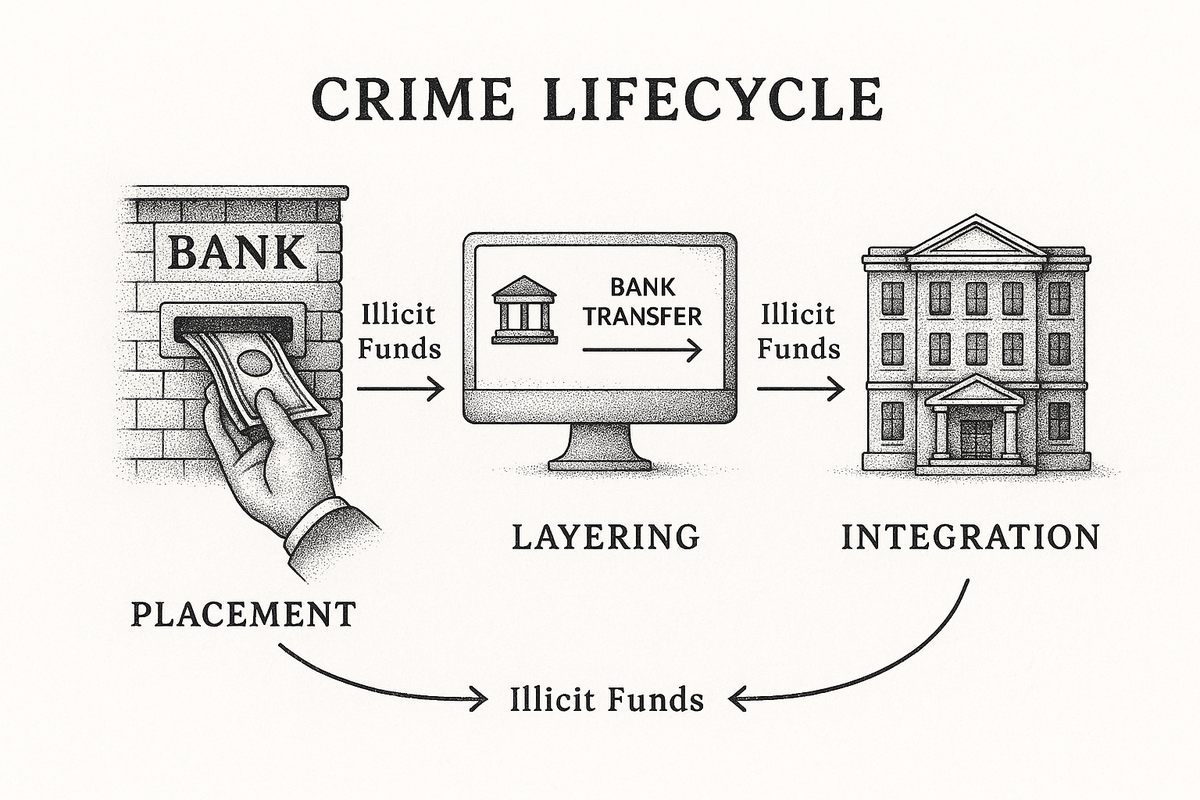
Financial crime follows a sequence: placement, layering, integration. Prevention controls are most effective at placement, when illicit funds first enter the financial system. Strong KYC, sanctions screening, and source-of-funds checks intercept illicit value before it enters. Detection controls are most effective during layering, when criminals move funds across accounts and jurisdictions to obscure their origin. Transaction monitoring, behavioral analytics, and network analysis surface patterns that indicate structuring, round-tripping, or shell company flows. Institutions should map their existing controls to each stage and identify where gaps exist. Most will find that integration, the final stage where laundered funds re-enter the legitimate economy, remains the least covered.
Measure outcomes, not activity
Alert volume is not a measure of program effectiveness. Neither is the number of SARs filed. FinCEN's proposed rule signals that regulators will increasingly evaluate whether programs actually prevent and detect illicit activity, not whether they generate documentation. Metrics worth tracking include: the percentage of SARs that lead to law enforcement action, the ratio of true positives to total alerts, the time between suspicious activity and intervention, and the dollar value of prevented losses.
Invest in prevention at the perimeter
The highest-ROI prevention controls sit at onboarding and payment initiation. Robust KYC and FRAML-integrated screening catch bad actors before they gain access. Real-time payment controls intercept suspicious transfers before settlement. These interventions cost a fraction of what post-event investigation and remediation require. The UK Finance 2026 Annual Fraud Report found that banks prevented 1.68 billion pounds in unauthorized fraud in 2025, equivalent to stopping 70 pence of every pound that criminals attempted to steal. That prevention ratio reflects years of investment in perimeter controls, and it illustrates what a mature prevention posture can achieve.
Automate detection to free capacity for prevention
When analysts spend 80% of their time reviewing and dispositioning alerts that detection systems generate, no capacity remains for prevention work: refining onboarding rules, investigating typology trends, or tuning screening thresholds. Automating the routine, high-volume portion of detection, particularly the false positives, releases experienced analysts to focus on controls that stop crime before it starts.
Treat convergence as architecture, not aspiration
Fraud detection and AML monitoring still operate as separate functions at most institutions, with separate teams, separate systems, and separate reporting lines. Converged programs that share data and signals across both disciplines detect patterns that siloed systems miss. A fraud alert on an account that also has unusual AML typology indicators is worth more than either signal alone.
Convergence also applies to the detection-prevention boundary itself. An alert generated by a detection system can feed directly into a prevention control: a flagged account triggers enhanced screening on all future transactions, or a detected typology pattern updates the onboarding risk model for similar customer profiles. When detection output flows back into prevention rules, the two functions create a feedback loop that strengthens over time rather than operating in parallel.
Where Sphinx Fits
Sphinx deploys AI compliance agents that work across both detection and prevention workflows. On the detection side, agents triage alerts, review cases, and draft SAR narratives at a pace that clears backlogs and reduces time-to-resolution by 80%. On the prevention side, agents handle sanctions screening, onboarding verification, and real-time risk scoring, catching threats before they enter the system. Every decision is logged with full audit trails, meeting the explainability standard that regulators require. Agents operate inside existing compliance platforms, so institutions do not need to rip out their current detection infrastructure to add prevention capacity. The result is a compliance program where detection and prevention reinforce each other rather than competing for the same analyst hours.
Frequently Asked Questions
What is the difference between financial crime detection and prevention?
Financial crime detection identifies suspicious activity that has already occurred or is underway, typically through transaction monitoring and alert-based systems. Financial crime prevention stops illicit activity before it happens, through controls like sanctions screening, identity verification, and real-time payment blocks. Effective compliance programs require both.
Why are regulators shifting focus from detection to prevention?
FinCEN's 2026 proposed AML/CFT rule moves the regulatory standard from maintaining procedures to achieving effective outcomes. Programs that file SARs but fail to prevent laundering through their own systems will not meet the new standard. FATF recommendations similarly emphasize risk-based prevention as a core obligation, not just post-event reporting.
How do false positives affect the detection-prevention balance?
False positive rates above 90% consume analyst capacity that could be redirected toward prevention controls. When compliance teams spend most of their time clearing alerts on legitimate transactions, they have little bandwidth to refine onboarding rules, tune screening thresholds, or investigate emerging typologies. Reducing false positives through automation or smarter models frees resources for prevention.
Can AI improve both detection and prevention simultaneously?
AI-based systems can operate across the full compliance lifecycle. On the detection side, machine learning models identify complex patterns that rule-based systems miss. On the prevention side, real-time scoring models assess risk at onboarding and payment initiation. The Nasdaq Verafin 2026 report found that 89% of financial institutions are using or evaluating AI-based anti-financial crime solutions, with the strongest returns in transaction monitoring and fraud detection.
What metrics should compliance teams track to measure program effectiveness?
Move beyond alert volume and SAR filing counts. Track the ratio of true positives to total alerts, the percentage of SARs that lead to law enforcement action, time between suspicious activity and intervention, dollar value of prevented losses, and the percentage of illicit actors caught at onboarding versus post-onboarding. These metrics reflect whether a program is actually preventing and detecting crime, not just generating documentation.
.png)