

TL;DR: Business onboarding software for financial institutions automates KYB verification, beneficial ownership identification, sanctions screening, and risk scoring during the account opening process. The best platforms in 2026 reduce onboarding timelines from weeks to hours while meeting CDD, EDD, and BSA requirements. This guide covers what to evaluate, how leading platforms compare, and where the bottlenecks actually are.
Why Business Onboarding Is Harder Than Consumer KYC
Consumer identity verification is a solved problem at scale. Document scanning, biometric matching, and database checks can verify an individual in seconds. Business onboarding is a different challenge entirely.
Verifying a business means confirming its legal existence across multiple registries, mapping its ownership structure to identify ultimate beneficial owners, screening every person and entity in that structure against sanctions and PEP databases, assessing the risk profile of the business type, and documenting the entire process for audit. For complex corporate structures — holding companies, multi-layered subsidiaries, cross-border entities — this process can take weeks when handled manually.
The regulatory requirements add weight. FinCEN's CDD Rule requires financial institutions to identify and verify the beneficial owners of legal entity customers. The FATF's Recommendation 10 mandates risk-based customer due diligence. The EU's anti-money laundering directives impose ongoing monitoring obligations beyond onboarding. Financial institutions that cannot demonstrate a robust KYB process face both regulatory risk and commercial risk — every day of onboarding delay is a day the customer might go to a competitor.
What Business Onboarding Software Needs to Do
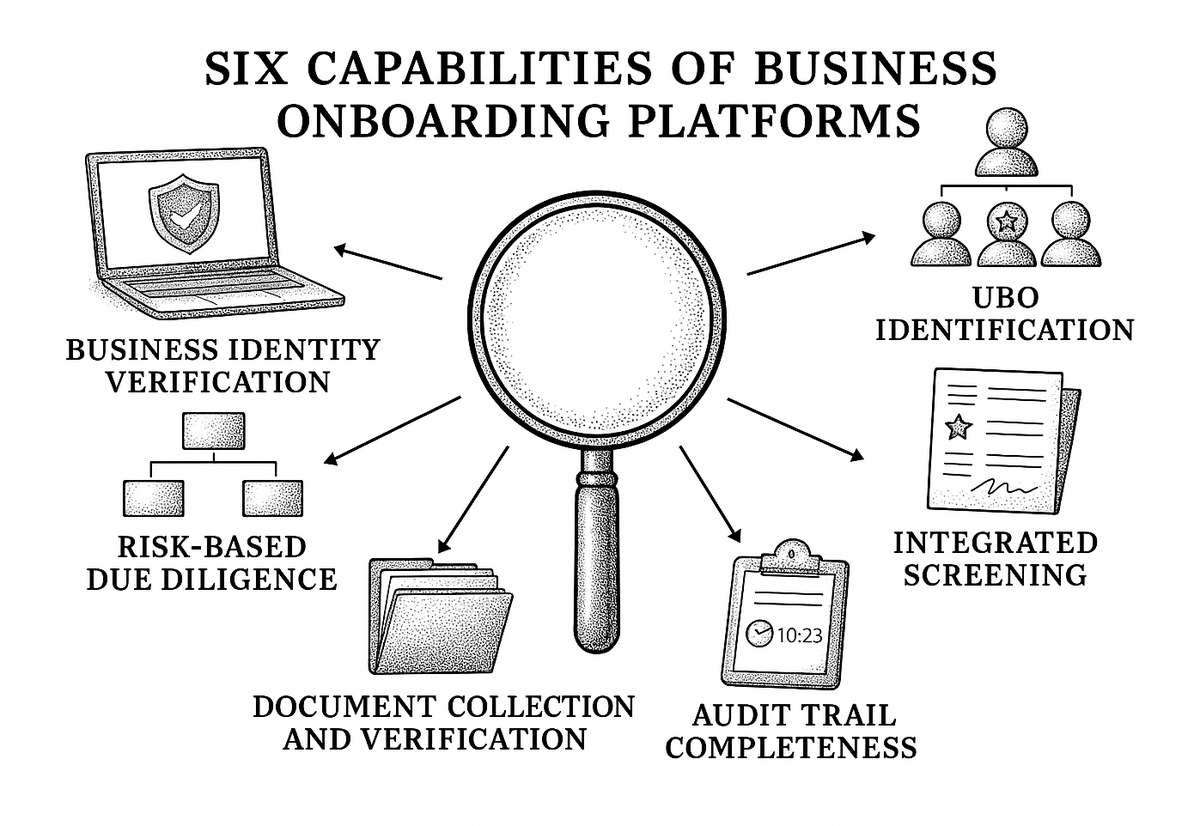
Six capabilities separate effective business onboarding platforms from tools that digitize manual workflows without actually automating them.
Business identity verification. The platform should verify business registration, tax identification, and operating status by pulling directly from primary sources — Secretary of State databases, IRS records, company registries across jurisdictions. Platforms that rely on aggregated third-party data introduce verification lag and coverage gaps.
UBO identification and mapping. Ultimate beneficial ownership identification requires tracing ownership chains through multiple entity layers. The best platforms automate this mapping — resolving ownership percentages through holding companies, trusts, and nominee structures to identify the individuals who ultimately control the entity. Manual UBO mapping is where onboarding timelines balloon from days to weeks.
Integrated screening. Every entity and individual in the ownership structure needs to be screened against sanctions lists, PEP databases, and adverse media sources. This screening must run at onboarding and on an ongoing basis as lists update. Platforms that separate onboarding verification from ongoing screening create operational gaps and audit trail fragmentation.
Risk-based due diligence workflows. Not every business requires the same level of scrutiny. A domestic retail business presents a different risk profile than a cross-border money services business. The platform should support configurable risk scoring that determines whether a business qualifies for simplified due diligence or requires enhanced due diligence — automatically routing to the appropriate workflow without manual triage.
Document collection and verification. Business onboarding involves collecting and verifying articles of incorporation, operating agreements, board resolutions, proof of address, financial statements, and identity documents for beneficial owners. Platforms that automate document collection, extraction, and verification against primary sources reduce the back-and-forth that slows onboarding.
Audit trail completeness. Every decision in the onboarding process — verification results, screening outcomes, risk scores, due diligence determinations, approval or rejection rationale — must be timestamped and stored in an immutable audit trail. When an examiner reviews an account opening, the institution must demonstrate that the process was followed and the decisions were documented.
How Leading Platforms Compare
Middesk specializes in business identity verification with direct access to Secretary of State databases, IRS records, and other primary sources. Automated UBO identification and verification is a core strength. Self-serve onboarding makes it accessible to growth-stage companies. Middesk focuses specifically on business verification — it does not provide transaction monitoring or case management.
Alloy operates as an identity decisioning platform, orchestrating data from 190+ sources into automated workflows. The no-code workflow builder lets compliance teams configure decisioning rules without engineering support. Alloy handles both consumer and business onboarding, making it a fit for institutions that want a single orchestration layer. The trade-off is that transaction monitoring capabilities are less sophisticated than purpose-built AML platforms.
Sumsub provides global coverage across 220+ countries with document verification supporting 14,000+ document types. KYB capabilities include business verification, UBO discovery, and integrated sanctions screening. Travel rule compliance for crypto businesses adds relevance for institutions operating across traditional and digital asset channels.
NICE Actimize covers business onboarding as part of its full financial crime lifecycle suite. The breadth is comprehensive — CDD, KYB, screening, monitoring, and reporting in a single platform. The trade-off is implementation complexity. Deployment timelines stretch to 12-18 months, and enterprise pricing starts above $500,000 annually. This is a fit for tier-one banks, not growth-stage fintechs.
Duna transforms KYB with intuitive, no-code workflows and design-thinking principles. Supporting over 210 integrated registries, it delivers identity verification, AML screening, and e-signatures in a conversion-optimized flow. Duna focuses on making the onboarding experience fast for the business being onboarded — not just for the compliance team processing it.
Where the Bottleneck Actually Is
Most business onboarding delays are not caused by verification technology. They are caused by the manual work that sits between verification and approval.
A platform can verify a business entity in minutes. But if the risk assessment requires an analyst to review the UBO structure, cross-reference screening results, evaluate the business type against internal risk appetite, and document the rationale — that review takes hours. For complex entities requiring EDD, the review can take days.
This is where automation of the review process — not just the data collection — becomes the critical capability. Platforms that automate evidence assembly, risk narrative generation, and disposition recommendations reduce the time between data gathering and decision. The institutions clearing onboarding backlogs fastest are the ones that automate the analyst workflow, not just the data inputs.
Where Sphinx Fits
Sphinx automates the compliance review layer of business onboarding. Agents review KYB verification results, evaluate screening hits, assess risk profiles, and document decisions — inside the tools compliance teams already use. Alviere automates 86% of compliance cases, including onboarding reviews. The approach works alongside existing verification platforms rather than replacing them — addressing the review bottleneck that determines how fast a business actually gets approved.
Frequently Asked Questions
What is business onboarding software?
Business onboarding software automates the process of verifying business entities during account opening. It covers business identity verification, beneficial ownership identification, sanctions and PEP screening, risk scoring, document collection, and audit trail documentation. Modern platforms reduce onboarding timelines from weeks to hours while meeting KYB, CDD, and BSA regulatory requirements.
What is the difference between KYC and KYB in onboarding?
KYC (Know Your Customer) verifies individual identities. KYB (Know Your Business) verifies business entities — including legal existence, registration status, ownership structure, and beneficial owners. KYB is more complex because it requires tracing ownership through multiple entity layers and screening every person and entity in the structure.
How long does business onboarding take with automation?
With modern platforms, verification data can be collected and compiled in minutes. The total onboarding timeline depends on the risk profile — simplified due diligence cases can complete in hours, while enhanced due diligence for complex ownership structures may still require days. The largest time savings come from automating the analyst review process, not just the data collection.
What regulations govern business onboarding for financial institutions?
Key regulations include FinCEN's CDD Rule (beneficial ownership identification for legal entity customers), the BSA's AML program requirements, FATF Recommendation 10 (risk-based CDD), the EU's AML directives (ongoing monitoring obligations), and jurisdiction-specific requirements. The trend across all regulatory frameworks is toward risk-based, effectiveness-driven programs.
Can business onboarding software handle complex ownership structures?
Leading platforms automate UBO mapping through multi-layered corporate structures — resolving ownership percentages through holding companies, trusts, and nominee arrangements. The OFAC 50% rule requires aggregating ownership across complex structures, which manual processes frequently miss. Automated UBO mapping is where the largest accuracy and efficiency gains occur.
.png)