

TL;DR: The best transaction monitoring software in 2026 combines adaptive detection, contextual risk scoring, and workflow automation to surface genuine suspicious activity instead of burying analysts in noise. With false positive rates still running 90-95% across the industry, the platforms that matter are the ones that reduce alert volume without sacrificing detection coverage. This guide ranks nine leading transaction monitoring platforms, explains what separates them, and provides a framework for choosing the right one.
What to Look for in Transaction Monitoring Software
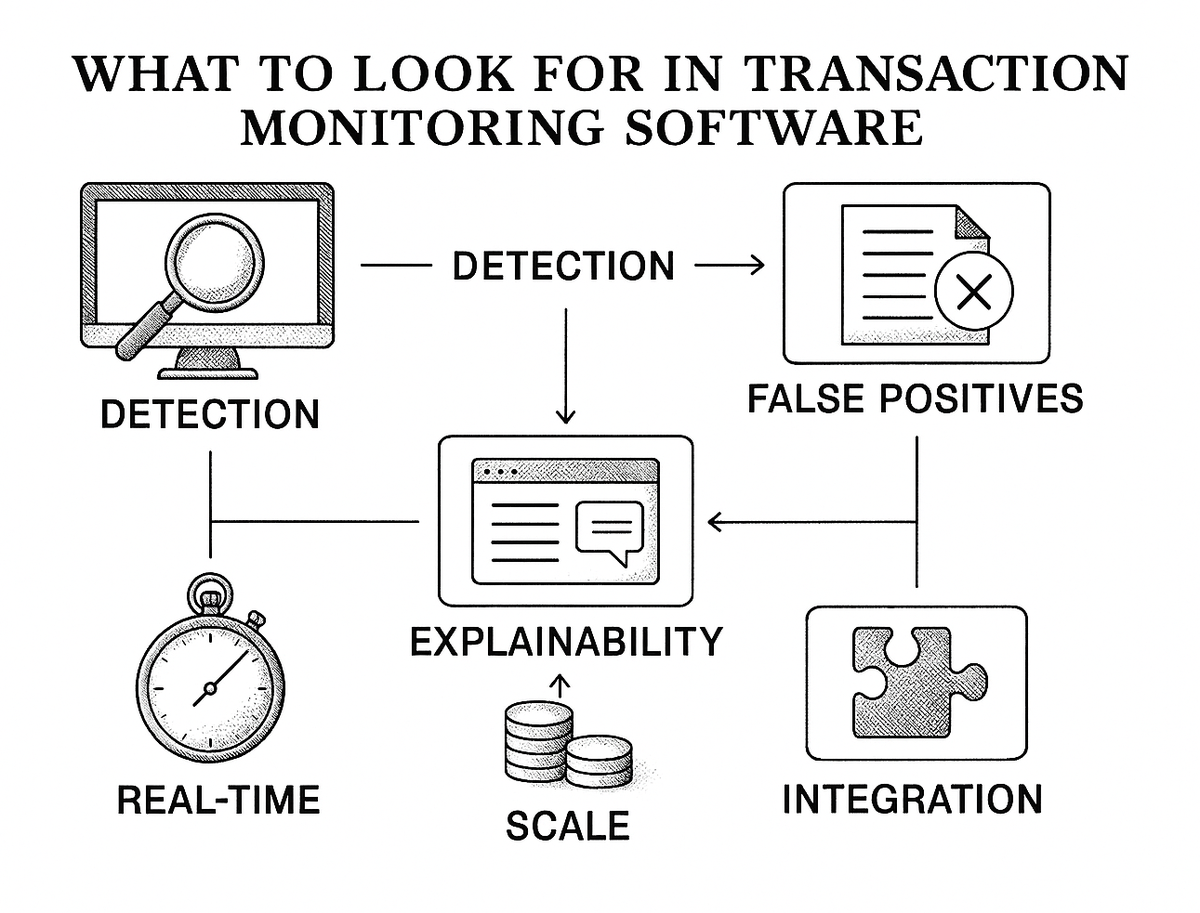
Transaction monitoring software analyzes customer transactions, behaviors, and patterns to identify activity that may indicate money laundering, terrorist financing, or other financial crimes. Unlike one-time screening checks, transaction monitoring is continuous and post-transactional. It watches for structuring, layering, rapid movement of funds, and deviations from established customer baselines. The software generates alerts when activity crosses predefined thresholds or deviates from expected patterns.
Six capabilities separate platforms that strengthen compliance operations from those that simply generate more work. Detection accuracy measures whether the system identifies genuine suspicious activity across the full range of money laundering typologies, from structuring and smurfing to trade-based laundering and funnel accounts. False positive management determines whether analysts spend their time investigating real risk or closing alerts that never warranted review. The transaction monitoring market is projected to reach $48 billion by 2031, growing at a 15.7% CAGR, driven largely by institutions seeking platforms that reduce this operational drag.
Real-time versus batch processing affects how quickly suspicious activity is flagged. With instant payment rails like FedNow expanding rapidly, batch-only systems leave a growing window where risk goes unmonitored. Scalability matters because transaction volumes scale faster than headcount. A platform that works at 10,000 transactions per day but degrades at 10 million creates a compliance gap as the institution grows. Explainability has become a regulatory expectation, not a feature request. Forrester's 2026 research on financial crime management highlights that regulators increasingly expect institutions to explain the reasoning behind automated decisions, not just the outcomes. And integration model, whether the platform replaces existing infrastructure or layers on top of it, determines implementation timeline, cost, and operational disruption.
Best Transaction Monitoring Software in 2026
The following platforms represent the leading options across different institutional profiles. Each evaluation covers core capabilities, strengths, limitations, and ideal fit. Rankings reflect a combination of detection quality, technology differentiation, operational impact, and suitability for modern compliance operations.
1. Sphinx
Sphinx sits at the top of this list not because it replaces the detection engines below, but because it solves the problem those engines create: more alerts than any compliance team can review. Sphinx works best paired with one of the transaction monitoring platforms below — it handles the alert triage and investigation layer while the TMS handles detection.
Sphinx approaches transaction monitoring differently from every platform on this list. Rather than replacing an institution's existing TMS, Sphinx deploys autonomous AI agents that operate at the alert triage and investigation layer, the stage where compliance teams spend the vast majority of their time and budget. The agents log into the same platforms analysts use, review alerts using the same data, cross-reference transaction records, customer profiles, and external risk intelligence, assess each case, and document findings with full reasoning chains. No API integration with the underlying TMS is required.
The results are measurable across a growing customer base. Sphinx clients report 87% fewer false positives reaching human reviewers, 98% of cases resolved same-day, and an 80% reduction in case review time. Named customers including Equals Money, Alviere, Conduit, Wert, FV Bank, and Synctera have deployed Sphinx agents across transaction monitoring and screening workflows. One customer cleared a six-month alert review backlog in two days. Every disposition is logged with an auditable trail explaining what data the agent examined, what logic it applied, and what conclusion it reached. SOC 2 Type II certified and GDPR compliant, with Y Combinator backing.
Sphinx does not replace the detection engine itself. It does not generate the initial alerts, maintain its own detection rules, or process raw transactions. It operates at the investigation and disposition layer where analyst labor concentrates. Teams that need a better detection engine should evaluate the platforms below. Teams whose detection engine generates more alerts than their analysts can review, which describes most compliance operations today, should evaluate Sphinx alongside or on top of their existing TMS.
Best for: Compliance teams drowning in alerts who need faster, auditable case resolution without replacing existing systems. Deployment: SaaS, works with existing TMS. Pricing: SaaS subscription.
2. NICE Actimize
NICE Actimize remains the default transaction monitoring platform for Tier 1 global banks. Its Suspicious Activity Monitoring platform, SAM, provides entity-centric detection across the full AML lifecycle, covering customer due diligence, transaction monitoring, sanctions screening, and regulatory reporting. Over 1,000 organizations across more than 70 countries use Actimize, and the platform processes billions of transactions daily across its global client base. In June 2026, DNB Bank ASA, Norway's largest financial services group, selected the X-Sight Enterprise platform to modernize its entire financial crime operation.
SAM's multi-layered detection architecture combines traditional rule-based scenarios with machine learning models for anomaly detection, network risk analytics, and predictive alert scoring. The Advanced Anomaly Detection module uses multivariate ML models to identify behavioral anomalies by comparing activity to both historical patterns and peer groups across all segments. Network analytics detect suspicious relationships and transaction patterns between counterparties. The ActimizeWatch managed analytics service extends the platform's capabilities by running continuous model optimization in the cloud, using consortium benchmarking data from similar institutions to refine detection without requiring on-premise data science resources.
The trade-off is complexity and cost. Implementation timelines for full SAM deployments typically stretch to 12-18 months. Enterprise pricing generally starts above $500,000 annually for mid-size institutions and can run significantly higher for global deployments. The platform carries technical debt from decades of acquisitions, and its innovation pace on cloud-native capabilities lags newer competitors. For institutions that need proven, regulator-tested infrastructure at enterprise scale, NICE Actimize delivers. For those prioritizing speed to value, the overhead may not justify the investment.
Best for: Tier 1 global banks with complex multi-jurisdictional requirements. Deployment: On-premise, cloud (X-Sight Enterprise), hybrid. Pricing: Enterprise custom, $500K+ annually.
3. SAS Anti-Money Laundering
SAS provides transaction monitoring as part of its broader financial crime compliance suite, built on the SAS Viya analytics platform. The system gives organizations with established data science teams the deepest customization of any platform on this list. Behavioral tuning, advanced scenario modeling, and visual analytics enable compliance teams to build, test, and deploy detection models tailored to their specific customer base and risk profile. Model governance capabilities are mature, with full experiment tracking, champion/challenger model management, and drift monitoring built into the platform.
SAS's strength lies in analytics flexibility. Institutions can develop proprietary ML models using their own transaction history, customer profiles, and risk data. These models feed richer signals into both the alert queue and investigation context. The platform supports both real-time and batch processing modes, with alert enrichment that surfaces contextual information at the point of investigation. Scenario management tools allow compliance officers to configure, test, and version detection rules with documented governance trails. SAS also maintains strong regulatory reporting templates for FinCEN, FCA, and other jurisdictional requirements.
The platform assumes the institution has the technical depth to use it. Organizations without dedicated data science teams will struggle to extract value from SAS's analytics capabilities. Deployment complexity is high, implementation timelines are long, and the total cost of ownership including internal staffing often exceeds the licensing cost. For large enterprises with analytics teams that want maximum control over detection models and governance, SAS delivers capability that few platforms match. For institutions seeking turnkey simplicity, it is the wrong fit.
Best for: Large enterprises with internal data science teams seeking maximum analytics control. Deployment: On-premise, cloud (SAS Viya). Pricing: Enterprise custom.
4. Feedzai
Feedzai's RiskOps platform operates at the intersection of fraud detection and AML transaction monitoring, making it particularly strong for institutions seeking converged financial crime management. The platform processes over 120 billion events per year and secures more than $9 trillion in payments annually across its client base. Celent named Feedzai a leader in its fraud prevention and AML transaction monitoring evaluations, recognizing the platform's ability to unify risk scoring across fraud and compliance workflows.
Real-time payment processing is Feedzai's core strength. The platform evaluates transactions as they occur using ML models trained on behavioral, transactional, and device-level signals. Segment-of-one profiling builds a 360-degree behavioral baseline for each individual customer, enabling precise anomaly detection that goes beyond peer-group comparisons. Explainable AI outputs provide analysts with clear reasoning behind each risk score. The platform supports omnichannel monitoring across cards, account-to-account payments, and digital banking channels, with integrated case management for unified investigation workflows.
Feedzai's primary limitation is that its AML transaction monitoring capabilities are less mature than its fraud detection strengths. Institutions with complex, multi-jurisdictional AML programs may find the AML-specific scenario coverage less comprehensive than dedicated AML platforms like NICE Actimize or SAS. The FRAML convergence trend benefits Feedzai's positioning, but organizations evaluating it strictly as an AML transaction monitoring tool should assess scenario coverage against their regulatory obligations carefully.
Best for: Institutions processing real-time payments seeking converged fraud and AML monitoring. Deployment: Cloud-native, SaaS. Pricing: Enterprise custom.
5. Hawk AI
Hawk AI has emerged as the leading cloud-native transaction monitoring platform for mid-market banks and fintechs seeking to modernize without enterprise-grade complexity. Built in Germany and deployed globally, Hawk's platform combines traditional rules with explainable AI across AML transaction monitoring, payment screening, fraud detection, and customer risk rating. Celent awarded Hawk its Advanced Technology distinction in financial crime compliance, recognizing the platform's AI-first approach to detection and investigation.
The platform's architecture processes billions of transactions in real-time using a containerized microservices infrastructure on Kubernetes with Apache Kafka for reactive communication. Average response times of 150 milliseconds support real-time payment interdiction across all payment rails through a single, rail-agnostic API. The AI layer analyzes all transactions, not just rule-triggered ones, identifying common root causes for false alerts and informing triage of similar cases. Hawk reports a 70% or greater reduction in false positives across its client base. Self-serve rule management, production data sandbox testing, and automated model governance give compliance teams direct control without depending on vendor professional services.
Hawk's multi-tenant infrastructure supports different business units and regional regulations within a single deployment, a significant advantage for institutions operating across jurisdictions. Limitations include a smaller client base compared to established enterprise vendors, which can matter during regulatory examinations where examiners look for proven deployments. The platform is relatively newer in the North American market compared to its European footprint. For mid-market banks and fintechs that want modern, explainable AI-driven monitoring without the overhead of legacy enterprise platforms, Hawk delivers a compelling combination of capability and operational simplicity.
Best for: Mid-market banks and fintechs seeking cloud-native, explainable AI monitoring. Deployment: SaaS, private cloud. Pricing: SaaS subscription.
6. ComplyAdvantage
ComplyAdvantage provides transaction monitoring as part of its broader AML platform, anchored by proprietary, AI-sourced risk intelligence that updates within minutes of new designations. Backed by $145 million in Series C funding, the platform has scaled rapidly across the fintech and digital banking segments. The Mesh transaction monitoring product, launched in late 2025, extends the core screening and data capabilities into behavioral detection with AI-driven relationship clustering and no-code rule building.
The API-first architecture makes ComplyAdvantage the fastest platform to deploy for institutions building compliance programs on modern infrastructure. Sub-second API response times, a visual rule builder requiring no engineering resources, and continuous risk intelligence integrated directly into monitoring flows enable compliance teams to adjust thresholds and build new detection rules independently. Deployment timelines of two to four weeks are realistic for standard implementations. ComplyLaunch provides startup-friendly pricing with up to 12 months free for eligible companies. ComplyAdvantage reports a 60-80% reduction in false positives for ongoing monitoring and 33% faster remediation times.
The transaction monitoring capabilities are newer and less battle-tested than the core screening product. Institutions with complex, multi-jurisdictional AML programs may find the detection scenario library less comprehensive than dedicated enterprise platforms. Historical investigative profile depth is thinner compared to legacy data providers. For fintechs, neobanks, and digital-first payment providers that need fast deployment and API-native integration, ComplyAdvantage delivers. For institutions requiring deep scenario customization or regulatory defensibility built over decades, supplemental tools may be necessary.
Best for: Fintechs and neobanks seeking fast, API-first deployment with integrated screening and monitoring. Deployment: Cloud SaaS, REST API. Pricing: Volume-based, startup tiers available.
7. Verafin (Nasdaq)
Verafin, acquired by Nasdaq, dominates the North American community bank and credit union market with a consortium-based approach to transaction monitoring that no other vendor replicates at scale. Rather than monitoring each institution in isolation, Verafin's platform aggregates anonymized data across its network of financial institutions to build cross-institutional analytics. This consortium intelligence provides visibility into counterparty risk that individual institutions cannot develop alone, enabling detection of multi-bank money laundering flows that single-institution monitoring misses entirely.
The platform generates alerts based on advanced behavioral analytics rather than static rule triggers. Verafin's system evaluates a customer's deposit and withdrawal activity across channels, monitors for structuring patterns over extended periods, and uses consortium data to profile counterparties beyond the institution's own network. Low-risk counterparties identified through consortium analysis can proceed without triggering unnecessary alerts, reducing false positive volumes. Automated SAR functionality allows investigators to create pre-populated SARs at the click of a button, complete narratives, and queue them for overnight electronic submission directly to FinCEN. Watch list scanning runs nightly against OFAC, 314(a), and internally created lists.
Verafin's limitations are geographic and institutional. The platform is optimized for the North American market and the community banking segment. Larger institutions with complex global operations may find the scenario coverage and customization insufficient. The consortium model's value depends on network density, meaning institutions in regions with fewer Verafin clients get less counterparty intelligence. For North American community banks and credit unions seeking a purpose-built monitoring platform with unique consortium analytics and streamlined regulatory reporting, Verafin is difficult to beat.
Best for: North American community banks and credit unions. Deployment: Cloud SaaS. Pricing: Custom.
8. Unit21
Unit21 positions itself as the operations-first transaction monitoring platform for growth-stage fintechs that need to build and iterate compliance programs without pulling on expensive engineering resources. The platform combines no-code rule configuration, AI detection models, and graph-based analytics in an interface designed for compliance operations teams rather than data scientists. The no-code rule builder allows teams to create complex statistical models, configure custom filters, and deploy changes to production without writing code.
The backtesting and shadow mode capabilities are a particular strength. Compliance teams can test new rules and AI models against historical or live data, measure precision, and see a sample of generated alerts before deployment. This reduces the risk of deploying poorly tuned rules that generate alert floods. Graph-based rules enable detection of entity relationships and shared information patterns, useful for identifying money mule networks and coordinated structuring that conventional monitoring misses. Unit21 reports up to 85% false positive reduction across its client base. The platform also recently introduced an AI agent for FinCEN 314(a) match validation that automates identifier comparison, focusing analyst time on true hits.
Unit21's primary limitation is scale. The platform is designed for fintechs and mid-market institutions, not Tier 1 banks processing billions of transactions. Regulatory acceptance is growing but does not yet match the track record of established enterprise vendors during bank examinations. For growth-stage fintechs that need to stand up a transaction monitoring program quickly, iterate on rules without engineering bottlenecks, and scale compliance operations alongside business growth, Unit21 delivers exactly that.
Best for: Growth-stage fintechs needing no-code rule management and fast deployment. Deployment: Cloud SaaS, API-native. Pricing: SaaS subscription, custom.
9. Quantexa
Quantexa takes a fundamentally different approach to transaction monitoring by building its platform around entity resolution and network analytics rather than traditional rule-based alerting. The Decision Intelligence platform ingests data from multiple internal and external sources, resolves entities across those datasets, and constructs dynamic network graphs that reveal hidden connections between individuals, organizations, and transactions. This contextual intelligence layer sits either on top of or alongside existing transaction monitoring infrastructure.
The platform's strength is uncovering complex, multi-layered financial crime that rule-based systems miss. Trade-based money laundering, shell company networks, and cross-institutional layering schemes involve relationships and patterns that only emerge when data is connected across sources. Quantexa's graph-based approach identifies these patterns by mapping the relationships between entities, not just the transactions between accounts. For investigations, this context dramatically accelerates the time to understand a case. The platform supports both batch and real-time processing and has been deployed at some of the world's largest banks including HSBC.
Quantexa is less a standalone transaction monitoring platform and more a contextual intelligence layer that enhances existing monitoring infrastructure. Institutions evaluating it as a direct replacement for traditional TMS may find that it addresses detection gaps rather than replacing the full monitoring workflow. Implementation requires significant data integration effort, as the platform's value depends on the breadth and quality of data it can resolve across. For institutions managing complex, opaque financial networks where traditional monitoring leaves blind spots, Quantexa provides detection capabilities that no rule-based system can match.
Best for: Large institutions with complex entity networks needing advanced contextual intelligence. Deployment: Cloud, on-premise, hybrid. Pricing: Enterprise custom.
How to Choose the Right Transaction Monitoring Platform
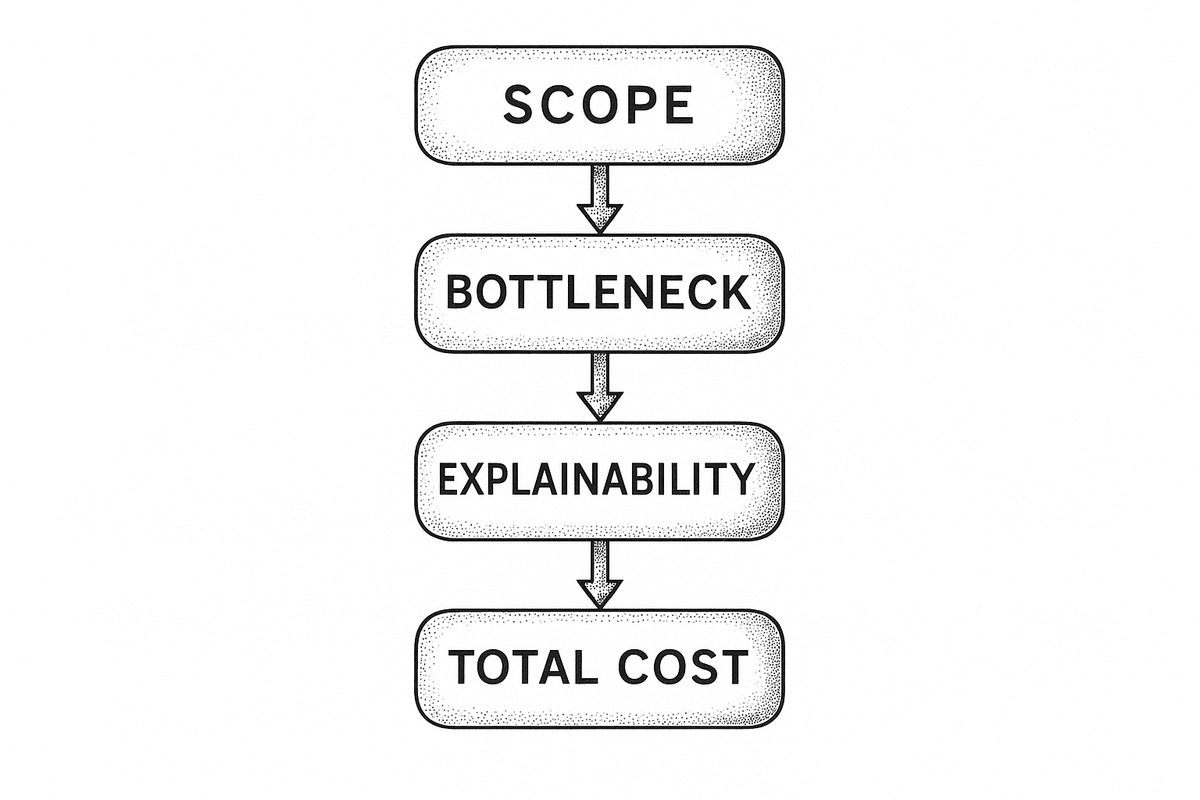
Selecting transaction monitoring software is an infrastructure decision that shapes compliance operations, detection effectiveness, and operational costs for years. The right framework starts with four questions that narrow the field before feature comparisons begin.
What does your institution actually need to monitor?
A fintech processing peer-to-peer payments faces different monitoring requirements than a correspondent bank handling cross-border wires. Payment rail coverage, transaction types, customer segmentation needs, and jurisdictional obligations define the detection scope. Enterprise platforms like NICE Actimize and SAS cover the broadest range of scenarios. Focused platforms like Hawk AI and Unit21 deliver faster value for institutions with well-defined monitoring needs. Matching the platform to the monitoring scope avoids paying for detection scenarios the institution does not use while ensuring coverage where it matters.
Where is the operational bottleneck?
If detection accuracy is the primary gap, investing in a stronger detection engine like NICE Actimize, SAS, or Quantexa makes sense. If false positive volume is overwhelming the team, platforms with strong AI-driven triage like Hawk AI, Feedzai, or Sphinx address the bottleneck directly. If integration friction with existing infrastructure is the constraint, API-first platforms like ComplyAdvantage and Unit21 remove that obstacle. Most institutions discover that their bottleneck is not detection, it is the investigation workload generated by what the detection engine finds. Teams that reduce alert review time at the triage layer often see greater operational gains than those who replace the detection engine entirely.
Does the platform explain its decisions?
Explainability is no longer optional. Regulators expect institutions to document why an alert was generated, how it was investigated, and what reasoning supported the disposition. Any AI-driven platform that reduces false positives but cannot explain how it reaches its conclusions creates a different kind of regulatory risk. Hawk AI's explainable AI framework, Sphinx's interpretable agentic approach, and Feedzai's transparent risk scoring all address this requirement directly. Black-box automation that works in production but fails under examination is a liability, not an asset.
What does total cost of ownership look like?
Licensing fees represent a fraction of total cost. Enterprise platforms like NICE Actimize and SAS carry implementation costs that can exceed the first year of licensing, plus ongoing requirements for dedicated compliance technology staff. Cloud-native platforms like Hawk AI and Unit21 reduce infrastructure overhead but may require workflow adjustments. Overlay solutions like Sphinx add capability without replacing existing infrastructure, which eliminates migration cost entirely. Evaluate total cost over a three-year horizon including implementation, integration, staffing, and ongoing tuning.
Frequently Asked Questions
What is transaction monitoring software?
Transaction monitoring software continuously analyzes customer transactions, behaviors, and patterns to identify activity that may indicate money laundering, terrorist financing, or other financial crimes. The software generates alerts when activity crosses predefined thresholds or deviates from established customer baselines. Financial institutions are required by BSA/AML regulations to maintain transaction monitoring programs, and the software is the primary technology that enables this obligation at scale.
Why are false positive rates so high in transaction monitoring?
False positive rates in traditional rule-based transaction monitoring systems run between 90 and 95%, meaning fewer than one in ten alerts represents genuinely suspicious activity. This occurs because static rules apply fixed thresholds without customer context, transaction history, or behavioral baselines. A $9,000 cash deposit triggers a structuring alert regardless of whether the customer regularly deposits similar amounts. AI-driven platforms reduce false positives by incorporating contextual signals, but meaningful reduction requires cleaner data foundations, contextual detection models, and investigation workflow automation working together.
What is the difference between real-time and batch transaction monitoring?
Batch transaction monitoring processes accumulated transactions at scheduled intervals, typically overnight or several times per day. Real-time monitoring evaluates each transaction as it occurs, scoring risk before settlement completes. With instant payment rails like FedNow growing rapidly, real-time monitoring is becoming essential because batch processing leaves a window where suspicious transactions have already settled before they are flagged. Most modern platforms support both modes, but institutions should verify real-time capability if they process instant payments.
Can transaction monitoring software replace compliance analysts?
No. Transaction monitoring software generates alerts and, with AI capabilities, can prioritize and enrich those alerts. But regulatory frameworks require human oversight of suspicious activity determinations, SAR filing decisions, and escalation judgments. The practical role of automation is not to replace analysts but to ensure they spend their time on cases that genuinely require expertise rather than clearing false positives. Platforms like Sphinx automate the investigation and disposition of routine alerts while routing complex cases to human reviewers with full evidence packages.
How long does it take to implement transaction monitoring software?
Implementation timelines vary dramatically by platform and deployment model. Enterprise platforms like NICE Actimize and SAS typically require 12 to 18 months for full deployment. Cloud-native platforms like Hawk AI and Unit21 can go live in weeks to a few months. API-first platforms like ComplyAdvantage report deployment timelines of two to four weeks for standard implementations. Overlay solutions like Sphinx that work with existing systems can be operational within days. The key variables are data integration complexity, scenario customization requirements, and internal approval processes.
.png)