

TL;DR: Compliance case management software centralizes how financial institutions investigate alerts, track cases, and file regulatory reports. The compliance case management software market reached $3.8 billion in 2025 and is growing at 11.2% CAGR, driven by FinCEN's shift toward effectiveness-based AML programs. The right platform reduces case closure time, enforces consistent investigation workflows, and produces the audit trail regulators now expect.
What Compliance Case Management Software Does
Compliance case management software is the operational layer between alert generation and regulatory reporting. When a transaction monitoring system, sanctions screen, or fraud detection model fires an alert, that alert becomes a case. Case management software governs what happens next: who investigates, what evidence gets gathered, how decisions get documented, and whether the outcome is a SAR filing, an escalation, or a closure with documented rationale.
The category covers a wide range of implementations. Some platforms focus narrowly on investigation workflows and regulatory filing. Others bundle case management with adjacent capabilities like screening, transaction monitoring, and customer due diligence. The distinction matters because a compliance team evaluating software needs to know whether it is buying a standalone investigation tool or an end-to-end compliance platform with case management built in.
At a minimum, compliance case management software handles five functions: alert intake and routing, investigation workflow management, evidence collection and documentation, regulatory report generation (SARs, STRs, CTRs), and audit trail preservation. Platforms that fall short on any of these five create gaps that surface during regulatory examinations.
Why It Matters Now
Three forces are converging to make case management a higher-priority investment than it was even two years ago.
Regulators are measuring effectiveness, not activity
FinCEN's proposed AML/CFT program rule, published in April 2026, shifts the standard from process-driven compliance to outcome-based effectiveness. Programs must be "reasonably designed, risk-based, and effective," with formal risk assessments that tie controls, monitoring, staffing, and reporting together. The rule requires institutions to demonstrate that their programs actually detect and report illicit finance, not just that they checked the right boxes. Case management is where that proof lives. Every alert disposition, escalation decision, and SAR filing flows through the case management system, and the quality of SAR narratives depends directly on how well case data is organized.
Alert volumes keep climbing
According to Dataintelo's 2025 market report, the BFSI sector accounts for 35.7% of compliance case management software revenue, reflecting the scale of the alert processing burden in financial services. False positive rates in rule-based transaction monitoring still range between 85% and 95%. Each false positive still requires a documented investigation. An institution generating 5,000 alerts per month that closes 90% as non-suspicious still needs to document 4,500 investigations with defensible rationale. Manual tracking in spreadsheets, email threads, and disconnected tools cannot sustain that volume without introducing gaps that examiners will find.
The market is growing fast
The compliance case management software market was valued at $3.8 billion in 2025 and is projected to reach $8.2 billion by 2033, growing at a CAGR of 11.2%. Cloud-based deployment now accounts for 62.4% of the market, reflecting a shift away from on-premises installations that require extensive IT involvement. The broader compliance software market reached $35.82 billion in 2025 according to Grand View Research, projected to hit $78.85 billion by 2033. Spending is following the problem.
What to Look for in a Platform
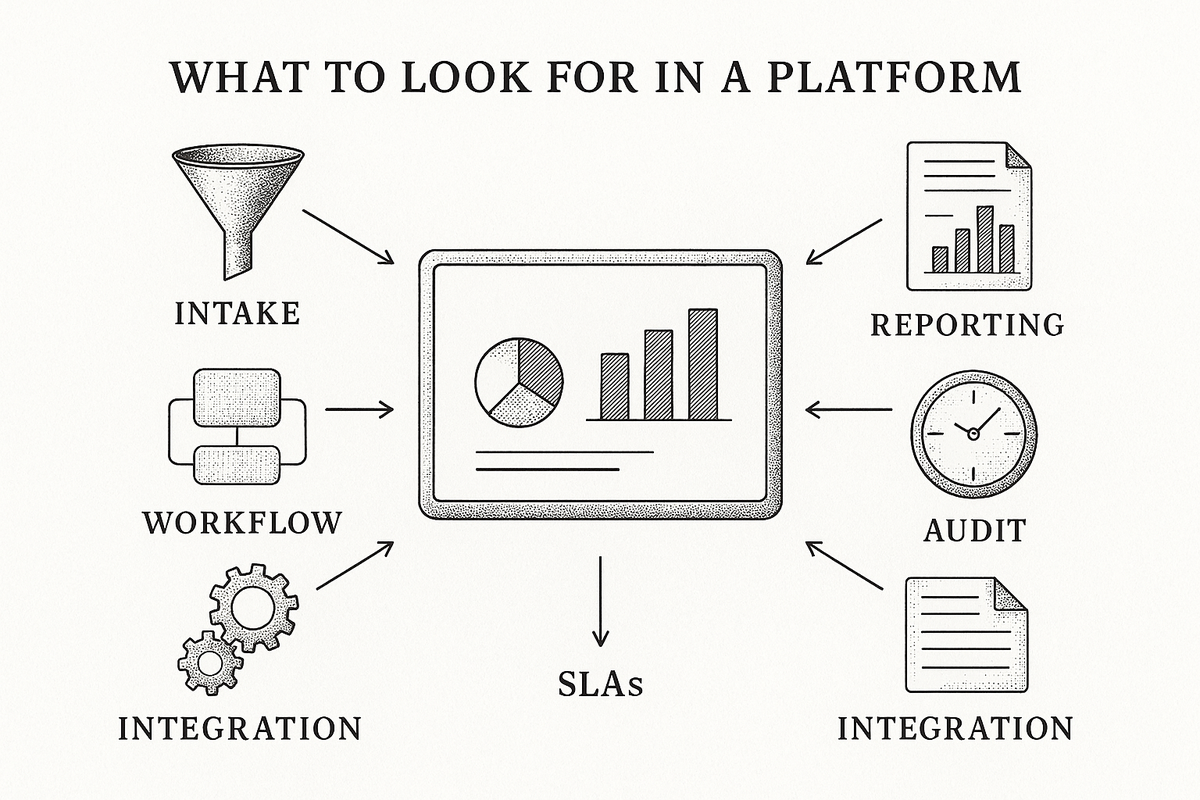
Vendor demos tend to showcase the same headline features: dashboards, workflow builders, and AI labels. The following evaluation framework separates platforms that solve the investigation problem from those that just organize it differently.
Alert intake and routing
The platform should ingest alerts from multiple upstream sources: transaction monitoring systems, sanctions screening engines, fraud detection models, and internal referrals. Routing logic should assign cases based on risk level, alert type, analyst expertise, and workload balancing. Manual triage queues where a supervisor assigns every case create bottlenecks that grow linearly with volume.
Investigation workflow and evidence management
Investigators need every relevant data point in one view: the triggering alert, customer profile, transaction history, prior case outcomes, screening results, and supporting documentation. Platforms that require analysts to toggle between multiple systems to gather evidence add 15-30 minutes per case. Multiply that across thousands of cases per month and the cost compounds quickly. Configurable workflows should enforce consistent investigation steps across all analysts without requiring code changes.
Regulatory reporting
SAR, STR, CTR, and Form 8300 preparation should pull directly from case data. The strongest platforms auto-populate regulatory forms with transaction details, subject information, and supporting evidence gathered during investigation. Direct filing integrations with FinCEN reduce the gap between investigation completion and submission. Institutions filing thousands of SARs annually need reporting workflows that maintain quality at volume, and narrative quality is where most programs fall short.
Audit trail and defensibility
Every action taken on a case must be logged: who accessed it, what evidence was reviewed, what decisions were made, when, and why. This is not optional. FinCEN's proposed effectiveness rule and existing examination standards require institutions to demonstrate that investigation processes are consistent, timely, and documented. Platforms that treat audit logging as an afterthought rather than a core architectural feature create regulatory exposure that only surfaces during examinations.
SLA tracking and performance analytics
Case aging, resolution time, analyst throughput, escalation rates, and SAR conversion rates should be visible in real time. These metrics serve two purposes: operational management and regulatory reporting. Examiners increasingly ask for program performance data, and institutions that cannot produce it on demand signal weak oversight.
Integration with existing infrastructure
Most financial institutions already run transaction monitoring, KYC, and screening systems from established vendors. The case management platform needs to work with that stack, not replace it. API-based integration, support for standard data formats, and compatibility with core banking systems determine whether a deployment takes weeks or months.
The Best Compliance Case Management Software
1. Sphinx — Best for Automating the Investigation Layer at Scale
Sphinx operates at the investigation layer of compliance case management — the workflow between alert generation and regulatory filing where analyst labor concentrates. Sphinx's AI agents automate alert triage, evidence gathering, case summarization, and disposition documentation directly inside existing monitoring platforms. The agents do not replace the case management system — they do the investigation work within it, handling the 80-90% of cases that follow predictable patterns while routing genuinely complex cases to human analysts.
The results are specific and documented. Conduit cleared a six-month backlog of over 1,000 alerts in two days. Equals Money automated 87.3% of reviews and went live in one week with zero engineering work. Alviere achieved 98.7% false positive detection accuracy with 82 analyst hours saved per week and 86% of cases closed automatically. Across the portfolio, Sphinx reduces case review time by 80% and resolves 98% of cases same-day.
Every agent decision is logged through the Interpretable Agentic Framework, producing audit-ready outputs with documented reasoning that satisfies regulatory examination standards under SR 11-7. Sphinx is not a case management platform replacement — it is the investigation capacity layer that makes existing case management workflows faster, more consistent, and less dependent on headcount.
Deployment: Cloud (browser-native, no API required) · Pricing: Custom enterprise · Certifications: SOC 2 Type II; GDPR and CCPA compliant
2. NICE Actimize (ActOne) — Best for Tier 1 Global Banks
NICE Actimize's ActOne is the entity-centric case management platform within the Actimize financial crime suite, providing investigation workflows, evidence management, and regulatory reporting for the world's largest banks. In the Forrester Wave: Anti-Money Laundering Solutions, Q2 2025, Actimize received the highest scores possible across all 10 criteria in the Current Offering category. The platform is used by more than 1,000 organizations across 70+ countries, processing billions of transactions daily.
ActOne's strength is workflow continuity. Alerts generated by Actimize's transaction monitoring engine flow directly into case management, where investigators access the triggering alert, customer profile, transaction history, and screening results in a single view. SAR preparation pulls directly from case data, and regulatory reporting modules handle FinCEN filing. The entire lifecycle — detection, investigation, decision, and filing — happens in one system without data handoffs between vendors.
The trade-off is cost and lock-in. Actimize deployments at large banks routinely run into seven figures annually, and the full-suite approach means that replacing one component (say, transaction monitoring) often requires replacing the entire stack. Implementation timelines of 12-18 months are common, and the platform requires dedicated technical resources for ongoing tuning and maintenance. Mid-market institutions and fintechs will find the operational overhead disproportionate to their scale.
Deployment: Cloud (AWS) and on-premises · Pricing: Modular enterprise (seven figures for large banks) · Coverage: 70+ countries
3. Nasdaq Verafin — Best for Community Banks and Credit Unions
Verafin provides integrated AML case management with consortium intelligence drawn from more than 3,800 financial institutions representing over $11 trillion in assets. The consortium model is the core differentiator: when a community bank investigates a case, Verafin's platform provides context from across the network — whether similar entities have triggered alerts elsewhere, whether transaction patterns match known typologies observed at other institutions. This cross-institutional intelligence fills the data gap that makes investigation at small institutions particularly difficult.
The platform's investigation workflow is fully integrated: document upload, task assignment, decision tracking, audit trails, and regulatory reporting flow through a single cloud-based system. For community banks and credit unions that cannot justify the cost and complexity of enterprise case management platforms, Verafin provides examination-ready investigation infrastructure without requiring dedicated IT staff or multi-quarter implementation projects.
Verafin's limitation is its positioning. The platform is optimized for US community financial institutions and lacks the global coverage, multi-jurisdictional regulatory reporting, and complex entity resolution capabilities that international banks require. Institutions with significant cross-border operations, complex corporate client bases, or Tier 1 examination expectations will outgrow Verafin's scope. Nasdaq acquired Verafin for $2.75 billion in 2021, but the platform has maintained its community FI focus.
Deployment: Cloud only · Pricing: Custom; scaled to institution size · Coverage: Primarily US
4. SAS Anti-Money Laundering — Best for Advanced Analytics in Investigations
SAS AML is built on the SAS Viya cloud-native platform, with Visual Investigator providing configurable case management alongside advanced analytics, network visualization, and entity resolution. SAS was named a Leader in both the Forrester Wave: AML Solutions, Q2 2025 (receiving top marks in 10 of 18 evaluation criteria) and the Datos Insights Matrix for fraud and AML case management. SAS is the only vendor Forrester has named a leader in both AML solutions and AI/ML platforms — a relevant distinction for institutions that want their case management analytics grounded in a broader AI infrastructure.
The platform's investigative capabilities go beyond standard workflow management. SAS's generative AI tools automate SAR narrative generation, and the analytics engine improves regulatory report conversion rates 3-5x beyond conventional rule-based methods. Visual Investigator provides network visualization that shows entity relationships, transaction flows, and risk connections in a graphical interface — capabilities that matter for complex investigations involving multiple subjects and layered transaction chains. SAS maintains over 90% client retention, reflecting sticky enterprise deployments.
SAS's limitation is the enterprise orientation. The platform is built for large institutions with dedicated analytics and compliance technology teams. Community banks and mid-market fintechs will find the implementation requirements, licensing costs, and ongoing tuning burden disproportionate to their needs. The depth of SAS's analytical capabilities is a strength only if the institution has the staff to use them — otherwise, the platform becomes expensive infrastructure running below its potential.
Deployment: Cloud (SAS Viya) and on-premises · Pricing: Enterprise · Coverage: Global
5. Quantexa — Best for Entity Resolution-Driven Investigations
Quantexa combines entity resolution and network analytics to provide an investigation platform where cases include not just the triggering alert but the full context of an entity's relationships, ownership structures, and transaction networks. The platform connects fragmented data across internal systems and external sources to build a unified view of each entity — resolving name variations, linking associated addresses, and mapping counterparty relationships that standard case management tools miss.
A Forrester Total Economic Impact study found a 228% three-year ROI, driven by faster investigations and more accurate entity matching. Standard Chartered partnered with Quantexa to deploy contextual decision intelligence across its anti-financial crime operations spanning 40+ countries. Quantexa's Q Assist AI copilot provides contextual insights during case review — summarizing entity relationships, flagging risk indicators, and generating investigation narratives without requiring analysts to manually trace network connections.
Quantexa is an investigation intelligence platform, not a traditional case management workflow tool. It excels at the "understand the entity" layer of investigations but relies on integration with existing case management and regulatory filing systems for the workflow, assignment, and reporting functions. Institutions should evaluate Quantexa as a complement to their case management infrastructure rather than a replacement. The data integration requirements are also significant — Quantexa's value scales with the breadth of connected data sources, and institutions with fragmented or siloed data will face extended implementation timelines.
Deployment: Cloud and on-premises · Pricing: Custom enterprise · Coverage: Global (offices in London, New York, Boston, Singapore, Melbourne, Sydney)
6. Unit21 — Best for No-Code Investigation Workflows at Mid-Market Scale
Unit21 provides a no-code risk infrastructure platform that lets compliance teams configure investigation workflows, build detection rules, and manage cases without engineering support. The platform monitors 4.5 billion events monthly across 200+ institutions, has raised $137 million in total funding, and processes roughly 5% of all Suspicious Activity Reports filed in the United States — a notable market share for a company focused on the mid-market segment.
In March 2026, Unit21 relaunched as an "AI Risk Infrastructure" platform with agentic AI that handles investigation workflows end-to-end. The platform supports one-click SAR and CTR filing, reducing the gap between case disposition and regulatory submission. Sub-250ms decisioning enables real-time risk decisions at transaction time, and the no-code rule builder allows compliance teams to iterate on detection and investigation logic in hours rather than the weeks required by platforms that depend on vendor professional services for configuration changes.
Unit21's trade-off is enterprise depth. The platform is optimized for mid-market fintechs, neobanks, and payments companies that value speed and configurability over the deep regulatory framework coverage that Tier 1 banks require. Institutions with complex multi-jurisdictional requirements, legacy system integration needs, or conservative examiner expectations may find the platform's flexibility insufficient for their compliance architecture.
Deployment: Cloud only · Pricing: Custom · Coverage: Primarily US; expanding globally
7. Hawk AI — Best for Unified Fraud and AML Case Management
Hawk AI provides a unified FRAML (fraud + AML) case manager that consolidates fraud and money laundering investigations into a single workflow rather than maintaining separate investigation tracks. The platform's AML Investigative Agent automates evidence gathering and case preparation, and Hawk reports a 70% false positive reduction and up to $5 million in savings over five years according to a Celent analysis. Hawk was named a Strong Performer in the Forrester Wave: Anti-Money Laundering Solutions, Q2 2025, receiving above-average customer feedback and the highest possible scores in six criteria including watchlist management, screening, and innovation.
The FRAML convergence approach is Hawk's core differentiator. Rather than investigating a fraud alert in one system and an AML alert in another — potentially for the same customer — Hawk surfaces both in a unified case view with shared context. This matters operationally because fraud and money laundering patterns often overlap, and separate investigation tracks create blind spots where related activity goes unconnected. For institutions moving toward converged financial crime operations, Hawk eliminates the tool gap that slows that transition.
Hawk's limitation is market position. The platform is newer and smaller than incumbents like NICE Actimize, SAS, or Verafin, with fewer large-bank reference implementations. Institutions with conservative vendor evaluation criteria or heavy examiner scrutiny should weigh Hawk's FRAML capabilities and Forrester recognition against the vendor maturity risk that comes with a growing platform.
Deployment: Cloud · Pricing: Custom · Coverage: Global
8. Lucinity — Best for AI-Native Case Management with Explainable Outputs
Lucinity is an AI-native case management platform built around the principle that every automated investigation output must be interpretable by compliance analysts and defensible to regulators. The platform was recognized as a Representative Vendor in the 2025 Gartner Market Guide for Anti-Money Laundering, and its customers include Visa, Trustly, and Tandem Bank. Lucinity's generative AI copilot, "Luci," provides case visualization, investigation summarization, and contextual recommendations — every output includes the specific data points and behavioral signals that contributed to the assessment.
Lucinity's SAR Manager is a genuine differentiator. The platform connects directly to FinCEN, the UK's NCA, and GoAML jurisdictions via API for automated regulatory filing, and generates SAR narratives from case data. For jurisdictions without API filing, Lucinity produces pre-formatted XMLs for manual submission. This end-to-end coverage from case investigation through regulatory filing — with AI-generated narratives reviewed by humans before submission — closes a workflow gap that most case management platforms leave open.
Lucinity is headquartered in Iceland with a growing US and European presence, but its market footprint is smaller than established vendors. Institutions should assess implementation support capacity and the vendor's ability to scale with their growth. The platform's strength is AI explainability and regulatory reporting integration, not breadth of geographic coverage or pre-built detection scenarios — institutions with extensive custom detection requirements may need to invest in scenario development during implementation.
Deployment: Cloud · Pricing: Custom · Coverage: US, UK, EU (expanding)
9. Abrigo (BAM+) — Best for US Community Financial Institutions
Abrigo's BAM+ provides end-to-end AML case management purpose-built for community banks and credit unions. The platform integrates monitoring, case management, and regulatory reporting in a single workflow, with direct-file SARs and CTRs that eliminate the gap between investigation completion and FinCEN submission. Abrigo serves more than 2,400 financial institutions and BAM+ earned the 2025 FinTech Breakthrough Award for Best AML Solution.
In July 2026, Abrigo launched an agentic AI platform on AWS designed to bring enterprise-grade financial crime detection capabilities to community institutions. Institutions using BAM+ report 80% efficiency gains in compliance operations through better-calibrated risk scoring and automated investigation workflows. The platform is designed for compliance teams of 1-5 analysts — a size that is typical for community banks but too small for most enterprise case management platforms to serve cost-effectively.
BAM+ is US-focused and designed for institutions up to mid-market size. Banks with international operations, complex corporate client bases, or transaction volumes exceeding mid-market thresholds will need a platform with broader jurisdictional coverage and more configurable investigation workflows. Abrigo excels at making examination-ready AML programs accessible to smaller institutions — not at scaling to enterprise complexity.
Deployment: Cloud (AWS) · Pricing: Scaled to institution size · Coverage: US-focused
10. Flagright — Best for Automated Regulatory Filing Across Jurisdictions
Flagright is an AI-native platform with automated SAR filing to FinCEN and more than 70 GoAML jurisdictions, built for fintechs and digital banks that need case management embedded into their compliance stack rather than deployed as a standalone system. The platform serves 100+ regulated institutions and is aligned with FinCEN, FCA, MAS, and 35+ global regulatory frameworks. Flagright's API-first architecture enables deployment in days — no custom connectors or dedicated engineering teams required.
Flagright's automated filing capability is the core differentiator. The platform's direct FinCEN transmission system files SARs and CTRs without manual portal entries or CSV exports, and the 70+ GoAML jurisdiction coverage means fintechs operating across multiple regulatory environments can handle filing from a single platform. For institutions that currently manage jurisdiction-by-jurisdiction filing with dedicated compliance operations staff, this consolidation represents a significant operational efficiency gain. The platform also includes transaction monitoring, screening, and case management — a full AML stack, not just a filing tool.
Flagright's constraint is maturity. The company is younger and smaller than incumbents, with fewer large-bank reference customers and less track record with complex regulatory examinations. Institutions under heavy examiner scrutiny or with conservative vendor evaluation criteria should weigh Flagright's automation capabilities against the vendor risk. For early-stage fintechs and digital banks that prioritize speed to compliance, the trade-off may be acceptable; for regulated banks with established examination relationships, it warrants additional due diligence.
Deployment: Cloud (API-first) · Pricing: Custom · Coverage: Global (FinCEN, FCA, MAS, 35+ frameworks, 70+ GoAML jurisdictions)
Red Flags in Vendor Evaluations
Compliance software buying cycles are long and switching costs are high. A few patterns should trigger additional scrutiny during evaluation.
Platforms that cannot demonstrate audit trail completeness under examination conditions are a risk regardless of other capabilities. Ask for a sample audit export and review it against what your examiners expect to see. If the vendor hedges on this request, the product may not be examination-ready.
Beware of AI claims without governance. A platform that uses AI to auto-close alerts or draft SAR narratives but cannot explain how those decisions were made creates a model risk problem. SR 11-7 and emerging AMLA guidance both require automated decisions to be documented, testable, and subject to human override. Cutting investigation time while creating a governance liability is not a net improvement.
Implementation timelines that stretch beyond 90 days for a case management deployment should prompt questions about architectural complexity and integration requirements. Cloud-native platforms with API-first designs typically deploy faster than legacy on-premises installations, and the market data confirms the shift: 62.4% of deployments are now cloud-based.
Finally, pricing transparency matters. Some vendors quote per-seat licenses but charge separately for regulatory reporting modules, API access, data storage, and premium support. A platform that looks affordable at the license level but costs 3x more fully loaded is a common pattern in enterprise compliance software.
Frequently Asked Questions
What is compliance case management software?
Compliance case management software is the operational platform that governs how financial institutions investigate alerts, manage cases, and file regulatory reports. It handles alert intake and routing, investigation workflow management, evidence collection, SAR and STR preparation, and audit trail preservation. The platform sits between detection systems (transaction monitoring, screening) and regulatory obligations (FinCEN filings, examination readiness).
How much does compliance case management software cost?
Pricing varies widely by platform category and deployment scale. Entry-level SaaS platforms start around $99 per month for smaller operations, while enterprise deployments from vendors like NICE Actimize can run into seven figures annually including implementation, licensing, and support. Cloud-based platforms generally offer more transparent per-seat or per-case pricing. The total cost of ownership should factor in implementation time, integration effort, regulatory reporting modules, and ongoing support fees.
What is the difference between case management and transaction monitoring?
Transaction monitoring detects suspicious activity by applying rules and behavioral models to financial transaction data, generating alerts when thresholds or patterns are met. Case management is what happens after an alert fires: the investigation, evidence gathering, decision-making, and regulatory reporting process. Some platforms bundle both capabilities, while others specialize in one or the other. Institutions that replace their monitoring system but keep manual investigation workflows often see limited improvement in overall program effectiveness.
Do regulators require specific case management software?
Regulators do not mandate specific vendors or platforms. They require that compliance programs be reasonably designed, risk-based, and effective, with consistent investigation processes and defensible audit trails. FinCEN's proposed 2026 AML/CFT program rule explicitly evaluates whether monitoring, controls, and reporting are aligned with the institution's risk profile. Case management software is the primary mechanism through which institutions demonstrate that alignment during examinations.
Can AI replace human analysts in compliance case management?
AI can automate evidence gathering, alert triage, case summarization, and regulatory report drafting, reducing the time analysts spend on routine investigation tasks. It does not replace the human judgment required for complex cases, escalation decisions, and SAR filing approvals. The most effective deployments use AI to handle high-volume, repetitive investigation work while routing genuinely ambiguous or high-risk cases to experienced analysts. Regulatory expectations under SR 11-7 and emerging AMLA guidance require that automated decisions remain subject to human oversight and override.
.png)