

TL;DR: Financial crime prevention software is converging around unified platforms that merge AML, fraud, sanctions, and onboarding into a single risk layer. The global market hit $29.23 billion in 2026 and is growing at 11.4% CAGR. This guide covers what features to evaluate, how leading platforms compare, and where the market is headed.
Why Financial Crime Prevention Software Is Changing
The financial crime compliance market is projected to grow from $29.23 billion in 2026 to $69.52 billion by 2034, according to Fortune Business Insights. That growth reflects a structural shift in how institutions approach financial crime — not incremental upgrades to legacy stacks, but wholesale platform replacement.
Three forces are driving the change. First, instant payment rails like FedNow, Pix, and UPI have compressed decision windows from hours to milliseconds. Batch-based screening systems designed for next-day settlement cannot keep pace. Second, regulators are explicitly rewarding effectiveness over process. FinCEN's April 2026 proposed rule to reform AML/CFT programs shifts the focus to risk-based, outcome-driven compliance — institutions that direct resources toward higher-risk activity rather than treating every alert equally. Third, the convergence of fraud and AML (often called FRAML) means institutions need platforms that see across domains, not siloed tools that miss connections between a suspicious transaction and a fraudulent onboarding.
The result is a market moving away from point solutions toward unified financial crime platforms. According to Everest Group's 2026 Top 50 FCC research, leading providers are delivering shared data models, cross-domain risk detection, and entity-level intelligence across fraud, AML, sanctions, and onboarding in a single fabric.
Six Features That Define Modern Platforms
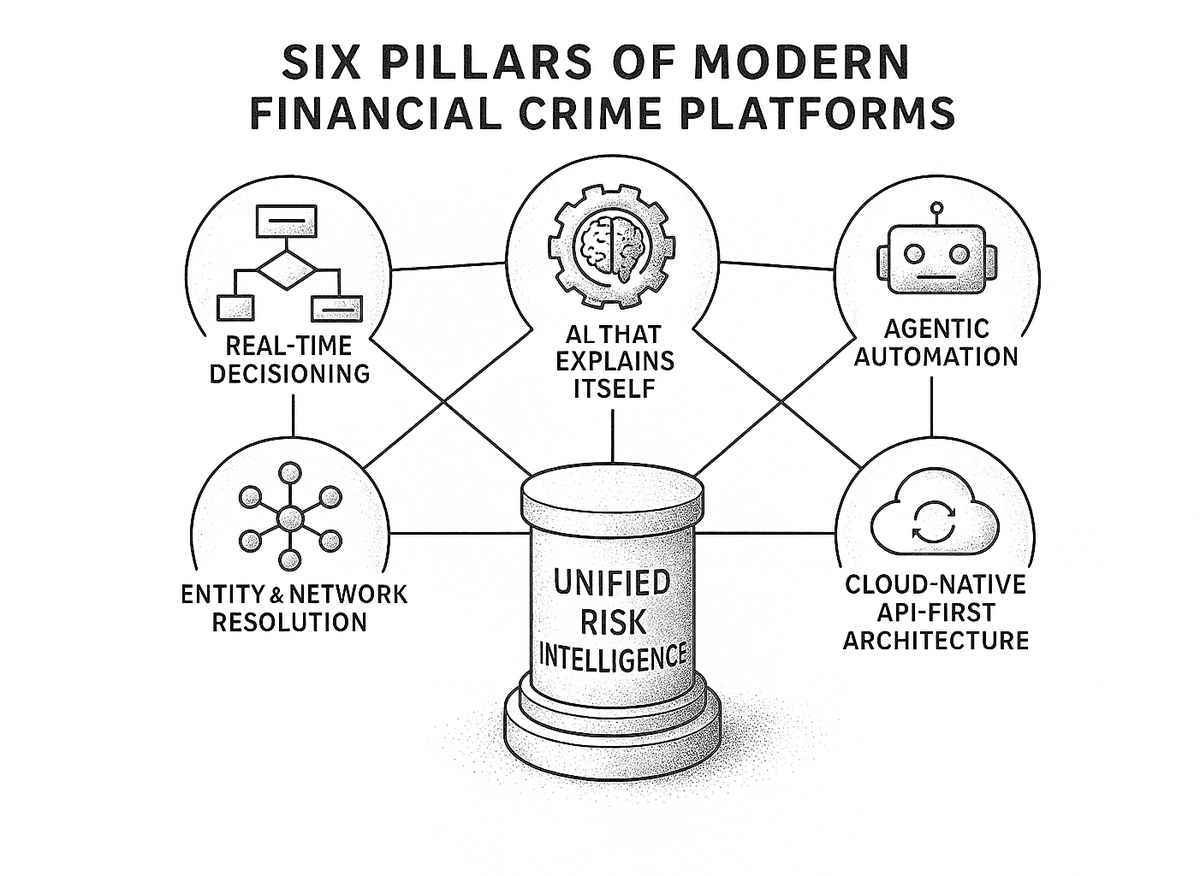
Not every financial crime prevention tool is built the same way. When evaluating platforms, these six capabilities separate modern systems from legacy compliance software.
Unified risk intelligence. The strongest platforms combine AML, fraud, sanctions screening, and onboarding verification into a shared data model. This means a suspicious onboarding pattern can inform transaction monitoring rules — and a sanctions hit can trigger enhanced due diligence across related entities — without manual handoffs between siloed systems.
Real-time decisioning. With instant payments now live in over 70 countries, financial crime systems need to screen, score, and decide at transaction speed. Look for platforms that support real-time interdiction at payment initiation alongside retrospective deep analytics for complex investigations. This dual-layer architecture — real-time plus batch — is becoming the baseline for modern programs.
AI that explains itself. AI adoption in financial crime is no longer experimental. Behavioral analytics, network graph intelligence, and automated case summarization are production-ready across multiple vendors. But the critical differentiator is explainability. Regulators expect institutions to demonstrate why a decision was made, not just what the decision was. Platforms that generate auditable reasoning — traceable from alert to disposition — will survive regulatory scrutiny. Those that operate as black boxes will not.
Agentic automation. The most advanced platforms now deploy AI agents that take operational actions: triaging alerts, drafting SAR narratives, resolving routine screening hits. This goes beyond copilot-style assistance into controlled execution. With it come new requirements around agent governance, authorization boundaries, and reversibility. The Interpretable Agentic Framework is one example of how vendors are addressing these concerns.
Entity and network resolution. Financial crime rarely involves isolated transactions. Effective platforms resolve entities across data sources — linking individuals, businesses, and accounts through ownership structures, shared addresses, and transaction patterns. Graph intelligence surfaces hidden relationships that rule-based systems miss entirely.
Cloud-native, API-first architecture. SaaS delivery lowers deployment timelines from months to weeks. API-first design allows compliance tools to embed directly into core banking, payments, and digital channel workflows. Cloud-native platforms also handle elastic scaling for real-time screening loads that would overwhelm on-premises installations.
How Leading Platforms Compare
The financial crime prevention market includes both enterprise incumbents and AI-native challengers. Each approaches the problem differently.
Enterprise incumbents like NICE Actimize, Oracle Financial Services, SAS, and FICO have decades of deployment history at the largest global banks. Their strength is comprehensive coverage — transaction monitoring, case management, sanctions screening, and regulatory reporting in integrated suites. NICE Actimize's Xceed platform, for example, now combines fraud and AML workflows with purpose-built AI agents for investigation support. The tradeoff: these platforms carry legacy architecture, longer implementation cycles, and pricing models designed for institutions with dedicated compliance technology teams.
Data-centric platforms like ComplyAdvantage and Refinitiv World-Check focus on screening data quality — curated sanctions lists, PEP databases, adverse media, and beneficial ownership records. ComplyAdvantage pairs real-time screening with configurable matching logic and false positive reduction. Refinitiv World-Check provides curated global entity records for onboarding and ongoing monitoring. These tools are strong for screening but often require separate systems for transaction monitoring and case management.
AI-native challengers represent the newest category. Platforms like Silent Eight, Strise, and Arva AI build around machine learning as core architecture rather than a bolt-on feature. Silent Eight has resolved over 100 million alerts with explainable AI. Strise emphasizes unified entity profiles powered by a proprietary data model. Arva automates up to 92% of AML, KYC, and KYB reviews. These platforms trade the breadth of enterprise suites for speed, automation depth, and lower false positive rates.
The right choice depends on institutional maturity, existing infrastructure, and which capabilities matter most. Large banks with entrenched systems may extend their enterprise platform. Fintechs and mid-market institutions often find more value in API-first, AI-native tools that deploy in weeks rather than quarters.
What the Regulatory Landscape Demands
Regulators are not just tolerating technology adoption — they are encouraging it. The U.S. Treasury's March 2026 congressional report on innovative technologies for countering illicit finance explicitly states that "well-governed technology is a force multiplier for combating illicit finance" and commits to supporting financial institutions' use of AI, digital identity, and blockchain analytics for compliance.
FinCEN's April 2026 proposed rule reinforces this direction. The rule distinguishes between program design failures and implementation deficiencies, raising the threshold for enforcement actions against institutions with properly established risk-based programs. The message: institutions that invest in effective, technology-enabled compliance will face less regulatory friction than those maintaining checkbox programs.
Globally, the FATF's fifth round of mutual evaluations — launched in 2024 — places stronger focus on effectiveness outcomes. The IFC's 2026 Good Practice Note found that 85% of surveyed stakeholders view new technologies as delivering the greatest benefit to AML/CFT, citing increased speed, flexibility, and improved governance. The shift toward real-time monitoring is no longer aspirational. It is what regulators expect.
Where Sphinx Fits
Sphinx operates as an AI-native compliance layer that deploys agents directly into existing workflows. Agents log into the same platforms analysts use — reviewing alerts, screening entities, filing SARs — and document every decision with a full audit trail. Customers like Equals Money have automated 87.3% of compliance reviews, while Conduit dispositions risk alerts 99% faster. No API integration required — Sphinx works inside the tools compliance teams already use.
Frequently Asked Questions
What is financial crime prevention software?
Financial crime prevention software is a category of compliance technology that detects, investigates, and reports suspicious financial activity. It typically includes transaction monitoring, sanctions screening, customer due diligence, case management, and regulatory reporting capabilities. Modern platforms increasingly unify these functions into a single system rather than operating them as separate tools.
How much do financial institutions spend on financial crime compliance?
The total cost of financial crime compliance in the U.S. and Canada reached $61 billion in 2024, according to industry surveys. Globally, the financial crime compliance software market is valued at $29.23 billion in 2026 and is projected to reach $69.52 billion by 2034. Spending is accelerating as institutions replace legacy batch systems with real-time, AI-enabled platforms.
What is FRAML and why does it matter for platform selection?
FRAML refers to the convergence of fraud detection and anti-money laundering into a unified framework. Rather than running separate fraud and AML systems, FRAML platforms detect patterns across both domains — such as a fraudulent onboarding followed by suspicious transactions. This convergence reduces operational silos and surfaces risks that isolated tools miss.
How is AI changing financial crime detection?
AI enhances financial crime detection through behavioral analytics, network graph intelligence, automated case summarization, and dynamic risk scoring. The most advanced platforms now deploy agentic AI that autonomously triages alerts, drafts regulatory filings, and resolves routine screening hits — with full audit trails. According to Everest Group, agentic AI is driving new requirements around agent governance, explainability, and reversibility.
What should fintechs prioritize when choosing financial crime prevention software?
Fintechs should prioritize API-first architecture for fast integration, real-time screening capabilities for instant payment flows, explainable AI that satisfies regulatory requirements, and scalable pricing that grows with transaction volume. Cloud-native platforms with pre-built integrations to core banking and payment systems typically deliver the fastest time to value for fintechs.
.png)