

TL;DR: Banks detect fraudulent transactions in real time by layering rules-based screening, behavioral analytics, and network intelligence across every payment rail. With instant payment systems compressing decision windows to milliseconds, the detection architecture has shifted from batch-based post-transaction review to real-time interdiction at payment initiation. False positive management — not detection alone — determines whether the system actually works.
The Shift from Batch to Real Time
For decades, banks detected fraud by reviewing transactions after they settled. Batch-based systems ran overnight, flagging suspicious patterns for analyst review the next morning. That model worked when settlement took days. It fails entirely on instant payment rails.
FedNow, Faster Payments, SEPA Instant, UPI, and Pix have compressed settlement from days to seconds. Once an instant payment posts, it is irrecoverable. There is no chargeback mechanism, no hold period, no next-day review window. The detection system either catches the fraud before the payment clears or it does not catch it at all.
This has forced a fundamental architectural change. Modern fraud detection runs in-line with the payment flow, scoring every transaction in real time and making an allow/block/hold decision before settlement. The latency budget is tight — sub-250ms across all payment rails is the standard that leading platforms target. A detection engine that adds noticeable delay to the payment experience creates customer friction that can be worse than the fraud it prevents.
Three Layers of Real-Time Detection
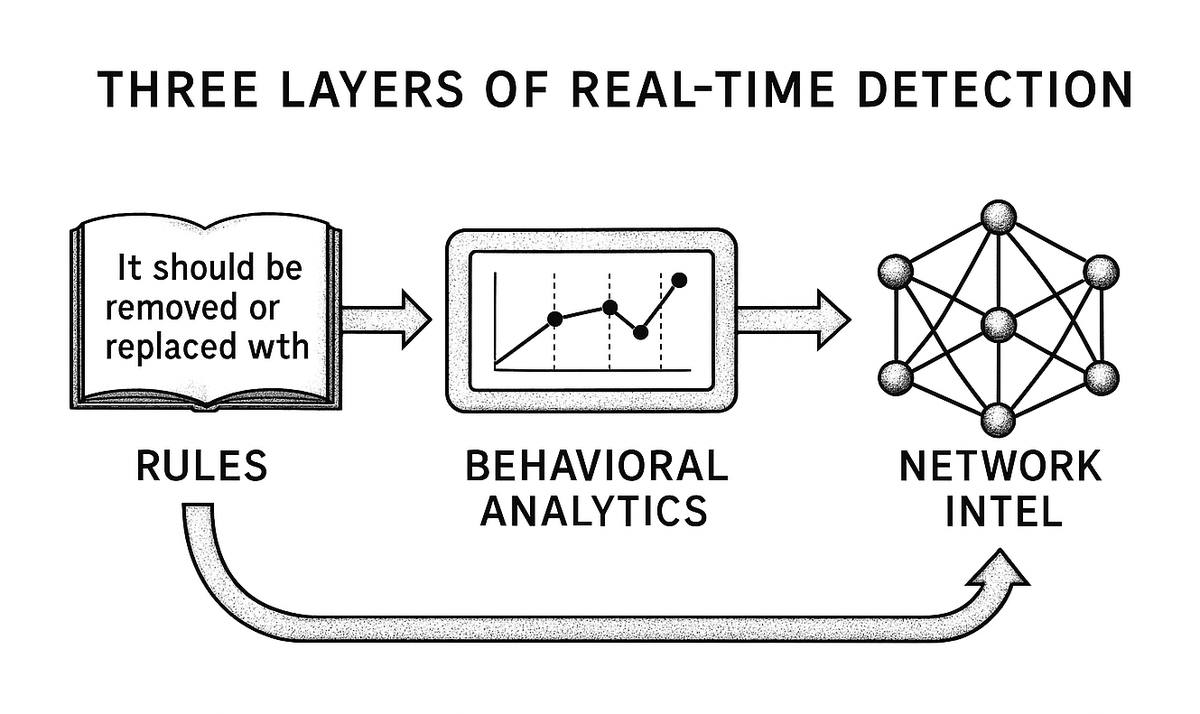
Effective real-time fraud detection operates across three layers, each catching different patterns.
Rules-based screening remains the foundation. Rules provide immediate response to known fraud patterns and full transparency into what triggered an alert. A compliance team can write a rule today based on a confirmed incident and deploy it by end of week. Rules catch the straightforward cases: transactions exceeding velocity limits, payments to sanctioned jurisdictions, structuring patterns below reporting thresholds. The limitation is that rules only catch what they are written to catch.
Behavioral analytics fills the gap that rules leave open. Machine learning models establish a behavioral baseline for each customer — typical transaction amounts, frequency, counterparties, times of day, geographic patterns — and flag deviations from that baseline. A $5,000 wire to a new international counterparty is unremarkable for a business with regular import activity. The same transaction from a dormant personal account is a signal. Behavioral models make this distinction automatically, without requiring a rule for every possible pattern.
The combination of rules and behavioral analytics is deliberate. Rules provide deterministic control and immediate explainability. ML models provide adaptive detection and pattern recognition. Most effective transaction monitoring platforms combine both rather than replacing one with the other.
Network and consortium intelligence extends detection beyond a single institution's data. A fraud pattern identified at one bank — a new mule account network, a compromised merchant, a deepfake onboarding attempt — can propagate across participating institutions in real time. This early-warning capability is particularly valuable for emerging typologies. Without consortium data, every institution discovers the same fraud pattern independently, weeks or months apart.
From Detection to Investigation
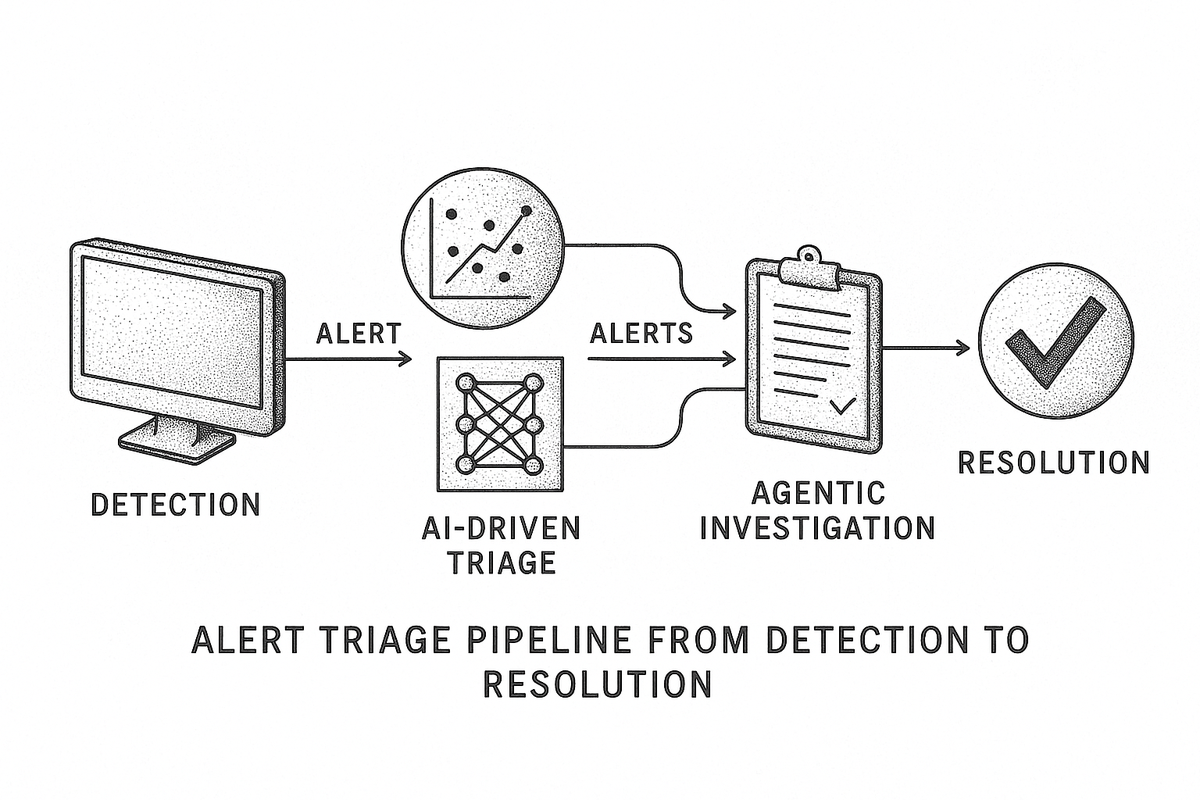
Detection is only the first step. The harder operational challenge is what happens after an alert fires. With false positive rates at 90-95% across the industry, the vast majority of alerts require investigation, documentation, and closure — all for transactions that turn out to be legitimate.
This is where the operational cost concentrates. A compliance team investigating 200 alerts per day may spend 60% of per-alert time retrieving customer history, transaction data, and related alerts from separate systems. Consolidating that information into a single investigation record — assembled automatically at case creation — is where the largest operational gains come from.
Banks manage this in three ways. First, better detection models reduce false positive volume at the source — behavioral analytics and contextual matching generate fewer spurious alerts than threshold-based rules. Second, AI-driven triage prioritizes alerts by risk severity so analysts focus on the most likely true positives first. Third, agentic investigation systems automate the evidence-gathering and narrative-drafting work that consumes analyst time, handling routine cases autonomously and escalating only the cases that require human judgment.
What Regulators Expect
Regulators have moved beyond evaluating whether a bank has a fraud detection system in place. They now evaluate whether that system produces effective outcomes.
FinCEN's April 2026 proposed rule to reform AML/CFT programs makes this explicit: financial institutions should direct resources toward higher-risk activity rather than treating every alert equally. A risk-based, technology-enabled approach is not just permitted — it is expected. Institutions that apply the same level of scrutiny to every transaction, regardless of risk, are no longer demonstrating compliance. They are demonstrating inefficiency.
The FATF's fifth round of mutual evaluations, launched in 2024, reinforces this direction with a stronger focus on effectiveness outcomes. The IFC's 2026 Good Practice Note encourages financial institutions to integrate advanced analytics and technology into risk management frameworks, noting that technology is "a critical enabler" of risk-based controls.
For banks, this regulatory shift creates a clear mandate: real-time detection capability is not optional, explainability is required for every AI-assisted decision, and effectiveness — measured by outcomes, not processes — is the standard against which programs are evaluated.
Where Sphinx Fits
Sphinx addresses the investigation layer that sits between detection and resolution. Agents triage fraud and AML alerts inside existing systems, reviewing the same data analysts see and documenting every decision with a full audit trail. Conduit dispositions risk alerts 99% faster. Banks and fintechs that already have detection engines in place use Sphinx to resolve the alerts those engines generate — without replacing the detection infrastructure or adding headcount.
Frequently Asked Questions
How do banks detect fraudulent transactions in real time?
Banks use a layered approach: rules-based screening catches known fraud patterns, behavioral analytics models detect anomalies against individual customer baselines, and network intelligence provides early warning on emerging typologies. These layers run in-line with the payment flow, scoring transactions before settlement and making allow/block/hold decisions in under 250 milliseconds.
Why is real-time fraud detection necessary for instant payments?
Instant payments settle in seconds and are irrecoverable once posted. There is no chargeback mechanism or hold period. If the detection system does not catch fraud before the payment clears, the funds are gone. Batch-based systems that review transactions hours or days later cannot protect institutions on instant payment rails.
What is the role of AI in bank fraud detection?
AI establishes behavioral baselines for each customer and detects deviations that rule-based systems miss. Machine learning models identify patterns in transaction amounts, frequency, counterparties, and timing that indicate fraud. The most advanced systems use agentic AI to autonomously investigate alerts, gather evidence, and draft case narratives for analyst review.
How do banks reduce false positives in fraud detection?
Banks reduce false positives through contextual matching (evaluating transactions against individual behavioral baselines rather than universal thresholds), multi-attribute entity resolution (scoring matches on more than just name similarity), and AI-driven triage that prioritizes alerts by risk severity. Leading platforms report 60-85% reductions in false positive rates.
What is consortium intelligence in fraud detection?
Consortium intelligence is the sharing of anonymized fraud signals across participating financial institutions. When one institution confirms a bad actor or identifies a new fraud pattern, that signal propagates across the network. This provides early warning before the pattern appears at other institutions, rather than each institution discovering it independently.
.png)