

TL;DR: Stablecon 2026 runs September 9-11 at the Gaylord National Resort in National Harbor, Maryland, just outside Washington DC, and the location is the point — the GENIUS Act's implementing rules are still unfinished. The stablecoin market grew 18.6% in the law's first year to roughly $308 billion, according to analysis of Federal Reserve and market data, while all seven regulators missed the July 18, 2026 rulemaking deadline. Expect 2,000+ attendees and 200+ speakers.
The essentials
One detail trips up first-time attendees before they even arrive. Stablecon markets itself as a Washington DC event, and functionally it is, but the venue sits across the Potomac in National Harbor, Maryland. Book travel to the venue, not to downtown DC.
The on-site resort is a genuine convenience. Attendees can walk from a session to their room in a few minutes, which matters for a three-day event with late receptions. It also means the conference does not really end in the evening, and the informal conversations at the Harbor Social opening reception on September 9 or the industry night at the Lookout 18 rooftop tend to be where positions get shared candidly.
Who actually attends
Stablecon segments its audience into three groups, and the labels are more useful than they first appear. StableGenius covers the people building stablecoin infrastructure and value chains — issuers, orchestration layers, on-and-off ramps. StableReady covers organizations already adopting, working through treasury management, settlement times and liquidity. StableCurious covers everyone still evaluating, which in 2026 includes a large number of banks and payment companies whose boards have started asking questions.
For a compliance audience, the important consequence is that the room contains both the firms that need to build a Bank Secrecy Act programme from scratch and the institutions that have run one for decades. Those two groups are solving mirror-image problems. Issuers are learning what a risk-based AML programme looks like when regulators expect bank-grade controls. Banks are learning what transaction monitoring means when settlement is instant, final and visible on a public ledger.
With 1,000-plus C-suite attendees out of roughly 2,000 total, the seniority skew is unusually high. That is good for decision-making conversations and less good for technical depth. Practitioners looking for implementation detail should aim at the side events and smaller sessions rather than the main stage.
What's on the agenda
The programme covers stablecoin innovation, cross-border payments, programmable finance, tokenization, institutional integration pathways, issuer positioning and regulatory frameworks. The DC-adjacent location is deliberate, and in 2026 the regulatory thread is the one worth planning around.
The GENIUS Act, signed on July 18, 2025, created the first comprehensive federal framework for payment stablecoins. Section 13 gave regulators one year to finalize implementing rules. That deadline passed on July 18, 2026 without a single final rule, with the OCC, FDIC, NCUA, Treasury, FinCEN, OFAC and the Federal Reserve all missing it. The law still takes effect on the earlier of January 18, 2027 or 120 days after rules are finalized, which leaves issuers preparing to comply with standards that exist only in proposal form.
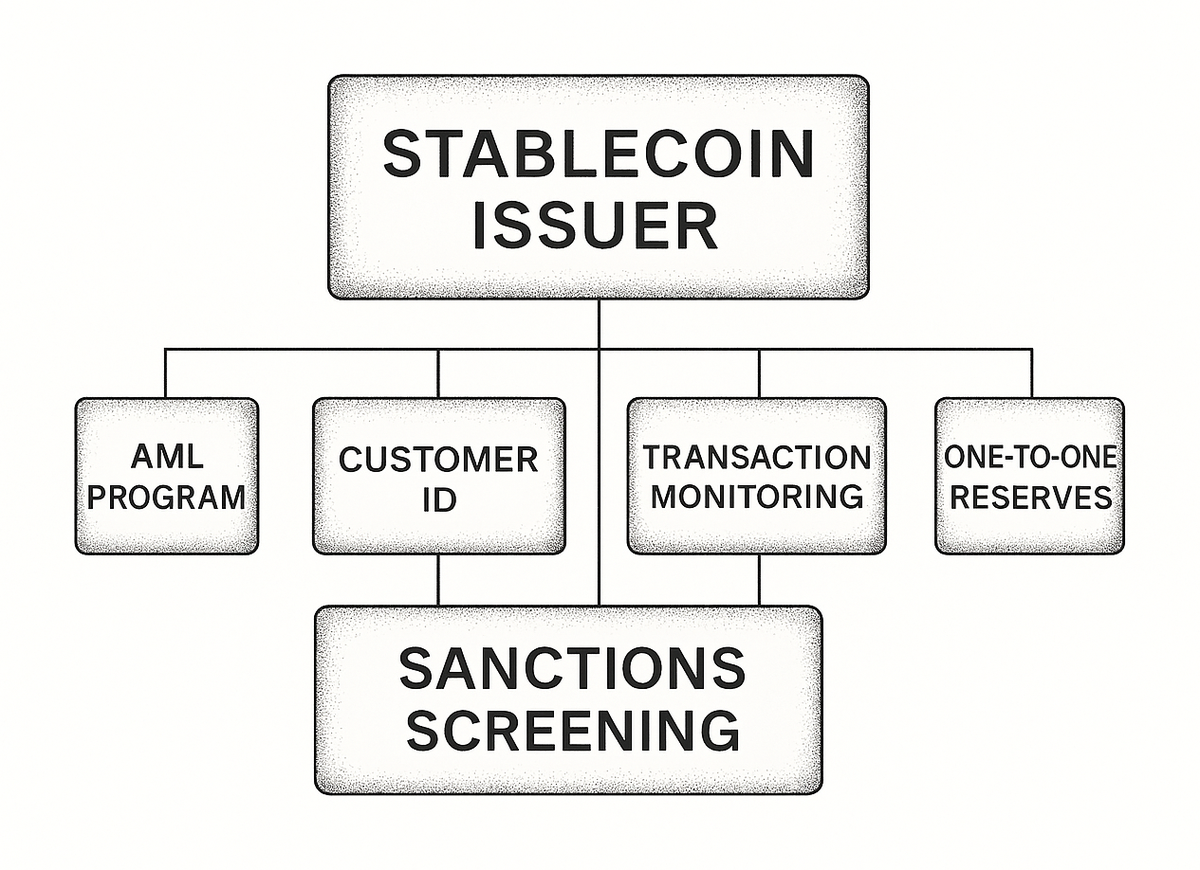
The substance of what is coming is not in doubt, and this is the part compliance teams should care about. A permitted payment stablecoin issuer is treated as a financial institution under the Bank Secrecy Act. That single classification pulls in a risk-based AML programme, customer identification, transaction monitoring calibrated to crypto-native payment flows, suspicious activity reporting, enhanced due diligence for higher-risk customers, sanctions screening, and ongoing examination by a federal or state regulator. Reserves must be held one-to-one in high-quality liquid assets. FinCEN and OFAC issued their joint AML and sanctions proposal on April 9, 2026, and the OCC published its proposed rule on February 25, 2026.
There is a structural story underneath the compliance requirements that will shape a lot of hallway conversation. Fixed compliance costs fall hardest on mid-sized issuers. Issuers with under $10 billion outstanding can seek state oversight where the state regime is certified as substantially similar to the federal framework, but crossing that threshold starts a 360-day clock to transition to federal supervision. Tether and Circle together hold roughly 83% of the market. The economics of the framework favour scale, and several attendees will be working out which side of that line they end up on.
Sessions worth prioritizing
Anything on the regulatory track deserves first claim on a compliance attendee's calendar, specifically sessions dealing with the gap between the proposed rules and operational reality. The interesting question in 2026 is not what the GENIUS Act requires but how institutions are building toward requirements that have not been finalized, and what they will do if the final rules diverge from the proposals.
Sessions on institutional integration pathways matter for banks and payment firms evaluating stablecoin settlement. The compliance question there is less about the token and more about what a monitoring programme looks like when a payment settles in seconds on infrastructure the institution does not control. Teams working through this should be clear on how a crypto AML compliance programme differs from a traditional one before they arrive, because the vendor conversations assume that baseline.
Cross-border payments sessions are worth attending for a reason that has little to do with technology. Stablecoin cross-border flows raise correspondent-banking-style questions about counterparty visibility, and the firms furthest along have usually developed practical answers they are willing to discuss.
The main stage keynotes are useful for market direction and less useful for implementation. If time is limited, trade a keynote for a side event.
How to prepare
Sort travel and accommodation first, since the group hotel booking deadline was August 25 and the resort is the only walkable option. Badge pickup opens September 8, and collecting it the evening before saves a morning queue.
The evening programme is not optional if the goal is relationships. The opening reception runs September 9 from 6pm to 9pm at Harbor Social, followed by an industry night party from 9pm to 11pm at the Lookout 18 rooftop. Multiple sponsors host each, and for a conference where a large share of attendees are senior, these are more productive than a main-stage session.
Arrive with a clear position on where the institution sits. The three audience segments are not marketing fluff — conversations go differently depending on whether the answer to "what are you doing with stablecoins" is "issuing," "settling," or "still deciding." Being able to state that in one sentence, along with the specific unresolved question behind it, converts vague networking into useful meetings.
For compliance and risk attendees specifically, it is worth reading the FinCEN and OFAC proposed rule before travelling rather than relying on conference summaries. Several sessions will assume familiarity, and the comment period discussions are more interesting when the underlying text is fresh.
How to evaluate vendors on the floor
Stablecoin compliance tooling is a young market with a wide quality range, and a DC-adjacent conference attracts vendors positioning around regulatory readiness. These questions cut through that quickly.
That final question is specific to this moment. A vendor claiming full GENIUS Act compliance coverage in 2026 is describing a product built against proposed rules, which is legitimate but should be stated plainly rather than implied. Ask what changes if the final rules differ from the proposals, and who absorbs that cost.
Sphinx works on top of existing systems rather than replacing them, automating the analyst work that follows an alert while keeping each decision documented and reviewable.
What to do after
The most valuable output from Stablecon for a regulated institution is usually a clearer view of a decision that was already pending. Write down, within a few days, what the trip changed about the institution's stablecoin position — whether that is a settlement pilot, a monitoring gap, a vendor shortlist or a decision to wait for final rules. Vague enthusiasm does not survive contact with a risk committee.
January 18, 2027 is the date that matters. Institutions with stablecoin exposure have a narrow window to build or validate the controls the framework assumes, and the practical work — transaction monitoring calibrated to on-chain flows, sanctions screening against wallet addresses, customer identification for a token holder base — takes longer than the compliance calendar suggests. Teams comparing tooling for that work can start with the current landscape of crypto compliance software.
For anyone planning the rest of the season, the fall 2026 financial crime and compliance conference calendar sets Stablecon against the other events competing for the same travel budget, including Money20/20 and Sibos, which both cover stablecoins from different angles.
Frequently Asked Questions
When and where is Stablecon 2026?
September 9-11, 2026, at the Gaylord National Resort & Convention Center, 201 Waterfront Street, National Harbor, Maryland. Badge pickup and welcome activities begin September 8. The event is marketed as a Washington DC conference, but the venue is in Maryland across the Potomac from the city.
Is Stablecon in Washington DC or Maryland?
Maryland. The Gaylord National Resort sits in National Harbor, just across the Potomac River from Washington DC, and the event uses the DC name for its proximity to federal policymakers. Book travel and ground transport to National Harbor rather than downtown DC.
Who should attend Stablecon?
Stablecoin issuers and infrastructure builders, banks and payment firms evaluating or already using stablecoin settlement, treasury teams looking at liquidity and settlement speed, and the compliance and risk leaders at any of those organizations. The GENIUS Act makes permitted issuers financial institutions under the Bank Secrecy Act, which puts AML, sanctions and customer identification squarely in scope.
What does the GENIUS Act require of stablecoin issuers?
A permitted payment stablecoin issuer is treated as a financial institution under the Bank Secrecy Act, which brings a risk-based AML programme, customer identification, transaction monitoring, suspicious activity reporting, enhanced due diligence and sanctions compliance, plus one-to-one reserves in high-quality liquid assets and supervision by a federal or state regulator. The law takes effect on the earlier of January 18, 2027 or 120 days after regulators finalize implementing rules, which had not happened as of the statutory July 18, 2026 deadline.
Is Stablecon worth the cost for a bank compliance team?
It is worth it for institutions with real or imminent stablecoin exposure, because the regulatory sessions and the issuer conversations are hard to replicate elsewhere and the attendee base skews senior enough to make partnership discussions productive. Teams with no stablecoin activity and no near-term plans will get more from a general anti-financial-crime event, where sanctions, monitoring and examination readiness get deeper treatment.
.png)