

TL;DR: The best crypto compliance software in 2026 spans two distinct layers: blockchain analytics platforms that trace on-chain activity and score wallet risk, and operational compliance tools that handle the screening, monitoring, and reporting workflows those analytics feed into. With 85 of 117 surveyed jurisdictions having passed Travel Rule legislation and the EU's MiCA transitional window closing on July 1, 2026, crypto businesses face the most prescriptive AML regime in the sector's history. This guide ranks eight leading crypto compliance platforms plus Sphinx, explains what separates them, and provides a framework for choosing the right stack.
What to Look for in Crypto Compliance Software

Crypto compliance software serves a fundamentally different operating environment than traditional financial crime tools. Transactions settle in seconds rather than days. Assets move across blockchains through bridges, mixers, and decentralized exchanges that have no analogue in conventional banking. Regulatory frameworks are converging rapidly: the EU's Markets in Crypto-Assets Regulation requires CASP authorization with evidence of operational analytics capability, the Transfer of Funds Regulation applies Travel Rule data requirements to every crypto transfer with no minimum threshold, and FATF's June 2025 revision of Recommendation 16 expanded the Travel Rule's scope to include fraud prevention and proliferation financing.
Seven capabilities separate effective crypto compliance platforms from the rest. Blockchain coverage determines how many networks the platform can trace, attribute, and score. The gap between vendors is significant: some cover 200-plus chains while others focus deeply on 50 or fewer. Real-time monitoring matters because on-chain transactions settle in seconds, and batch-only screening leaves exposure windows that regulators increasingly treat as control failures. Travel Rule compliance has shifted from optional to baseline, with France, Germany, and the Netherlands already enforcing Travel Rule requirements as part of CASP authorization reviews.
DeFi and cross-chain support distinguishes platforms that can follow funds through bridges, liquidity pools, and decentralized exchanges from those limited to centralized exchange flows. Sanctions screening must cover both traditional watchlists and blockchain-specific designations, including OFAC-sanctioned wallet addresses. SAR filing capabilities determine whether suspicious activity identified on-chain can be converted into defensible regulatory reports. And API integration quality governs how cleanly the compliance layer embeds into exchange infrastructure, wallet products, and payment processing workflows.
Top Crypto Compliance Software in 2026
The following platforms represent the leading options across different segments of the crypto compliance market. Each evaluation covers core capabilities, strengths, limitations, and ideal fit. Rankings reflect blockchain analytics depth, compliance workflow coverage, market presence, and suitability for regulated crypto operations in 2026.
1. Sphinx
Sphinx sits at the top of this list not because it replaces the blockchain analytics tools below, but because it handles the operational compliance work those tools feed into — the alert triage, investigation, and reporting that consumes the majority of compliance team capacity. Sphinx works best alongside a blockchain analytics provider and a Travel Rule solution — it handles the screening, monitoring, and SAR filing layer while specialized tools handle on-chain intelligence and counterparty data exchange.
Sphinx addresses the operational layer of crypto compliance that blockchain analytics platforms do not cover: the alert triage, case investigation, and regulatory reporting work that consumes the majority of compliance team capacity. Rather than replacing blockchain analytics tools like Chainalysis, TRM Labs, or Elliptic, Sphinx deploys autonomous AI agents that work alongside them, taking the alerts those platforms generate and automating the investigation and disposition workflow that currently requires manual analyst effort.
The agents operate inside existing compliance platforms, reviewing alerts, cross-referencing sanctions lists and customer records, assessing risk, and documenting findings with full reasoning chains. For crypto companies, this means the on-chain risk scores generated by a blockchain analytics provider flow into the same workflow where Sphinx agents handle PEP screening, adverse media checks, transaction monitoring alert triage, and SAR preparation. Named crypto customers include Wert and FV Bank. Across all deployments, Sphinx reports 87% fewer false positives reaching human reviewers and 98% of cases resolved same-day.
Sphinx does not provide blockchain analytics, wallet risk scoring, or on-chain tracing capabilities. It is not a replacement for Chainalysis, Elliptic, or TRM Labs. It is the operational compliance layer that sits downstream from those tools, handling the work that happens after an alert fires. For crypto companies building AML compliance programs, the practical stack often includes a blockchain analytics provider for on-chain intelligence, a Travel Rule solution for cross-border compliance, and an operational layer like Sphinx to handle the screening, monitoring, and reporting workload. SOC 2 Type II certified and GDPR compliant, with every decision auditable through an interpretable agentic framework.
Best for: Crypto companies scaling compliance operations without proportionally scaling headcount. Deployment: SaaS, works with existing compliance and blockchain analytics platforms. Pricing: SaaS subscription.
2. Chainalysis
Chainalysis is the incumbent market leader in blockchain analytics, with the broadest enterprise deployment, the deepest investigations product, and the highest regulatory acceptance of any platform in the space. Founded in 2014, the company has built an intelligence platform used by over 1,500 organizations across 45-plus jurisdictions, including the FBI, DEA, IRS Criminal Investigation, Europol, and Interpol. Its Reactor investigation tool has been cited in landmark cases involving terrorism financing, ransomware, darknet markets, and North Korean hacking operations. Law enforcement agencies using Chainalysis have seized or frozen approximately $34 billion in illicit funds.
The product suite covers the full compliance lifecycle. Chainalysis KYT (Know Your Transaction) provides real-time transaction monitoring with sub-second alert generation, behavioral alerts, and configurable risk thresholds. Reactor enables visual transaction graph analysis across chains, clustering wallets by controlling entity and assigning risk scores. The platform covers 200-plus blockchains with automatic token support for over 40 million assets. Over 50 regulators worldwide rely on Chainalysis data, which means institutions using the same intelligence operate from a shared foundation with their supervisors.
The trade-off is price. Chainalysis is consistently the most expensive option, with mid-sized CASP deployments running EUR 120,000 to 250,000 annually. The cost is justified for institutions whose Reactor usage is material or whose regulatory posture demands the most defensible analytics available. For screening-only deployments at smaller volumes, alternatives offer comparable coverage at significantly lower price points. The platform also carries an enterprise sales model that smaller crypto-native companies may find misaligned with their procurement cycles.
Best for: Enterprise exchanges, financial institutions entering crypto, and any organization where regulatory defensibility is the primary selection criterion. Deployment: Cloud SaaS, on-premise, FedRAMP authorized. Pricing: Enterprise custom, EUR 120K-250K+ annually.
3. TRM Labs
TRM Labs has scaled aggressively since its founding in 2018, reaching a $1 billion valuation in February 2026 after a $70 million Series C led by Blockchain Capital with participation from Goldman Sachs and Citi Ventures. The platform differentiates through attribution depth on newer blockchain ecosystems, particularly Solana, Tron, and Polygon, and through transparent, explainable risk scoring that provides explicit confidence levels and reasoning for every attribution. This matters when regulators ask why a specific transaction was flagged or cleared.
TRM's product portfolio covers screening, investigation, and law enforcement workflows. TRM Wallet Screening provides sub-second risk assessments. TRM Forensics is the investigative tracing tool. Know Your VASP delivers entity-level risk profiles with over 80 configurable risk indicators. The platform maintains 3.1 billion-plus labeled addresses and adds 160-plus new services weekly. TRM is particularly strong on stablecoin flow tracing for USDT and USDC, which matters disproportionately for institutional CASPs where stablecoin volumes dominate transaction activity.
TRM's growing integration with Notabene and Veriscope for Travel Rule data exchange adds a compliance workflow layer that pure analytics competitors lack. Pricing is aggressive relative to Chainalysis, running EUR 60,000 to 150,000 annually for mid-sized CASPs. Limitations include a newer attribution database compared to Chainalysis, which means historical entity coverage for pre-2020 activity is thinner, and an investigations UX that, while fast-improving, is still less mature than Reactor for complex multi-hop tracing.
Best for: Crypto-native companies prioritizing value, transparent scoring, and strong Solana/Tron/stablecoin coverage. Deployment: Cloud SaaS, FedRAMP High. Pricing: Enterprise custom, EUR 60K-150K annually.
4. Elliptic
Elliptic is the oldest blockchain analytics company, founded in London in 2013, and maintains the strongest regulator relationships across the UK FCA and EEA national competent authorities. For CASPs pursuing MiCA authorization, Elliptic's presence in regulatory submissions and its European headquartering carry weight that US-based competitors do not replicate. The company reached a $670 million valuation in 2026 and has built its differentiation around cross-chain analytics and holistic screening capabilities.
The product suite centers on three platforms. Elliptic Lens handles wallet screening and transaction risk assessment with sub-second response times, resolving 99% of alerts in under five minutes according to the company. Elliptic Navigator manages transaction monitoring at scale, processing tens of thousands of transactions in real-time. The Nexus engine powers Holistic Screening, the platform's signature capability: automated cross-chain, cross-asset risk assessment in a single API call that follows funds as they move between blockchains through bridges, DeFi protocols, and swap services. An AI copilot generates screening summaries and risk analysis, reportedly saving compliance teams three-plus hours per day.
Elliptic's pricing sits 30-40% below Chainalysis at the mid-tier, making it the strongest value proposition for European-centric operations. The trade-off is narrower chain coverage than Chainalysis, particularly on long-tail Solana, Tron, and emerging EVM L2 chains. The investigations UX is functional but less feature-rich than Reactor. For regulated crypto businesses operating primarily in European and UK markets, Elliptic combines strong analytics with the regulator engagement that matters during authorization reviews.
Best for: European CASPs, MiCA authorization applicants, and institutions prioritizing cross-chain DeFi coverage. Deployment: Cloud SaaS, ISO 27001 certified. Pricing: Enterprise custom, 30-40% below Chainalysis at mid-tier.
5. ComplyAdvantage
ComplyAdvantage provides the bridge between traditional financial crime compliance and crypto-specific requirements. The Mesh platform, launched in October 2025, unifies customer screening, ongoing monitoring, transaction monitoring, payment screening, and customer risk scoring in a single AI-native system. For crypto companies that need to screen customers against sanctions lists, PEP databases, and adverse media sources alongside on-chain risk data, ComplyAdvantage delivers this without requiring separate traditional and crypto compliance stacks.
The platform's strength lies in speed and data freshness. Critical sanctions lists are updated within minutes of publication, not hours or days. Payment Screening on Mesh, launched in May 2026, provides name screening at low latency across bank, card, remittance, and crypto rails. Intelligent muting technology identifies and suppresses repeat false positives, and the agentic AI assistant Cassie automates detection, remediation, and regulatory filing while cutting false positives by 70% according to the company. The no-code interface allows compliance teams to calibrate match sensitivity and manage watchlists without engineering dependency.
Limitations include less depth in on-chain blockchain analytics compared to dedicated blockchain analytics providers like Chainalysis, TRM Labs, or Elliptic. ComplyAdvantage is not a blockchain tracing tool. It does not provide wallet clustering, transaction graph visualization, or cross-chain fund flow analysis. For crypto companies, ComplyAdvantage works best as the screening and monitoring layer that sits alongside a blockchain analytics provider, handling the PEP screening, sanctions checks, and adverse media monitoring that blockchain analytics platforms do not cover.
Best for: Crypto fintechs needing traditional AML screening and monitoring alongside blockchain analytics. Deployment: Cloud SaaS, REST API. Pricing: Volume-based custom, startup tiers available.
6. Crystal Intelligence
Crystal Intelligence, originally spun out of Bitfury Group, leads the market on raw blockchain coverage with support for 330-plus blockchains and 10,000-plus digital assets. The platform covers Bitcoin, Ethereum, Tron, Solana, Litecoin, Binance Smart Chain, and hundreds of additional networks. For exchanges and VASPs that list long-tail tokens and need compliance coverage across their full asset inventory, Crystal's breadth is unmatched. The company also maintains 110,000-plus attributed entities, with particular depth in Eastern European exchange attribution.
Crystal Expert is the core platform, combining real-time transaction monitoring, automated address screening, and sanctions and blocklist checks. The Q1 2026 product update introduced a fully transparent risk scoring system where every factor contributing to a risk score traces back to a specific, explainable connection, eliminating hidden inputs that make scores difficult to defend to auditors. The RiskCheck API and Monitor now use the same scoring algorithm, resolving a longstanding friction point for teams running two-layer compliance setups. Crystal Foresight, launched in late 2025, adds stablecoin intelligence with cross-chain flow analysis, issuance and redemption tracking, and MiCA-aligned reporting templates.
Crystal's VASP Check feature provides continuous monitoring of counterparty VASPs with alerts on suspicious activity, covering license verification, counterparty risk exposure, transfer volume analysis, and jurisdiction-based risk assessment. Sanctions and entity data update every 15 minutes. The platform offers both enterprise and SMB tiers, including Crystal Go for smaller operations. Limitations include less mature DeFi protocol coverage compared to Elliptic and a smaller overall market presence than the top-three blockchain analytics providers.
Best for: Exchanges and VASPs needing the broadest blockchain coverage and explainable risk scoring. Deployment: Cloud SaaS, on-premise available. Pricing: Enterprise and SMB tiers, Crystal Go for smaller operations.
7. Merkle Science
Merkle Science occupies a distinct position as the leading crypto compliance platform in Asia-Pacific markets. Headquartered in New York but with primary operations across Singapore, India, and the UK, the company has built deep relationships with APAC regulators, particularly the Monetary Authority of Singapore. For VASPs operating under Singapore's Payment Services Act or seeking MAS licensing, Merkle Science's regulatory coverage and regional expertise carry particular weight. The Singapore Fintech Association has recommended Merkle Science for compliance with industry regulations.
The Compass platform provides behavior-based transaction monitoring that goes beyond static blacklist matching. Rather than relying solely on known sanctioned addresses, Compass applies behavioral rules that detect suspicious patterns, including structuring, rapid fund movement, and interaction with high-risk service categories, even when the counterparty addresses are not yet attributed. The AI Agent introduced in early 2026 enhances investigative workflows with contextual intelligence and actionable recommendations. Compass AI Studio, launched in May 2026, adds a conversational AI layer that allows compliance analysts to query critical-risk addresses, review alerts, and drill into transaction graphs using natural language.
Merkle Science's Tracker tool provides visual fund-flow analysis for investigations, and the KYBB (Know Your Blockchain Business) module handles VASP due diligence. The regulatory rule library covers Singapore MAS, VARA, MiCA, and other jurisdictions. Limitations include a smaller attribution database compared to Chainalysis and TRM Labs, narrower overall chain coverage, and a company scale ($1M-10M annual revenue, approximately 40-50 employees) that may raise questions about long-term vendor stability for larger enterprises. For mid-market crypto companies operating in or expanding into APAC markets, Merkle Science provides the strongest regional fit.
Best for: VASPs and exchanges operating in Asia-Pacific markets, particularly Singapore and regulated APAC jurisdictions. Deployment: Cloud SaaS, API. Pricing: Custom, mid-market accessible.
8. Notabene
Notabene is the dominant Travel Rule compliance platform, purpose-built for FATF Recommendation 16 and the regulatory frameworks that implement it. With over 2,000 financial institutions on the Notabene Network and more than $2 trillion in compliant transaction volume processed through the platform, Notabene has established the largest active counterparty network in the industry. For any crypto business where Travel Rule compliance is a licensing requirement, which increasingly means every regulated VASP, Notabene provides the infrastructure that makes compliant cross-border transfers operationally viable.
Notabene Transact, launched in July 2026, automates pre-transaction decision-making by evaluating every transaction against OFAC lists, jurisdiction rules, counterparty logic, and risk parameters before funds move. The platform's Transaction Authorization Protocol (TAP) is an open-source messaging standard that enables verified entities to transact securely across wallets, exchanges, and smart contracts. SafeGateway provides protocol-agnostic Travel Rule data exchange, connecting VASPs regardless of which messaging protocol they use. The system tracks jurisdiction-specific Travel Rule requirements across 100-plus countries and maintains regulatory currency automatically.
Notabene is not a blockchain analytics platform. It does not provide wallet risk scoring, transaction graph visualization, or on-chain investigation tools. It is complementary infrastructure that sits alongside a blockchain analytics provider. The EU's Transfer of Funds Regulation requires CASPs to demonstrate a signed contract with a Travel Rule provider and integration evidence as part of the authorization application. Notabene, along with alternatives like Sygna, Sumsub, and Veriscope, fills this specific regulatory requirement. For exchanges processing cross-border volume at scale, Notabene's counterparty network size directly determines transaction success rates.
Best for: Exchanges and VASPs needing Travel Rule compliance infrastructure at scale. Deployment: Cloud SaaS, API-first. Pricing: Custom, free tier available (SafeTransact-Rise).
How to Choose the Right Crypto Compliance Stack
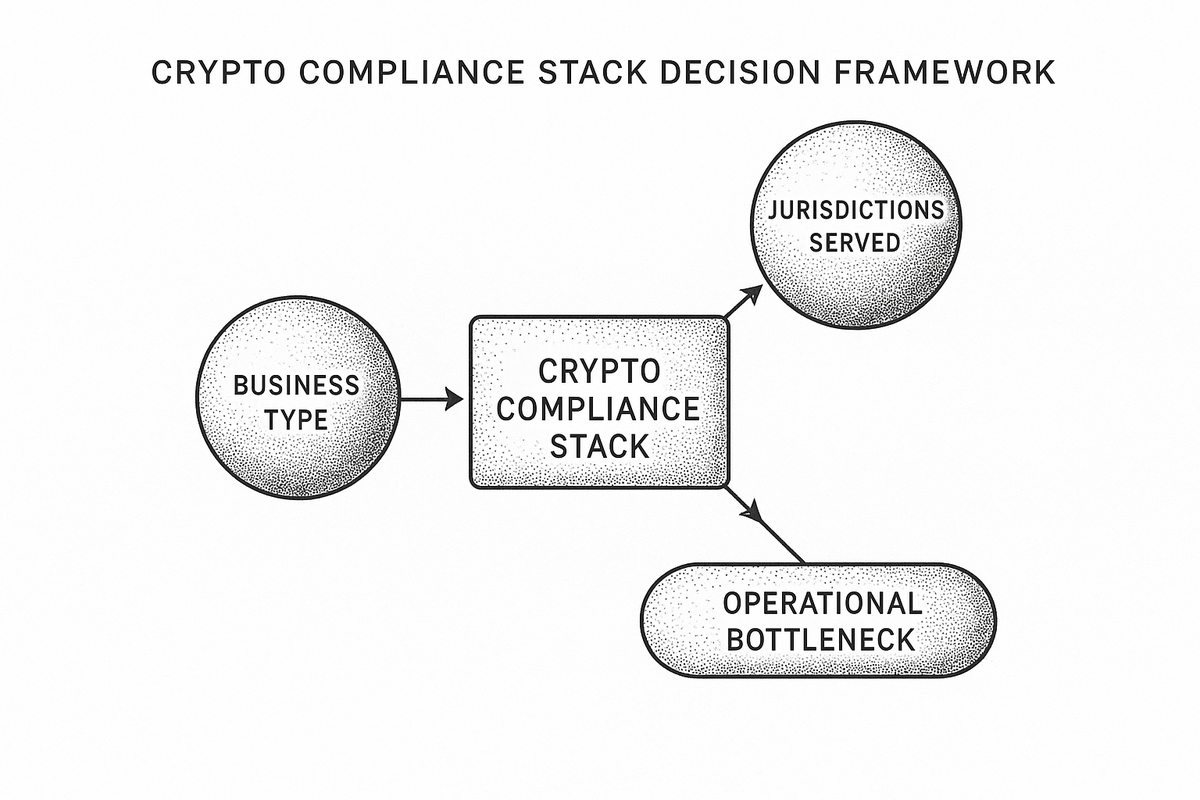
Crypto compliance is not a single-vendor problem. The regulatory requirements span on-chain analytics, traditional AML screening, Travel Rule data exchange, and operational workflow automation. Most regulated crypto businesses in 2026 run a stack of two to four specialized tools rather than a single platform. The right combination depends on three factors.
What type of crypto business are you?
A centralized exchange processing high volumes across dozens of blockchains needs deep blockchain analytics coverage, Travel Rule infrastructure, and operational capacity to handle alert volumes at scale. Chainalysis or TRM Labs for analytics, Notabene for Travel Rule compliance, and an operational layer for alert triage represent the standard enterprise stack. A payment processor handling fiat-to-crypto conversion needs traditional AML screening alongside on-chain risk scoring, making ComplyAdvantage paired with a blockchain analytics provider the logical combination. A DeFi-adjacent business needs strong cross-chain coverage, making Elliptic's Holistic Screening or Crystal Intelligence's breadth more relevant than investigation-heavy tools designed for centralized exchange workflows.
Which jurisdictions do you operate in?
Regulatory geography shapes platform selection more than feature lists. US-regulated entities benefit from Chainalysis's unmatched regulatory acceptance and FedRAMP authorization, or TRM Labs's growing federal footprint. European CASPs pursuing MiCA authorization find Elliptic's regulator relationships and Crystal's MiCA-aligned reporting templates more directly useful. APAC-focused VASPs under MAS regulation benefit from Merkle Science's regional expertise. Multi-jurisdictional operations often deploy two blockchain analytics providers for coverage redundancy, using one as the primary monitoring platform and another for investigation and validation.
Where is the operational bottleneck?
If the constraint is on-chain visibility, selecting the right blockchain analytics provider matters most. If the constraint is Travel Rule compliance blocking cross-border transfers, Notabene or an equivalent Travel Rule solution is the priority. If the constraint is the operational capacity to process alerts, investigate cases, and file reports, the downstream compliance workflow layer, including tools like Sphinx that automate triage and disposition, delivers the most immediate impact. Many crypto compliance teams invest heavily in analytics infrastructure but underinvest in the operational capacity to act on what those analytics surface. The result is sophisticated on-chain intelligence feeding into manual workflows that cannot scale with transaction volume.
Frequently Asked Questions
What is crypto compliance software and why do crypto businesses need it?
Crypto compliance software helps virtual asset service providers, exchanges, and crypto-native financial institutions meet anti-money laundering, sanctions, and counter-terrorist financing obligations. It typically includes blockchain analytics for on-chain transaction monitoring and wallet risk scoring, traditional AML screening for sanctions, PEPs, and adverse media, and Travel Rule solutions for sharing originator and beneficiary information on cross-border transfers. Crypto businesses need this software because they are regulated as financial institutions in most major jurisdictions. Under MiCA, CASPs that cannot demonstrate operational compliance capability will lose authorization to operate in the EU after July 1, 2026.
Do crypto companies need both blockchain analytics and traditional AML software?
In most cases, yes. Blockchain analytics platforms like Chainalysis, TRM Labs, and Elliptic trace on-chain activity, score wallet risk, and investigate illicit fund flows. But they do not typically cover traditional AML requirements like PEP screening, adverse media monitoring, customer risk scoring, or SAR filing. Platforms like ComplyAdvantage and Sphinx address these operational compliance needs. The practical stack for a regulated crypto business usually includes a blockchain analytics provider, a Travel Rule solution, and a screening and monitoring layer that handles the full AML workflow.
How much does crypto compliance software cost?
Pricing varies widely by vendor category and company size. Blockchain analytics platforms range from EUR 60,000 to 250,000 or more annually for mid-sized CASPs, with Chainalysis at the premium end and TRM Labs and Elliptic offering more competitive pricing. Crystal Intelligence provides SMB tiers for smaller operations. Travel Rule solutions like Notabene offer free tiers for low-volume use and custom pricing at scale. Traditional AML screening platforms like ComplyAdvantage offer volume-based pricing with startup-friendly tiers. Total cost of ownership for a full compliance stack, including blockchain analytics, Travel Rule, and operational compliance, typically runs EUR 100,000 to 400,000 or more annually for mid-sized operations.
What is the Travel Rule and which software handles it?
The Travel Rule, codified as FATF Recommendation 16, requires VASPs to collect and transmit originator and beneficiary information for crypto transfers above applicable thresholds. The FATF recommends a USD/EUR 1,000 threshold, but the EU applies no minimum threshold for CASP-to-CASP transfers. Notabene is the largest dedicated Travel Rule platform, with over 2,000 institutions on its network. Other Travel Rule solutions include Sygna, Sumsub, and Veriscope. Some blockchain analytics providers like TRM Labs offer Travel Rule integrations through partnerships. EU CASPs must demonstrate a signed contract with a Travel Rule provider as part of their MiCA authorization application.
Can one platform handle all crypto compliance requirements?
No single platform in 2026 covers every requirement. Blockchain analytics providers excel at on-chain intelligence but lack traditional AML screening. Travel Rule platforms handle counterparty data exchange but not transaction monitoring. Traditional AML platforms cover screening and monitoring but lack blockchain tracing capabilities. The market is moving toward integration rather than consolidation, with vendors building partnerships and API connections between specialized tools. The most effective crypto compliance programs assemble a stack of complementary platforms connected through APIs, rather than seeking a single vendor that does everything.
.png)