

TL;DR: The best SAR filing software in 2026 automates narrative generation, validates FinCEN form fields before submission, and keeps the entire investigation-to-filing workflow inside a single audit trail. With financial institutions filing over 4.1 million SARs in 2025 and FinCEN's October 2025 guidance shifting emphasis from filing volume to filing quality, the platforms that matter are the ones that produce defensible narratives faster without sacrificing the detail law enforcement needs. This guide ranks eight leading SAR filing platforms, explains what separates them, and provides a framework for choosing the right one.
What to Look for in SAR Filing Software
SAR filing software handles the lifecycle from the moment an investigation determines that activity is suspicious through narrative drafting, FinCEN form population, approval routing, electronic submission, and post-filing record retention. The best platforms do not treat filing as an afterthought bolted onto case management. They treat it as the core output that regulators, examiners, and law enforcement evaluate.
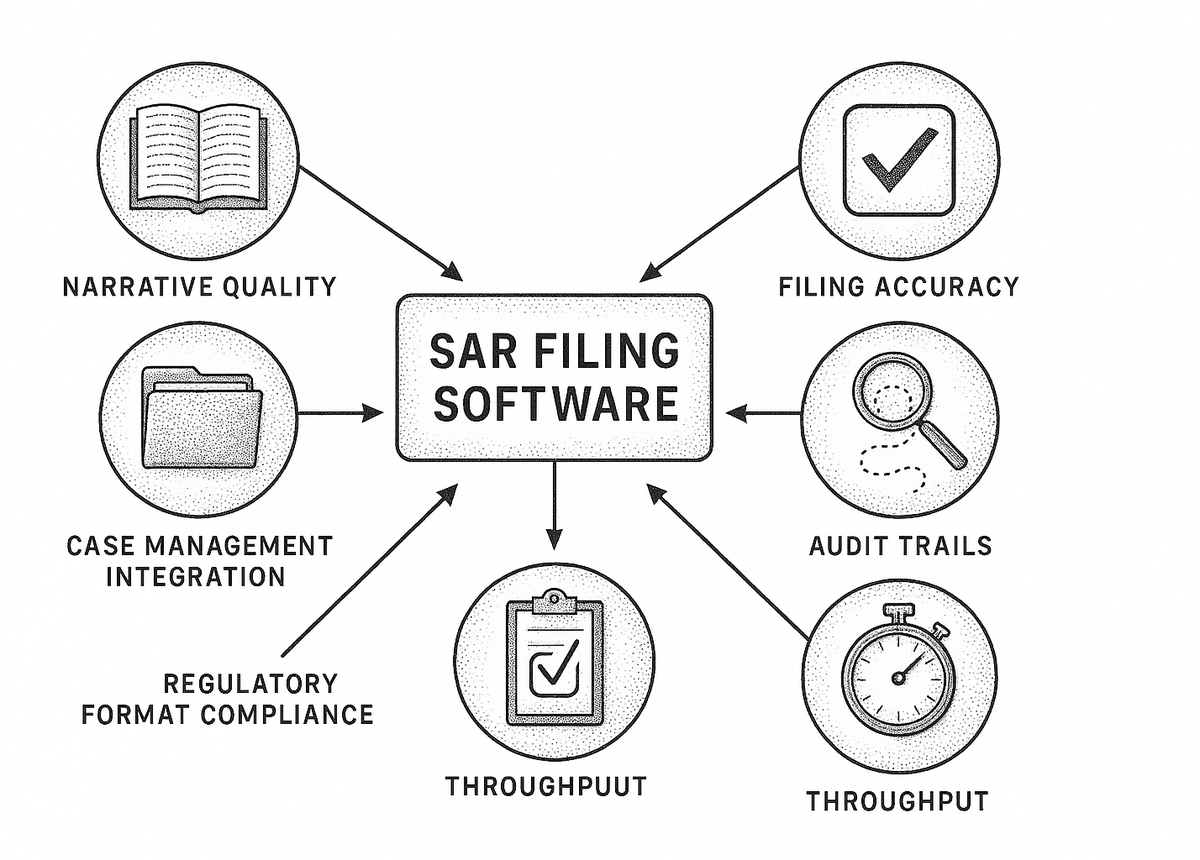
Six capabilities separate effective SAR filing platforms from the rest. Narrative quality is the most consequential. FinCEN's SAR Narrative Guidance Package requires every filing to answer who, what, when, where, why, and how with enough transactional specificity that an investigator can assess merit without requesting additional information. Platforms that generate AI-drafted narratives grounded in case evidence, with per-claim source attribution, produce filings that hold up under examination. Those that generate fluent but unsourced text create a different kind of risk.
Filing accuracy determines whether submissions are accepted or rejected. The BSA E-Filing System enforces strict field validation, and platforms that pre-validate mandatory and non-critical fields before submission eliminate the correction cycles that slow compliance teams. Case management integration matters because SAR filing does not happen in isolation. The investigation, the evidence, the alert that triggered it, and the filing decision should exist in a single workflow with a continuous audit trail. Regulatory format compliance spans FinCEN SAR Form 111, FINTRAC STRs, goAML for 60-plus jurisdictions, and jurisdiction-specific schemas. Throughput, the ability to handle filing volume at scale without degrading quality, separates platforms built for production from those built for demos.
Best SAR Filing Software in 2026
The following platforms represent the leading options for SAR filing across different institutional profiles. Each evaluation covers core capabilities, strengths, limitations, and ideal fit. Rankings reflect a combination of filing workflow maturity, narrative automation quality, market presence, and suitability for modern compliance operations.
1. Sphinx
Sphinx sits at the top of this list not because it replaces the filing platforms below, but because it automates the investigation and narrative work that determines filing quality — the step where compliance teams spend the most time. Sphinx works best paired with one of the SAR filing platforms below — it handles the upstream investigation and narrative generation while the filing platform handles submission and regulatory formatting.
Sphinx approaches SAR filing differently from every platform on this list. Rather than providing a filing form or a workflow tool, Sphinx deploys autonomous AI agents that handle the upstream investigation work that determines SAR quality: reviewing alerts, pulling transaction histories, cross-referencing customer data, assessing risk, and generating complete SAR narratives with full audit trails. The agents work inside existing compliance systems, logging into the same platforms analysts use, so institutions do not need to migrate away from their current filing infrastructure.
The impact is measurable across every stage that precedes the filing. Sphinx clients report 87% fewer false positives reaching human reviewers upstream, which directly reduces unnecessary SAR volume. Of the cases that do require action, 98% are resolved same-day, eliminating the filing backlogs that trigger examiner scrutiny. Case review time drops by 80%. The AI-generated narratives include full reasoning chains explaining what data the agent examined, what logic it applied, and what conclusion it reached, satisfying the auditability requirements that FinCEN's April 2026 proposed rule explicitly encourages. Named customers including Equals Money, Alviere, and Conduit have deployed Sphinx agents across their compliance workflows. One customer cleared a six-month alert review backlog in two days.
Sphinx does not replace the filing submission mechanism itself. It does not maintain its own BSA E-Filing connection or generate the FinCEN XML. It operates at the investigation, narrative, and disposition layer, which is where compliance teams spend the vast majority of their time and where filing quality is actually determined. For teams whose SAR bottleneck is not the filing form but the investigation and narrative work that feeds it, Sphinx eliminates the constraint without requiring a platform migration. SOC 2 Type II certified, GDPR compliant, and backed by Y Combinator.
Best for: Compliance teams with high alert volumes needing faster, higher-quality investigation and narrative generation. Deployment: SaaS, works with existing filing systems. Pricing: SaaS subscription.
2. Hummingbird
Hummingbird is the platform most purpose-built for SAR filing. Founded in 2017 as an investigations-first compliance tool, it developed and patented its SAR automation engine before expanding into transaction monitoring and customer screening in 2025. The patented filing technology handles the full lifecycle from alert validation through FinCEN and FINTRAC submission, with every field validated before filing and acceptance tracked end-to-end. Compliance teams at Plaid, Etsy, and DraftKings use Hummingbird as their system of record for investigations and regulatory reporting.
The platform's AI generates SAR narratives from investigation data, reducing the time analysts spend on documentation while maintaining the specificity that law enforcement needs. No-code workflow automation lets compliance officers set triggers, conditions, and approval routing without engineering dependencies. Electronic filing supports FinCEN in the US, FINTRAC in Canada, and goAML jurisdictions globally, with real-time submission status tracking and rejection notifications. The Investigation Canvas brings together data from internal systems and third-party tools into a single view, so the evidence that feeds the narrative lives alongside the filing itself.
Limitations include a US-centric design heritage that makes it strongest for FinCEN filings and less proven in complex multi-jurisdictional programs. The transaction monitoring module, launched in September 2025 through the LogicLoop acquisition, is newer and less mature than the investigation and filing capabilities. Pricing scales with investigator seats, which can make it expensive for larger compliance teams. For organizations where investigation quality and SAR filing automation are the primary pain points, Hummingbird is built for exactly that job.
Best for: Fintechs and banks that need patented SAR automation with audit-ready filing workflows. Deployment: Cloud SaaS. Pricing: Per-seat, custom.
3. Abrigo (BAM+)
Abrigo is the dominant SAR filing platform in US community banking. The BAM+ platform provides end-to-end AML coverage including transaction monitoring, case management, customer due diligence, and direct SAR and CTR filing to FinCEN, all from a single system. Institutions using Abrigo have reported up to 80% efficiency gains and 50% reductions in alert volume. The platform's Scenario Tuner earned the 2025 FinTech Breakthrough Award for Best AML Solution, and over 25 years of deployment experience across community banks and credit unions gives it an unmatched understanding of smaller institution workflows.
BAM+ aggregates and pre-fills SAR data from the investigation trail, eliminating the manual assembly that consumes analyst time. Direct batch filing to FinCEN with acknowledgment tracking within the platform ensures nothing falls through the cracks. The AML Assistant, launched in 2025, uses adaptive machine learning to score alerts, prioritize high-risk cases, and automatically assemble investigative narratives, delivering up to 80% time savings per alert. The AI is transparent and explainable, showing exactly what triggered each alert and what factors contributed to the score, which matters during examinations.
Limitations include a platform designed primarily for US community financial institutions, which means it may lack the multi-jurisdictional filing support that global programs require. The user interface, while functional and steadily modernized, does not match the design polish of newer entrants like Hummingbird or Lucinity. For community banks and credit unions that need a proven, right-sized AML platform with strong SAR filing built in, Abrigo remains the default choice for good reason.
Best for: Community banks and credit unions needing end-to-end BSA/AML with direct FinCEN filing. Deployment: Cloud, on-premise. Pricing: Modular, mid-market accessible.
4. NICE Actimize (STAR)
NICE Actimize's Suspicious Transaction Activity Reporting (STAR) solution is the SAR filing platform deployed at the majority of the world's largest banks. STAR integrates across the full ActOne suite, connecting transaction monitoring, case management, and regulatory reporting into a single enterprise workflow. The platform autopopulates both mandatory and optional FinCEN fields from investigation data, ensuring critical information is not missed, and uses generative AI through X-Sight AI Narrate (formerly NarrateAI) to craft SAR narratives that align with regulatory filing expectations.
X-Sight AI Narrate claims to accelerate SAR creation by up to 70%. The AI synthesizes suspicious transaction data and investigation intelligence into coherent narratives with consistent quality and regulatory compliance. STAR provides complete oversight of the filing process through out-of-the-box dashboards, automatically triggers continuing activity reports in line with FinCEN's 90-day review process, and records all changes to the SAR form both before and after filing with full auditability. Multi-jurisdictional support covers compliant filing forms across FinCEN, FCA, MAS, and other regulatory bodies.
The trade-off is the same as with every NICE Actimize product: complexity and cost. Implementation timelines for the full suite stretch to 12-18 months. Enterprise pricing typically starts at $500,000 or more annually, placing it out of reach for mid-market buyers. STAR works best as part of a broader Actimize deployment rather than as a standalone SAR filing tool. For Tier 1 banks already running the ActOne platform, STAR delivers proven, regulator-tested SAR automation at enterprise scale.
Best for: Tier 1 and Tier 2 banks with existing NICE Actimize deployments. Deployment: On-premise, cloud, hybrid. Pricing: Enterprise custom, $500K+ annually.
5. Verafin (Nasdaq)
Verafin, acquired by Nasdaq in 2021, combines consortium-based intelligence with streamlined SAR filing in a platform built for community banks and mid-size institutions across the US and Canada. The consortium model is the differentiator. By pooling anonymized data across its network of financial institutions, Verafin identifies cross-institutional patterns that single-institution monitoring misses, such as funnel accounts, money mule networks, and coordinated structuring rings. This intelligence feeds directly into the investigation and SAR filing workflow.
Verafin's SAR filing automates the tedious aspects of report preparation. The platform completes all data fields when a report is generated, flags missing required information, and lets analysts focus on the narrative section rather than manual data assembly. Once the narrative is complete, a single click queues the SAR for automated overnight e-filing directly with FinCEN. SAR workflow dashboards show report status from incomplete through accepted by FinCEN, and the platform provides 90-day reminders for continuing activity reports. Integrated case management means analysts can open an investigative case directly from an alert and generate a SAR without leaving the system.
Limitations include a filing capability focused primarily on FinCEN and FINTRAC, with limited coverage for other global jurisdictions. The platform is optimized for community banking workflows, which can feel restrictive for complex multi-entity programs. Verafin's AI capabilities in narrative generation, while improving, are less advanced than dedicated SAR automation platforms like Hummingbird. For US and Canadian community banks that want consortium intelligence feeding directly into a streamlined filing process, Verafin is a strong fit.
Best for: Community banks in the US and Canada wanting consortium intelligence with integrated filing. Deployment: Cloud SaaS. Pricing: Custom, mid-market.
6. Lucinity
Lucinity is an Icelandic AML platform that has built one of the cleanest user experiences in compliance software, combining case management, transaction monitoring, and regulatory reporting in an interface that compliance analysts actually enjoy using. The platform's Luci AI agent autonomously reviews AML alerts, surfaces risk indicators, and generates case summaries, functioning as an AI investigator that works through the same steps a human analyst would: pulling transaction history, checking customer risk profiles, reviewing adverse media, and assembling evidence.
Regulatory reporting is embedded within the Case Manager, providing a unified system to investigate, document, and file. Luci AI drafts filings from case data, reducing time spent on paperwork. The platform supports straight-through filing to FinCEN, NCA, and select goAML jurisdictions via API, with manual filing supported through pre-formatted XML exports for regulators without API integrations. Versatile report types include SARs, CTRs, STRs, and jurisdiction-specific variants. The explainable AI approach ensures every risk score comes with reasoning, not just a number, which matters for both internal QA and regulatory examination.
Limitations include a smaller client base than established US vendors, which means fewer reference cases in heavily regulated US banking segments. The platform's AI capabilities are strongest on the investigation and case management side, with filing automation that is functional but less purpose-built than Hummingbird's patented approach. Pricing details are not publicly available. For teams that want a modern, AI-native investigation platform with clean UX and integrated regulatory reporting, Lucinity is a compelling choice, particularly for European and multi-jurisdictional programs.
Best for: Compliance teams prioritizing UX and AI-augmented investigations across jurisdictions. Deployment: Cloud SaaS. Pricing: Subscription, custom.
7. Unit21
Unit21 provides a no-code compliance operations platform that embeds SAR filing directly into the AML workflow, automating narrative generation, enabling direct submissions, and delivering real-time status visibility. The platform auto-populates FinCEN SARs, CTRs, FINTRAC STRs, and goAML STRs with all relevant information from the case record. Filing narratives are auto-filled based on custom templates that compliance teams configure without engineering support, eliminating the Excel macros and procedure documents that many institutions still rely on.
Direct electronic submission to FinCEN, FINTRAC, and 45-plus countries via goAML happens from within Unit21, with no external portals or manual file uploads required. Filing progress is monitored from the dashboard, and continuing activity reports are generated and tracked automatically to prevent missed deadlines. The no-code rule builder lets compliance officers define detection rules, set filing thresholds, and configure approval workflows without writing code. The result is a platform where alert-to-case-to-filing happens in a single flow, taking minutes instead of days.
Limitations include a transaction monitoring module that is newer than the core case management and filing capabilities. The platform is strongest for growth-stage fintechs and mid-market institutions, and may lack some of the enterprise-grade features that Tier 1 banks require. While multi-jurisdictional coverage is broad at 45-plus countries, direct API filing is supported for select regulators only, with filing packages generated for the rest. For fintechs and mid-market financial institutions that want a single platform where compliance staff control the rules, the investigations, and the filings without depending on engineering, Unit21 delivers.
Best for: Growth-stage fintechs needing no-code SAR workflows with multi-jurisdictional filing. Deployment: Cloud SaaS, API-first. Pricing: Custom, startup-friendly tiers available.
8. Flagright
Flagright takes a developer-first approach to SAR filing, building its entire regulatory filing product around API-native architecture and fast integration. The platform automatically drafts SARs from case data, routes them for approval, and e-files directly with regulators across 35-plus jurisdictions. Every report type and every filing stage, from escalation through regulator acknowledgment, is managed in a single platform with no portal-switching and no copy-paste.
SAR creation is triggered directly from an active investigation case, which means no exports, no duplicate data entry, and no separate filing system. AI generates regulator-ready narrative drafts from live case evidence in minutes. Multi-level review workflows with enforced separation of duties ensure that filings go through proper approval before submission. Every SAR action is logged with timestamps, user attribution, and field-level change history for regulator inspection. Native API filing is supported for select regulators, with compliant filing packages generated automatically for all other supported jurisdictions.
Limitations include a younger company with a smaller client base than established vendors, which means fewer case studies and regulatory examination track records to reference. The platform's filing capabilities, while broad in jurisdictional coverage, are less battle-tested at the volumes that large US banks generate. Documentation and support resources are less extensive than those of established players. For developer-led fintechs that want to build SAR filing into their compliance stack via API with minimal friction, Flagright offers the fastest path from integration to production filing.
Best for: Developer-first fintechs needing API-native filing across 35+ jurisdictions. Deployment: Cloud SaaS, API-first. Pricing: Startup-friendly, usage-based.
How to Choose the Right SAR Filing Platform
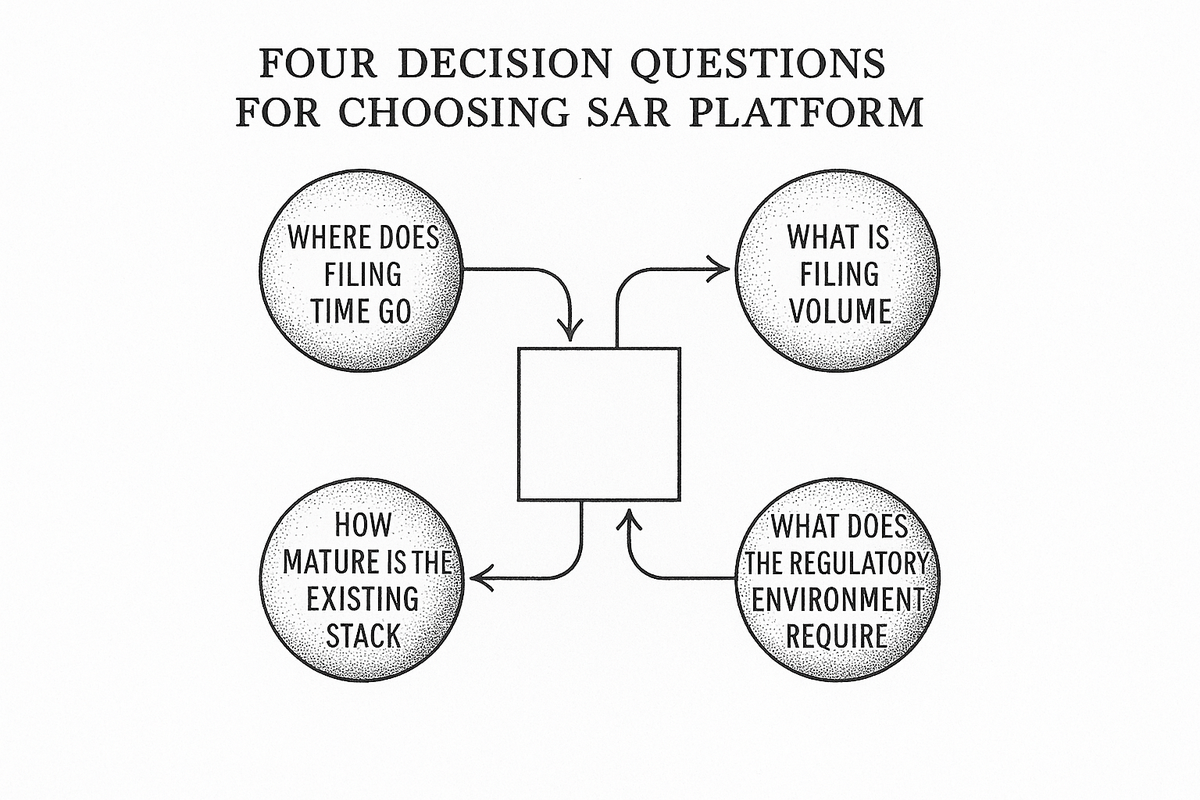
Choosing SAR filing software is not a feature-matching exercise. It is a decision about where in the filing lifecycle the institution's actual bottleneck sits, and which platform addresses that constraint without introducing new ones. Four questions frame the decision.
Where does filing time actually go?
Most compliance teams assume their bottleneck is the filing form itself. It rarely is. The time goes to investigation, evidence assembly, and narrative drafting, the work that happens before anyone opens a FinCEN form. If the bottleneck is upstream, platforms like Sphinx and Hummingbird that automate investigation and narrative generation will deliver more impact than platforms that optimize the form-filling step. If the bottleneck is literally the filing submission process, direct e-filing from Abrigo, Verafin, or Unit21 addresses that directly.
What is the institution's filing volume and complexity?
A community bank filing 50 SARs per quarter has different needs than a fintech filing 500 per month across multiple jurisdictions. Abrigo and Verafin serve the former with right-sized pricing and community banking expertise. Unit21 and Flagright serve the latter with API-first architecture and multi-jurisdictional coverage. NICE Actimize serves Tier 1 banks where volume, complexity, and regulatory scrutiny all operate at the highest level. Matching the platform to actual volume prevents both underspending and overspending.
How mature is the existing compliance stack?
Institutions with established case management and transaction monitoring systems need a filing solution that integrates rather than replaces. Sphinx works alongside existing infrastructure without requiring migration. Hummingbird and Unit21 provide their own case management but also integrate with external systems. NICE Actimize works best when the institution is already running the ActOne suite. Rip-and-replace implementations carry cost and risk that incremental approaches avoid.
What does the regulatory environment require?
FinCEN's April 2026 proposed rule explicitly encourages the responsible use of AI, machine learning, and generative AI in AML programs, and states that institutions experimenting with innovative technologies will not face additional supervisory risk solely for using them. This regulatory posture means AI-assisted SAR drafting is not just permissible but encouraged, provided human oversight, auditability, and the institution's accountability for filing decisions remain intact. Platforms that provide explainable AI with full audit trails align with this direction. Those that use opaque automation do not.
Red Flags in SAR Software Vendor Evaluations
Vendor evaluations for SAR filing software reveal warning signs that experienced compliance teams learn to recognize. Any vendor that cannot demonstrate a live SAR filing from alert through FinCEN acceptance during a demo is showing a prototype, not a product. AI narrative generation that produces fluent text without source citations or evidence attribution is a liability, not a feature, because examiners will ask where each claim in the narrative came from.
Vendors that quote filing time savings without specifying whether the baseline includes investigation and narrative work are measuring the wrong thing. Filing the form takes minutes. Preparing a defensible filing takes hours. Claims of "90% faster SAR filing" that measure only the form submission step are accurate and irrelevant. Watch for platforms that require the institution to export data into a separate filing system, because every manual transfer introduces error risk and breaks the audit trail. And evaluate whether the platform handles continuing activity reports automatically, including FinCEN's updated guidance that removed the rigid 90-day requirement in favor of risk-based filing timelines.
Frequently Asked Questions
What is SAR filing software and why do financial institutions need it?
SAR filing software automates the creation, validation, and submission of Suspicious Activity Reports to FinCEN and other financial intelligence units. Financial institutions covered by BSA rules are required to file a SAR within 30 days of detecting suspicious activity involving $5,000 or more when a subject is identified, or $25,000 or more when no subject is identified. With over 4.1 million SARs filed in 2025, manual filing processes using spreadsheets and copy-paste workflows create quality risks, missed deadlines, and audit deficiencies that SAR filing software is designed to eliminate.
Can AI generate SAR narratives that regulators will accept?
Yes. There is no rule prohibiting AI assistance in drafting SAR narratives, and FinCEN's April 2026 proposed rule explicitly encourages the responsible use of AI and generative AI in AML programs. The legal requirement is that the institution and its compliance officer remain accountable, the decision to file is made by a human, and the process is governed and documented. AI-drafted narratives must be grounded in case evidence with per-claim source attribution so that a reviewer can verify every statement before filing. Platforms that meet these standards, including NICE Actimize's X-Sight AI Narrate, Hummingbird's patented automation, and Sphinx's agentic narrative generation, produce filings that satisfy regulatory expectations.
How much does SAR filing software cost?
Pricing varies widely by vendor and institutional size. Community banking platforms like Abrigo and Verafin offer modular pricing accessible to smaller institutions. API-first platforms like Flagright and Unit21 offer startup-friendly tiers with usage-based pricing. Enterprise solutions from NICE Actimize typically start at $500,000 or more annually. Overlay solutions like Sphinx operate on SaaS subscription models. Total cost of ownership should include implementation, integration, training, and ongoing maintenance, not just the license fee. A platform that costs less per filing but takes 12 months to deploy may cost more over three years than a pricier solution that goes live in weeks.
What changed with FinCEN's October 2025 SAR guidance?
FinCEN, jointly with the Federal Reserve, FDIC, NCUA, and OCC, issued FAQ guidance in October 2025 that clarified several SAR obligations. Notably, the guidance confirmed that financial institutions are not required to conduct separate post-SAR reviews and may rely on risk-based internal controls. It also clarified that the previously suggested 90-day continuing SAR filing cycle is not mandatory, and institutions may file continuing activity reports on risk-based timelines instead. Additionally, the guidance stated there is no requirement to document a decision not to file a SAR. These changes reduce compliance burden while maintaining the core obligation to report genuinely suspicious activity.
What is the difference between SAR filing software and AML case management software?
AML case management software organizes investigations, tracks tasks, manages evidence, and routes decisions through approval workflows. SAR filing software specifically handles the conversion of investigation findings into regulatory report format, validation against filing requirements, electronic submission to regulators, and post-filing record retention. Many platforms combine both capabilities, but the distinction matters because strong case management does not guarantee strong filing automation. The filing step requires FinCEN form field mapping, narrative generation, pre-submission validation, and e-filing integration, which are specialized capabilities that not every case management platform provides natively.
.png)