

TL;DR: Credit unions face document fraud at three entry points most banks do not share: member onboarding, indirect lending, and shared branching. BCU, a member-owned credit union, prevented $80 million in fraud losses using AI-powered document detection. With NCUA’s 2026 supervisory priorities explicitly listing fraud prevention and roughly 6% of all documents now flagged as fraudulent across the industry, credit unions need detection capabilities matched to their cooperative structure.
Three Entry Points Banks Don’t Have
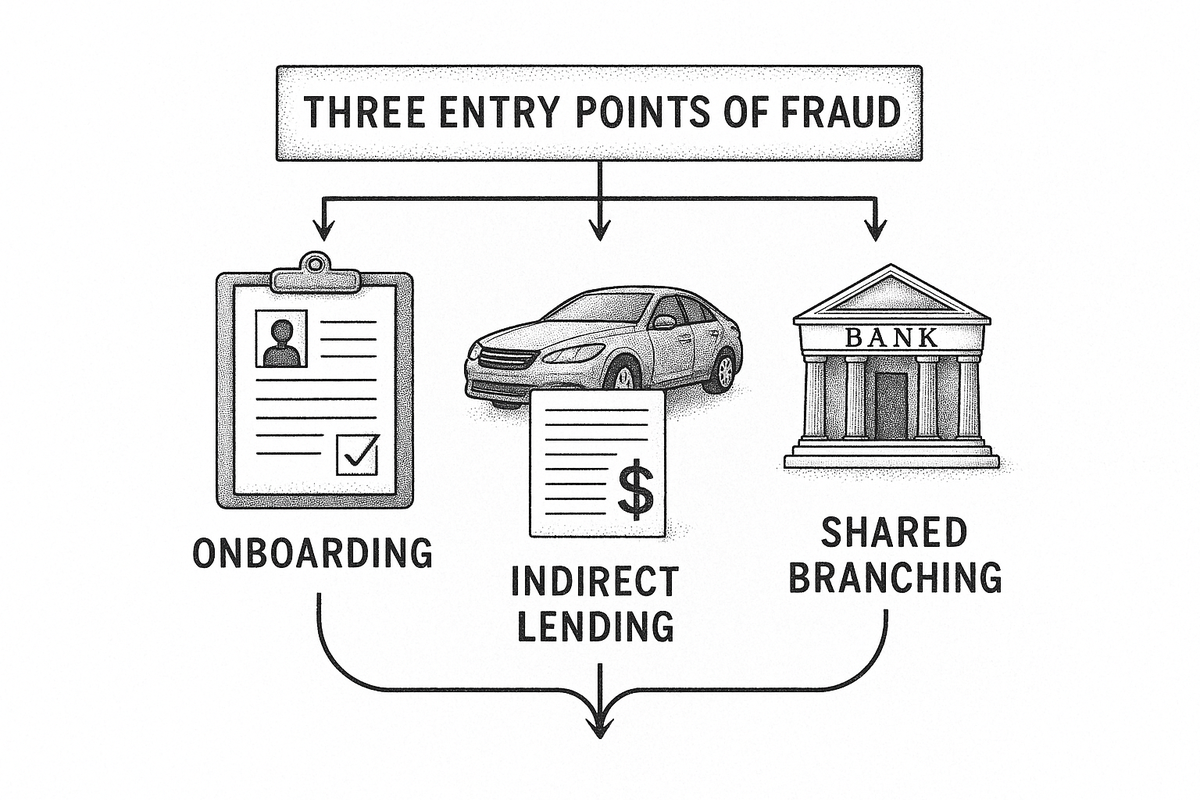
Credit unions operate under a cooperative model that creates document fraud exposure at points traditional banks rarely encounter. Three attack surfaces stand out: member onboarding designed for convenience over adversary resistance, indirect lending where the credit union does not control document collection, and shared branching where fraud can enter through another institution’s weaker controls.
Member Onboarding
Credit unions have historically optimized onboarding for accessibility and low friction. Field of membership verification — confirming a prospective member qualifies through an employer, geographic area, or association — adds documentation steps that do not exist in standard bank account opening. Employer letters, association memberships, and address verification documents create gaps that fraudsters exploit with synthetic identity packages. These packages arrive with matching pay stubs, employer verification letters, and proof of residency that satisfy field of membership requirements while establishing a fraudulent relationship from day one.
Fraudsters prioritize credit unions precisely because digital onboarding workflows are optimized for member convenience, not document scrutiny. The result is an onboarding pipeline that moves fast but does not verify whether the documents driving the process are authentic.
Indirect Lending
In indirect lending, the dealer or merchant collects the borrower’s documents — pay stubs, tax returns, proof of residency, membership applications — and forwards them to the credit union for approval. NCUA guidance is clear that no credit union may delegate loan approval authority to a third party. But while the credit union retains approval authority, it does not control the integrity of documents collected at the dealer level.
Missing stipulations are common — proof of income not submitted, residency verification incomplete, membership applications filled out by the dealer rather than the applicant. Detecting fraudulent documents at the point of receipt, before funding, is where the gap closes. First payment defaults often serve as the earliest fraud signal, which means the credit union has already funded the loan before any red flag surfaces.
Shared Branching
Shared branching allows credit union members to transact at other credit unions within the cooperative network. A member of Credit Union A walks into Credit Union B and conducts transactions as if at their home institution. The host credit union authenticates the member and processes the transaction, but authentication standards and document verification capabilities vary across the network.
A host credit union with weaker identity verification controls can let fraudulent transactions pass through to the home credit union’s accounts. Responsibility for detecting fraud within the shared branching network remains unclear — the host processes the transaction, but the home credit union absorbs the loss. The weakest link in the cooperative determines the fraud exposure for every participant.
Why Credit Union Fraud Teams Are Outmatched
Most credit union fraud teams consist of two to five people. They handle everything from check fraud to electronic crime to loan fraud investigations. These small teams now face industrialized fraud operations that produce synthetic identity packages at scale — matched pay stubs, tax documents, employer verification letters, utility bills, and bank statements that are internally consistent and designed to survive manual review.
The volume problem is concrete. According to Inscribe’s 2026 State of Document Fraud Report, approximately 6% of all documents processed across their network were flagged as fraudulent — roughly one in sixteen documents showing signs of manipulation, fabrication, or misrepresentation. A credit union processing 500 loan applications per week with three documents each faces roughly 90 potentially fraudulent documents per week. For a three-person fraud team, that is 30 flagged documents per investigator per week, on top of every other case in the queue.
AI-generated document fraud compounds the challenge. Inscribe’s data shows detected AI-generated document fraud increased nearly 5x from April to December 2025. While AI-generated fraud still comprised less than 5% of total fraudulent documents detected, its growth rate means the tools are becoming accessible and the output is becoming harder to distinguish from authentic documents. Fraud teams that rely on visual inspection and specimen-image comparison cannot keep pace.
The cooperative loss structure amplifies the stakes. When a bank absorbs fraud losses, shareholders bear the cost. When a credit union absorbs fraud losses, member equity absorbs the cost — every dollar lost to document fraud reduces the credit union’s capacity to offer competitive loan rates, pay dividends, and invest in member services. The financial impact falls directly on the people the institution exists to serve. Understanding the intersection of fraud and AML operations is one step toward building detection that works across both domains.
What NCUA Examiners Evaluate in 2026
The NCUA 2026 Supervisory Priorities explicitly list fraud prevention and detection as an examination focus area. Examiners will review internal controls, governance frameworks, and the effectiveness of fraud detection systems as part of their risk-focused examinations. The priorities also emphasize vendor management and third-party oversight — directly relevant for credit unions deploying AI-powered detection tools.
FinCEN’s regulatory trajectory reinforces the direction. The November 2024 deepfake media alert (FIN-2024-Alert004) outlined red flag indicators for GenAI-created fraudulent documents and reminded financial institutions — credit unions included — of their BSA reporting obligations when they suspect deepfake-related fraud. FinCEN’s proposed rule on AML/CFT program effectiveness shifts the evaluation framework from checkbox compliance to outcome-based assessment, meaning credit unions need to demonstrate that their fraud detection controls produce results, not just that procedures exist on paper.
In practice, examiners look at separation of duties between loan origination and document verification, internal controls for detecting altered or fabricated documents, audit trails that document how fraud decisions were made, and due diligence processes for any AI vendors used in the detection workflow. Credit unions that cannot explain how their detection system reached a conclusion — or that rely entirely on manual review with no systematic documentation — face examination friction that goes beyond the fraud itself.
What Detection at Credit Union Scale Looks Like
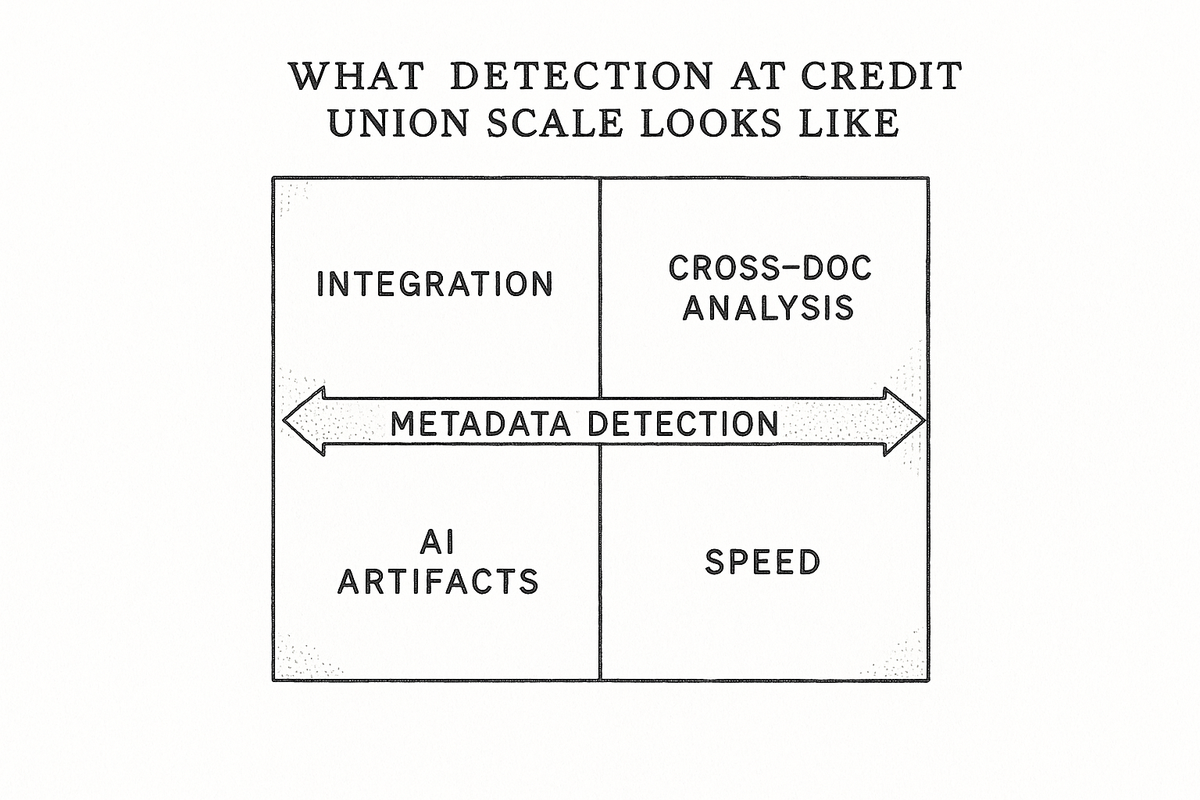
Evaluating document fraud detection for credit unions requires criteria matched to how credit unions actually operate. Four capabilities separate effective solutions from products that create more integration burden than fraud prevention value.
Integration with credit union core systems is the first filter. Credit unions run on specialized platforms — Symitar and Jack Henry, DNA by Fiserv, Corelation KeyStone — that differ from the core banking systems most fraud detection tools are designed for. A solution that requires months of API integration or a core system upgrade is not viable for a credit union with a small IT team. Detection methods that work within existing systems without requiring the credit union to rebuild its technology stack are the ones that actually get deployed.
Cross-document analysis catches what single-document review misses. Fraud rings reuse templates, employer names, and formatting patterns across multiple applications. A pay stub that looks clean in isolation reveals itself when the same template has appeared in six other applications across the credit union’s portfolio. In shared branching scenarios, this cross-document intelligence becomes even more valuable — detecting patterns that span the cooperative network rather than stopping at a single institution’s portfolio.
Metadata and AI artifact detection addresses the growing category of AI-generated documents. Template-based fraud leaves different forensic traces than AI-generated fraud — compression artifacts, noise distributions, font rendering inconsistencies, and metadata signatures all differ depending on the tool used to create the document. Effective detection runs both template-matching and AI-artifact analysis on every document, rather than checking for one fraud type and missing the other.
Speed protects the member experience. Credit unions compete on service and relationships, not scale. A detection system that adds two days to loan processing or forces applicants through multiple verification rounds undermines the member relationship that differentiates credit unions from banks. Detection needs to return results fast enough that members do not notice a delay — ideally within the same session, whether at a branch, through a dealer, or in a digital application.
Where Sphinx Fits
Sphinx’s browser-based agents operate inside existing credit union core systems without requiring API integration or infrastructure changes. Agents log into the same platforms staff use, review documents using the same data sources, and generate auditable decision trails that document every step of the fraud review for NCUA examiners. For credit unions evaluating detection solutions, the deployment model matters as much as the detection accuracy — a tool that works on day one, inside the systems already in place, removes the integration burden that keeps most credit unions stuck on manual review.
Frequently Asked Questions
How does document fraud affect credit union members differently than bank customers?
Credit unions are member-owned cooperatives, so fraud losses are absorbed by member equity rather than corporate shareholders. Every dollar lost to document fraud reduces the credit union’s capacity to offer competitive loan rates, pay dividends on share accounts, and invest in member services. The financial impact is distributed directly across the membership.
What types of documents are most commonly forged in credit union fraud?
Pay stubs and bank statements account for the majority of document fraud across credit unions and lenders. Inscribe’s data shows bank statements represent 59% of fraudulent documents industry-wide, followed by pay stubs and tax returns. Credit unions also see fraudulent employer verification letters and proof of residency documents tied to field of membership verification requirements.
Does NCUA require credit unions to use AI for fraud detection?
NCUA does not mandate any specific technology for fraud detection. The 2026 supervisory priorities focus on whether credit unions have effective internal controls, adequate separation of duties, and demonstrable fraud prevention outcomes. Credit unions that use AI tools are expected to conduct third-party vendor due diligence and maintain oversight of how the tool reaches its decisions.
How does shared branching create fraud risk for credit unions?
Shared branching allows members to transact at other credit unions within the cooperative network, but authentication and document verification standards vary across participating institutions. A host credit union with weaker controls can process fraudulent transactions that the home credit union ultimately absorbs. The decentralized nature of the network makes coordinating fraud detection signals across institutions difficult.
What should a credit union look for when evaluating document fraud detection vendors?
Integration with credit union core systems (Symitar, Jack Henry, DNA, KeyStone), cross-document analysis that catches fraud rings reusing templates, metadata and AI artifact detection for AI-generated documents, processing speed that does not degrade the member experience, and auditable decision trails that satisfy NCUA examination requirements. Deployment complexity matters — solutions that require extensive IT integration are impractical for most credit unions.
.png)