

TL;DR: Transaction monitoring software prices range from $0.02 per transaction for API-first tools to $500,000+ annually for enterprise suites. With false positive rates still at 90-95% industry-wide, the ROI case depends less on detection capability and more on how efficiently the platform handles the investigation workload those detections create. This comparison covers pricing, features, and what actually drives return on investment.
Why Pricing Alone Does Not Tell the Story
Transaction monitoring software pricing is notoriously opaque. Most vendors hide behind "contact sales" pages, making direct comparison difficult. But even where prices are public, licensing fees represent a fraction of total cost. Implementation, integration, staffing, and ongoing tuning drive the real expense — and the real ROI calculus.
A platform that costs $50,000 annually but requires a 12-month implementation and two dedicated engineers has a fundamentally different cost profile than one that costs $100,000 but deploys in three weeks with self-service configuration. The best transaction monitoring platforms are evaluated on three-year total cost of ownership, not annual licensing.
Pricing Models Across the Market
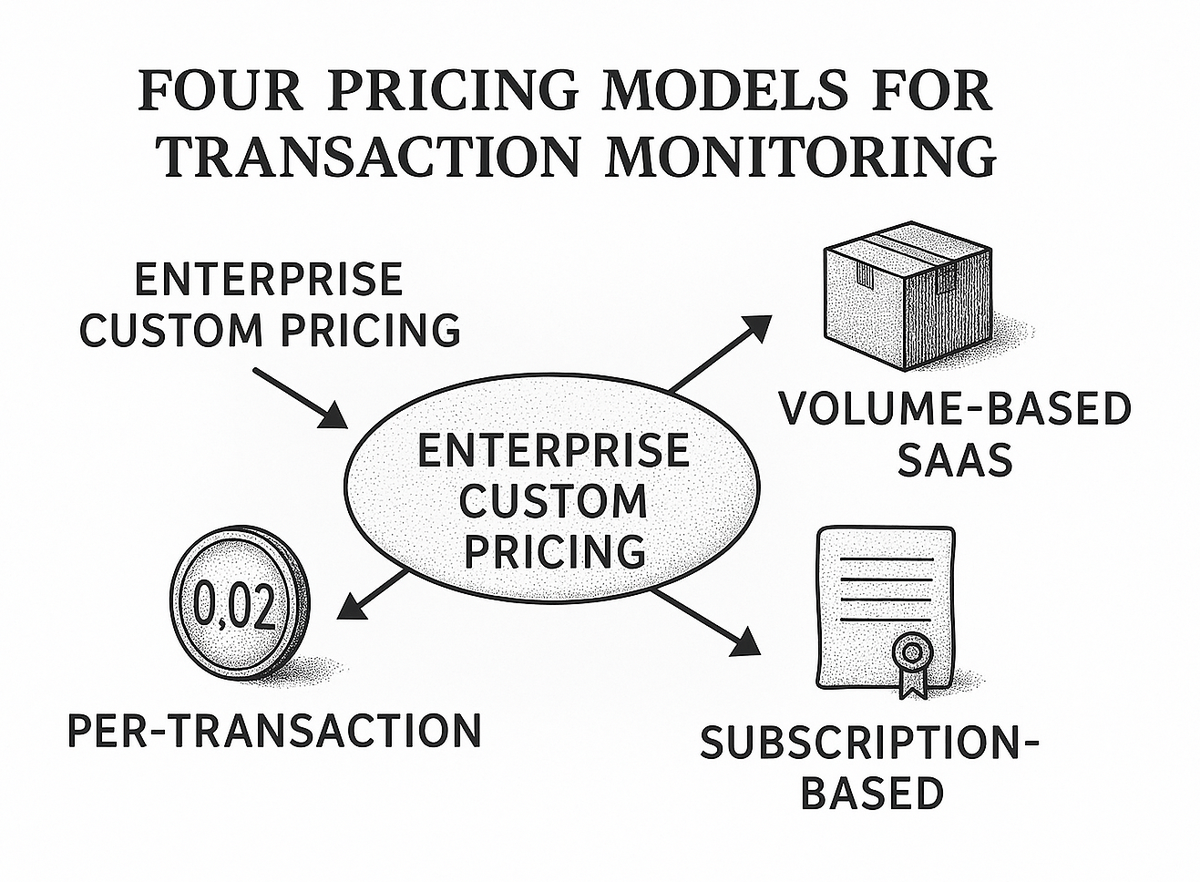
Transaction monitoring vendors use four pricing architectures, each with different scaling characteristics.
Enterprise custom pricing is the norm for incumbents like NICE Actimize, Oracle FCCM, SAS, and Feedzai. Licensing typically starts above $500,000 annually for mid-size institutions, with implementation costs that can exceed the first year of licensing. These platforms are built for tier-one banks processing billions of transactions. For institutions at that scale, the per-transaction cost is low. For mid-market buyers, the fixed overhead makes them economically impractical.
Volume-based SaaS pricing is used by platforms like ComplyAdvantage and Hawk AI. Costs scale with the number of transactions screened or customers monitored. ComplyAdvantage offers startup-friendly pricing through its ComplyLaunch program, with up to 12 months free for eligible companies. This model aligns cost with growth but can spike unpredictably during periods of rapid transaction volume increases.
Per-transaction pricing is the most transparent model. Didit publishes a flat $0.02 per transaction with no minimums, no contracts, and no setup fees. This is the most predictable model for fintechs, though buyers should evaluate whether the monitoring depth matches their regulatory requirements — the cheapest platform is not the best value if it generates compliance gaps.
Subscription-based pricing is used by platforms like Unit21 and Hawk AI for their core SaaS offerings. Annual contracts with tiered pricing based on company size or transaction volume. SEON starts at $699/month for 2,500 checks. These models offer predictability but typically require annual commitments.
Features That Drive ROI
Every transaction monitoring vendor lists the same core capabilities: rules engine, alert generation, case management, regulatory reporting. The features that actually drive ROI are the ones that reduce the cost of handling alerts — because alert investigation is where compliance teams spend most of their time and budget.
False positive reduction. Industry-wide, 90-95% of transaction monitoring alerts are false positives. Every false positive costs analyst time to investigate, document, and close. Platforms that reduce false positives through better contextual matching, behavioral analytics, and AI-driven triage deliver the most immediate ROI. ComplyAdvantage reports 60-80% reduction in false positives. Unit21 reports up to 85%. Hawk AI reports 70%+. These numbers translate directly into recovered analyst capacity.
Self-service rule configuration. Platforms that require engineering resources to adjust detection rules create ongoing dependency costs. No-code rule builders — offered by Unit21, ComplyAdvantage, and Hawk AI — let compliance teams iterate on detection logic independently. The ROI comes from faster response to new typologies and reduced engineering overhead.
Automated investigation workflows. The gap between detection and disposition is where most operational cost sits. Platforms with AI-powered investigation agents — like Unit21's Investigation Agent or agentic compliance systems — automate evidence gathering, narrative drafting, and disposition recommendations. Unit21 reports 44-93% reductions in handle time. This is the single largest ROI lever in transaction monitoring.
Backtesting and shadow mode. Deploying poorly tuned rules generates alert floods that overwhelm analysts. Platforms that let compliance teams test new rules against historical or live data before activation — Unit21, Hawk AI, and Feedzai offer this — prevent the costly cycle of deploy-flood-retune that plagues rule-based systems.
Network intelligence. Standalone transaction monitoring sees only your institution's data. Consortium-based platforms like Unit21 share anonymized fraud signals across member institutions, providing early warning on emerging typologies. A pattern identified at one institution propagates across the network immediately, rather than being rediscovered independently weeks later.
Calculating Three-Year Total Cost of Ownership
A realistic TCO comparison accounts for five cost layers beyond licensing.
Implementation. Enterprise platforms (NICE Actimize, Oracle, SAS) require 12-18 months of implementation work, often involving system integrators at $200-400/hour. API-first platforms (ComplyAdvantage, Unit21) deploy in 2-6 weeks with internal resources. The implementation delta can exceed $500,000.
Integration. Transaction monitoring systems need clean data feeds from core banking, payment processing, and customer management systems. Platforms with deep pre-built connectors reduce integration cost. Platforms that require custom data mappings add engineering months.
Staffing. Enterprise platforms typically require dedicated compliance technology staff to manage scenarios, tune rules, and maintain the system. Cloud-native platforms with self-service configuration reduce this requirement. Overlay solutions like Sphinx eliminate the staffing requirement entirely by working within existing systems.
Tuning and maintenance. Detection rules decay as financial crime patterns evolve. Platforms that automatically suggest rule optimizations based on alert outcomes reduce ongoing tuning costs. Platforms that require manual scenario development need periodic investment in typology analysis and rule calibration.
Regulatory reporting. Built-in SAR and CTR filing workflows eliminate the manual reporting overhead. Platforms that require export to separate reporting tools add process cost and audit risk at the handoff point.
Where Sphinx Fits
Sphinx does not replace transaction monitoring software. It resolves the alerts that monitoring systems generate. Agents triage alerts, investigate cases, and draft SAR narratives inside your existing tools — without replacing your detection engine or requiring data migration. Customers report 87% fewer false positives and 98% of cases resolved same-day. For institutions where the bottleneck is investigation workload rather than detection accuracy, Sphinx addresses the cost driver directly. Equals Money automated 87.3% of compliance reviews with this approach.
Frequently Asked Questions
How much does transaction monitoring software cost?
Prices range from $0.02 per transaction for API-first tools like Didit to $500,000+ annually for enterprise suites like NICE Actimize. Most mid-market platforms use volume-based or subscription pricing that is not publicly disclosed. Total cost of ownership over three years — including implementation, integration, and staffing — typically exceeds licensing fees by 2-3x for enterprise platforms.
What is the biggest cost driver in transaction monitoring?
Alert investigation. With false positive rates at 90-95% industry-wide, the majority of compliance team time is spent reviewing and closing alerts that turn out to be benign. Reducing false positives or automating alert triage delivers more ROI than upgrading detection accuracy in most cases.
Should fintechs choose enterprise or API-first transaction monitoring?
API-first platforms like ComplyAdvantage and Unit21 typically offer faster deployment, lower total cost, and self-service configuration suited to fintech teams without dedicated compliance technology staff. Enterprise platforms like NICE Actimize and SAS are designed for tier-one banks with complex multi-jurisdictional requirements and teams that can manage the implementation overhead.
What ROI metrics should compliance teams track?
Track false positive rate reduction, average alert handling time, SAR filing throughput, time to deploy new detection rules, and regulatory examination outcomes. The most meaningful metric is analyst capacity recovered — how many hours per week your team gains back from automated triage, which can be redirected toward complex investigations and program improvement.
Can you use transaction monitoring software alongside an AI overlay?
Yes. Overlay solutions like Sphinx work on top of existing transaction monitoring platforms without replacing them. The monitoring system handles detection and alert generation. The overlay handles investigation, disposition, and reporting. This approach avoids the cost and risk of migrating off an existing monitoring platform while addressing the investigation bottleneck directly.
.png)