

Whether operational in your first market or your fifth, Sphinx lets teams enforce consistent controls across jurisdictions on day one, without slowing onboarding or review cycles.
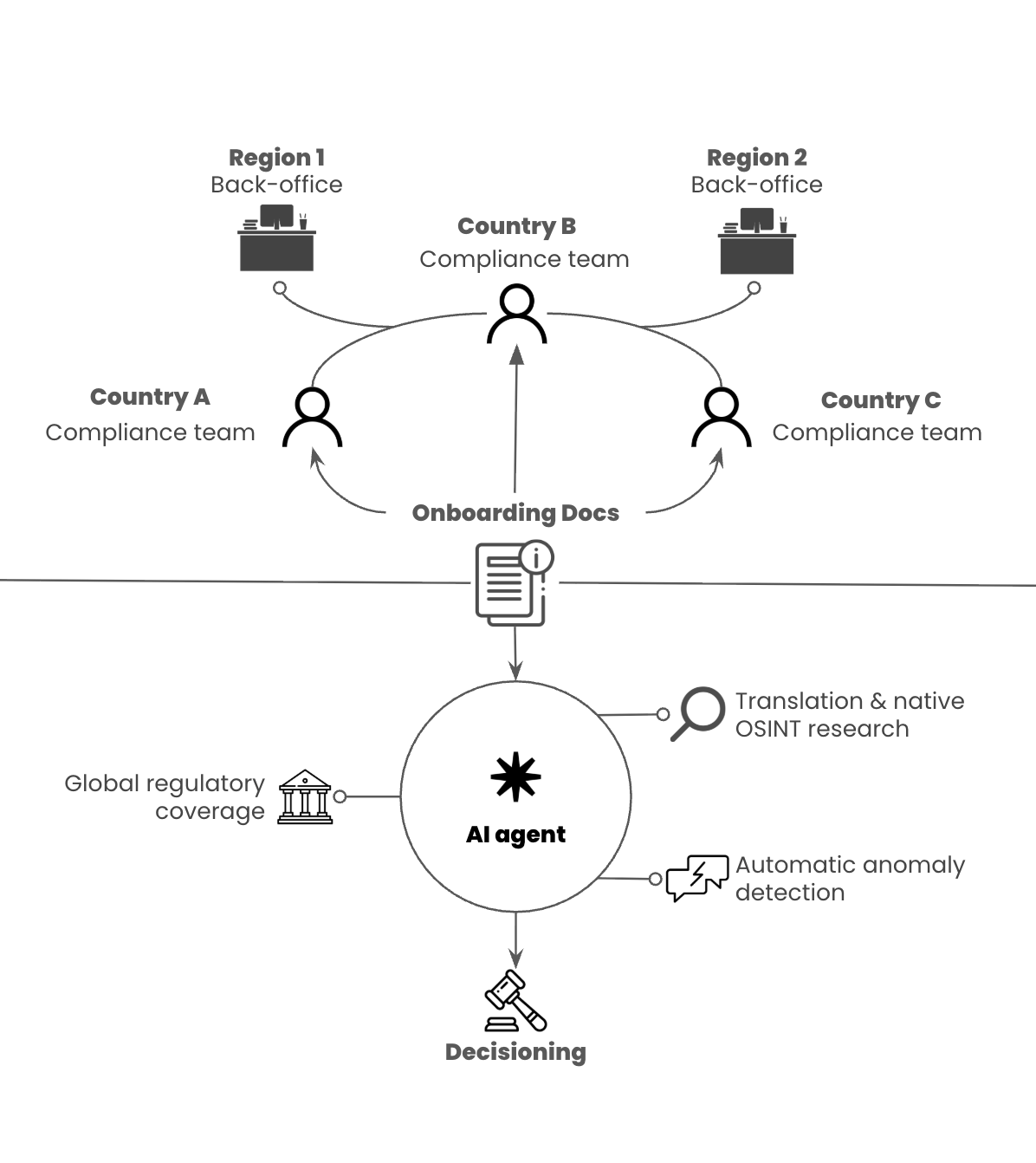
Three fast use cases
1. Multi-country onboarding, standardized.
Your compliance teams need a multi-country program to standardize client onboardings despite different ID schemas and regulations. Sphinx reviews documents against jurisdiction-specific policy packs, performing customized checks, and escalating those cases which represent elevated risk within their regional thresholds.
Outcome: standardized decisions across markets, without breaking SLAs.
2. Proof of funds, verified in seconds.
Your analysts are reviewing payslips for an international client, but are unsure as to the validity of the Proof of Funds. In the meantime, Sphinx checks the embedded transaction reference and issuer metadata against expected formats and detected tampering. The case is escalated with a short memo and evidence attached.
Outcome: an expert, evidence-led escalation ready for immediate action.
3. Transliteration done right.
A sanctions alert was dismissed as a false positive based on an English rendering of the name. Sphinx re-runs the case using native-script sources and transliteration maps, finds the canonical match, and reverses the decision with a clear explanation.
Outcome: faster, more accurate detection with fewer missed true positives.
Global Expertise, Zero Change Management
Keep your stack, workflows, and teams. Sphinx does the adapting.
1. Country-aware rules, always current.
Sphinx ships with policy packs that align to local ID standards, common document types, and regulator expectations. As requirements shift, Sphinx updates the checks so your workflows never break.
2. Document validation that travels.
From rigid financial statement conventions in Brazil to encoded ID numbers in South Africa, Sphinx validates structure, fields, and issuer patterns with regional precision.
3. No engineering lift.
Sphinx operates like an analyst: it logs into the tools you already use, reads cases, makes decisions, and writes back reasoning. Engineering priorities stay focused where they matter.
Compliance that speaks every language
Sphinx evaluates names and documents natively, not just in translation, reducing human error and increasing control accuracy.
Sphinx resolves Latin-script names against Arabic, Cyrillic, CJK, and other variants using canonical forms and similarity thresholds. Our AI agents read local registries and media in their source language, reconciling DOB, geography, and role before dispositioning.
Every memo includes the transliteration logic, native-script evidence, and sources, so reviewers and auditors see both the outcome and the rationale behind it.
What this changes on day one
1. Consistent outcomes across markets.
The same risk story yields the same decision – whether in Brazil or Bahrain.
2. Less manual variance.
Analysts focus on edge cases; Sphinx handles repeats and explains exceptions due to regional differences.
3. Lower cost per decision.
Routine false positives close automatically with attached reasoning; escalations arrive summarized.
4. Audit-ready by default.
Every step is logged, replayable, and tied to country-specific rules.
Cross-border growth without limits
Global controls shouldn’t be multi-quarter projects. With Sphinx, they’re your day-one default: consistent, explainable decisions; document checks that understand local context; and language-aware matching that reduces false negatives.
You scale across borders without scaling headcount, and you keep governance clean while you do it.
.png)