TL;DR: FinCEN 314(a) information sharing is a mandatory government-to-institution search: law enforcement asks FinCEN to query U.S. financial institutions for accounts and transactions tied to named subjects reasonably suspected of terrorism or money laundering. As of March 17, 2026, FinCEN's 314(a) Fact Sheet reports 8,747 processed requests (928 terrorism or terrorist financing, 7,819 money laundering). Matches go back through FinCEN's portal within 14 days of posting. Negative searches require no reply. Section 314(b) is a different program: voluntary institution-to-institution sharing under a safe harbor.
A Law Enforcement Canvass, Not a Watchlist
FinCEN 314(a) information sharing is the process FinCEN uses to ask covered financial institutions whether they hold accounts or have conducted transactions for a named person, entity, or organization. The legal basis is Section 314 of the USA PATRIOT Act, implemented for this program at 31 CFR 1010.520. A requesting agency certifies that the subject is engaged in, or reasonably suspected based on credible evidence of engaging in, terrorist activity or money laundering. FinCEN reviews that certification, then posts the subject list to designated points of contact through the Financial Industry Portal at fiportal.fincen.gov, the successor to the legacy Secure Information Sharing System.
The output is lead information. FinCEN's fact sheet is explicit: a 314(a) match is not a substitute for a subpoena or other legal process. Law enforcement that wants the underlying documents still has to meet the legal standard for the tool it chooses. The institution's job is to search, report positive matches, keep the request confidential, and document that the work was done. Subject lists are not a standing watchlist and are not updated when an investigation is dropped or a subject is exonerated. Using a 314(a) name as the sole reason to refuse or close an account is the opposite of what the FFIEC BSA/AML Manual tells banks to do. A match can feed BSA analysis, including a SAR decision, but the match itself is not a filing trigger and is not an OFAC hit.
314(a) and 314(b) Are Different Programs
Section 314 created two information-sharing channels. They share a statute number and a FinCEN portal. That is where the similarity ends. 314(a) is government-to-institution and mandatory once a request is posted. 314(b) is voluntary institution-to-institution sharing under 31 CFR 1010.540, with a statutory safe harbor if the conditions are met. Sphinx's companion explainer on FinCEN 314(b) information sharing covers the June 2026 fact sheet and registration. This article stays on 314(a).
Mixing the two shows up in exams as the wrong policy or a team treating 314(a) names like a 314(b) typology feed. 314(a) lists cannot be shared with a foreign office, branch, or affiliate unless the request specifically allows it.
How the Request Reaches the Bank
FinCEN posts 314(a) cases on a bi-weekly cycle. Designated points of contact receive a notification that new information is available in the portal. Emergency requests can go out off-cycle. The FinCEN Section 314(a) page is the public entry point; operational FAQs for participants live in the portal or can be requested from FinCEN's 314 Program Office at sys314a@fincen.gov.
Before FinCEN posts anything, the requesting agency certifies credible evidence of terrorist financing or money laundering and supplies identifiers sufficient to distinguish common names — typically date of birth, address, and taxpayer identification number, plus a named agency contact. For money laundering requests, FinCEN also requires the matter to be significant and that traditional investigative methods have been exhausted. That filter exists because 314(a) canvasses the industry; it is not the first lookup in a routine case.
The December 23, 2025 Federal Register notice for OMB Control Number 1506-0049 estimated 12,726 expected respondents and approximately 44 hours of annual burden per respondent (555,702 hours industry-wide). Those figures describe the standing search obligation. Cumulative case volume sits on a different ledger: FinCEN's March 17, 2026 fact sheet counts 8,747 processed requests since the program began, heavily weighted toward money laundering rather than terrorism. Each covered institution should designate one or more 314(a) POCs through its primary federal supervisor. Stale contacts are a common exam finding: lists post, nobody downloads them, and the 14-day clock still runs.
What Records to Search, and the 14-Day Clock
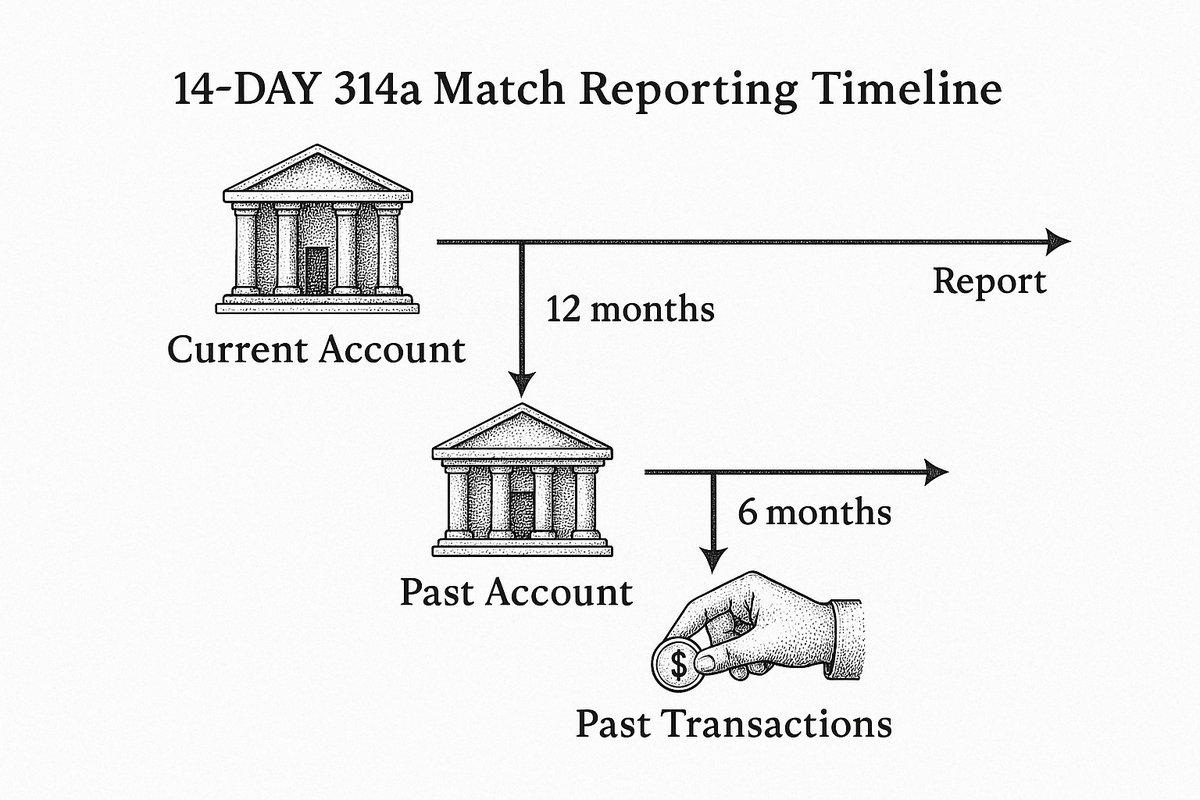
Unless FinCEN specifies otherwise, the required search window is defined. Institutions search for any current account for a named subject; any account maintained for that subject during the preceding 12 months; and any transaction conducted by or on behalf of the subject during the preceding six months that the institution is required to record or that it records and maintains electronically. Funds-transfer searching is limited to records kept under 31 CFR 1010.410, and only where the institution was the originator's bank or the beneficiary's bank.
Positive matches must be reported through the portal within 14 days of the posting date, or within any shorter window FinCEN states. 31 CFR 1010.520(b)(3)(ii) says a match report includes the subject's name, each account number or the date and type of each matching transaction, and identifying information provided when the account was opened or the transaction was conducted. FinCEN has long accepted a portal confirmation of the match, with optional comments.
Negative searches require no response. Silence is the designed outcome for most subjects at most institutions, which makes internal logging the only proof the search happened. Examiners will not see a FinCEN "all clear." They will ask for download history, systems queried, completion date, and who signed off. FinCEN recommends forwarding requests to domestic subsidiaries or affiliates that offer in-scope accounts, but those entities search only if they themselves are financial institutions subject to 31 CFR 1010.520. Third-party vendors may run the record search under a confidentiality agreement. Vendors cannot receive portal credentials or direct FI Portal access.
Confidentiality, Use Limits, and What Examiners Read
A 314(a) request may be used for three purposes only: reporting the required information to FinCEN; deciding whether to establish or maintain an account or engage in a transaction; and assisting with BSA/AML compliance, including SAR analysis. That last use sits inside the five pillars of an AML compliance program: independent testing and training should cover 314(a) the same way they cover CIP and monitoring.
Disclosure of the fact that FinCEN requested information is prohibited except to FinCEN, the institution's primary federal regulator, or the law enforcement agency on whose behalf FinCEN is asking. Customer-facing staff and the subject of the request are outside that circle. GLBA-style customer information safeguards are treated as sufficient for 314(a) files if they are actually applied to these lists.
A 314(a) match does not, by itself, require a SAR. The filing decision follows the same suspicious-activity rules as any other case. If the institution files, the narrative should explain the activity and the institution's analysis — not announce that FinCEN posted a 314(a) name. Guidance on how to write a better SAR narrative still applies: facts, chronology, and why the activity is suspicious, without leaking the existence of the government request.
FinCEN's 314(a) FAQs recommend retaining evidence that every required search was performed and that positive matches were reported, even though the rule does not prescribe a retention schedule. The portal's activity report is the easiest official artifact. Pair it with a search log: request identifier, posting date, systems and date ranges queried, reviewer, completion date, match or no-match, and portal confirmation if a match was filed. That file is what community bank BSA exam preparation should put in the exam binder next to CIP samples and SAR metrics.
Missed searches have a defined catch-up. If the institution failed to complete one or more 314(a) requests received in the previous 12 months, it must obtain those prior requests from FinCEN and search records as they existed at the original posting date — not accounts opened afterward. Matches found in that catch-up are reported through the portal within 14 calendar days of receiving the prior request. Requests older than 12 months do not have to be reconstructed. A missed 314(a) cycle is not a regulator-ordered AML lookback review, but the documentation habit is similar: a closed population, a fixed as-of date, and a written record of what was searched and what was found.
Where Sphinx Fits
Sphinx operates as an AI-native compliance layer inside the systems analysts already use. Agents can assemble 314(a) search evidence — systems queried, date ranges, identifiers — and attach that trail to the case file without portal credentials. Human POCs still download FinCEN's lists and submit matches. The result is an examiner-readable record of the search, the match decision, and any SAR analysis that followed.
Frequently Asked Questions
What is the difference between FinCEN 314(a) and 314(b)?
314(a) is a mandatory government-to-institution search under 31 CFR 1010.520. FinCEN posts named subjects; the institution searches specified records and reports matches within 14 days. 314(b) is voluntary institution-to-institution sharing under 31 CFR 1010.540. The recipient of a 314(b) inquiry has no duty to reply.
How long do financial institutions have to respond to a 314(a) request?
Positive matches must be reported through FinCEN's portal within 14 days of the posting date, unless the request sets a different deadline. Negative searches require no reply. Emergency postings can arrive off the usual two-week cycle, so the clock is tied to each posting date, not to a fixed Tuesday.
Does a 314(a) match require a SAR?
No. The FFIEC manual and FinCEN's 314(a) FAQs state that identifying an account or transaction for a named subject does not by itself require a SAR. The institution may use the information for BSA analysis and should file only if the activity independently meets suspicious-activity reporting standards. The SAR must not disclose that FinCEN made a 314(a) request.
What records must be searched under 314(a)?
Unless FinCEN specifies otherwise, search current accounts, accounts maintained for the named subject in the preceding 12 months, and recorded transactions by or on behalf of the subject in the preceding six months, including funds-transfer records kept under 31 CFR 1010.410 where the institution was the originator's or beneficiary's bank. Lists generally cannot be sent to foreign offices unless the request says otherwise.
What if the bank missed a 314(a) search?
For requests received in the previous 12 months that were not completed, contact FinCEN's 314 Program Office, obtain the prior lists, and search records as of the original posting date. Report any matches within 14 calendar days. Requests older than 12 months do not require a retroactive search. Examiners treat a silent gap as a control failure even when no matches exist.
.png)