
TL;DR: Document fraud statistics that appear in public reports measure complaints, SAR narratives, and consumer losses — not whether a submitted PDF was edited after creation. In a six-month window after its mail-theft alert, FinCEN received 15,417 BSA reports from 841 institutions covering more than $688 million in mail theft-related check fraud, and 26 percent of those reports described stolen checks used as templates to produce counterfeits. Visual review still misses competent fakes; the useful signal sits in the file's production method, timestamps, and recycled patterns.
What public document fraud statistics actually count
Document fraud statistics are published numbers that describe forged, altered, or counterfeit documents as they show up in filings, complaints, and consumer reports. They do not, by themselves, tell a fraud analyst whether a bank statement, pay stub, or certificate of incorporation is genuine.
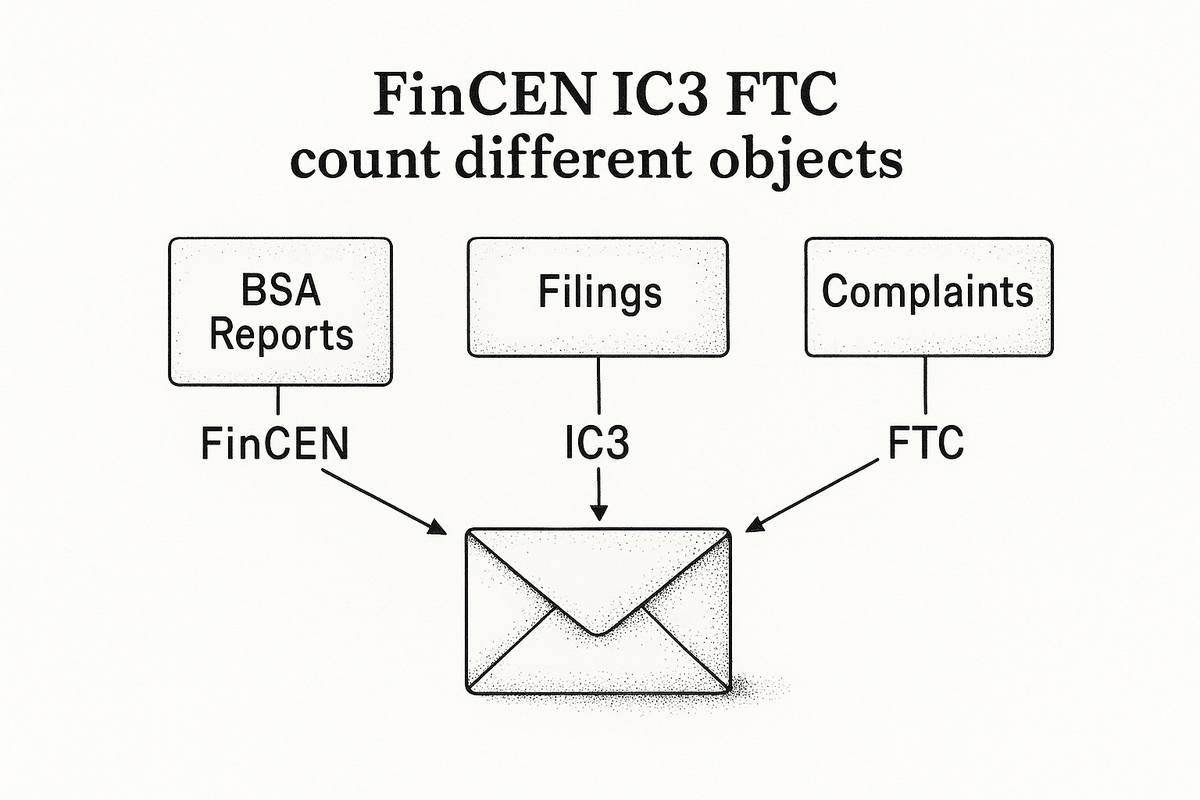
The most citable U.S. figures come from three agencies, and each measures a different object. FinCEN's September 2024 Financial Trend Analysis on mail theft-related check fraud counted BSA reports: 15,417 filings from 841 financial institutions between 27 February and 31 August 2023, covering more than $688 million in actual or attempted transactions. FinCEN's manual review of those reports found three primary outcomes after checks were stolen from the U.S. Mail: 44 percent were altered and deposited, 26 percent were used as templates to create counterfeit checks, and 20 percent were fraudulently signed and deposited. Banks filed 88 percent of the reports.
That 26 percent figure is one of the few official percentages that describe document reproduction as a method, not just a loss total. A stolen check used as a template is a document fraud problem: the instrument that reaches the teller or remote-deposit pipeline is a copy built to look like the original. Teams that only track document fraud in banking as a visual mismatch will under-weight that pattern, because a competent counterfeit does not look wrong on the screen.
The FBI's Internet Crime Complaint Center publishes a different stack. The 2024 IC3 Internet Crime Report recorded 859,532 complaints and $16.6 billion in reported losses, a 33 percent increase from 2023. Credit Card/Check Fraud accounted for 12,876 complaints and $199,889,841 in losses; Identity Theft accounted for 21,403 complaints and $174,354,745. Those rows are useful for scale. They are not a census of fake PDFs submitted at onboarding.
Consumer reporting sits one layer further from the file. According to the FTC's March 2025 release of 2024 Sentinel data, consumers reported losing more than $12.5 billion to fraud, a 25 percent increase over the prior year, and Sentinel received 6.5 million reports in total, including more than 1.1 million identity theft reports. Identity theft and document fraud overlap when a stolen identity is paired with supporting paperwork. They are not the same event. A stolen SSN can travel with a real statement, an edited statement, or a generated one.
Where the published numbers stop
Public series miss the files that never become a SAR, a complaint, or a consumer report. A loan officer who rejects a pay stub in the branch does not create an IC3 record. A fintech that silently drops a KYB packet does not increment FinCEN's mail-theft FTA. The $688 million check-fraud window is large and still only the subset of activity that institutions tagged to FinCEN's alert key term during six months in 2023.
The other gap is generative production. In November 2024, FinCEN issued an alert on fraud schemes involving deepfake media, citing an increase in SAR narratives that describe fraudulent identity documents used to circumvent identity verification. That alert is a typology, not a national percentage of AI-generated PDFs. Related analysis of generative AI document fraud as a compliance risk treats the FinCEN alert as a reporting signal, not as a detection method.
Synthetic identity fraud sits in the same blind spot. Public identity-theft counts capture misuse of personal data. They do not say whether the supporting bank statement was exported by the issuer, edited after creation, or assembled from a template farm. Edited-real files are the harder class: most of the layout, fonts, and issuer chrome are legitimate, and only selected fields — a balance, an EIN, a registration date — have been changed. Generated-from-scratch files can look equally clean and still fail issuer matching, timestamp trails, and model-artifact checks. A dashboard that only shows "fraud losses this quarter" will not distinguish those two production methods.
Read the table as a map of measurement, not as a single national rate.
The tells that still work, and the ones that don't
Visual tells still catch crude work: a stretched logo, a font that does not exist in the issuer's template, a total that does not add. Those catches are real and they are no longer sufficient. Competent edited-real files keep the original production stack and change a small set of values. Generated files can satisfy every layout heuristic a reviewer has been trained to check. FinCEN's check-fraud FTA already showed that sophistication varies: some actors optimize for speed, others invest in disguising the negotiation. The same split now appears in PDFs.
What still works is asking how the file was made. Production method distinguishes an issuer export from a desktop edit or a model render. A timestamp trail shows whether "issued on" matches the file's own history, including saves and exports that a screenshot was meant to hide. Issuer matching tests whether the claimed bank, employer, or registry actually uses that layout. Consistency checks whether running totals, tax lines, and dates agree with each other. Model artifacts flag computational residue that never appears in a bank's own PDF pipeline. Recycled patterns catch the same fake reused across applicants.
None of those six checks is an evasion recipe. Each is a class of signal. A reviewer who only zooms in on pixels will miss the history. A system that only OCR-reads the dollar amount will miss the edit. Screenshot-then-submit remains a common way to strip metadata; that move should raise the review bar, not lower it, because the file's story has been cut short on purpose.
What to do with a suspect file
Treat a suspect file as evidence, not as a vibe. Hold the application. Do not coach the applicant on how to "fix" the PDF. Compare the file against the rest of the package — ID, statement, pay stub, incorporation papers — and look for the same name, address, and income story told three slightly different ways. Escalate when the production method and the claimed issuer disagree. Reject when the file is clearly not an original and the customer cannot produce one through a channel the issuer controls. Break-test the control by running known-clean and known-bad samples through the same path the customer uses.
The fastest way to see the file's story is to check a document in the Watchdoc playground. Upload is free, the first file does not require an email, and the x-ray shows why a verdict landed rather than a score with no trail. Use that output in the case file: production method, timestamp trail, issuer matching, consistency, model artifacts, recycled patterns. The goal is a decision a second reviewer can defend, not a hunch that the PDF "looked off."
Where Sphinx fits
Sphinx scores the file, shows the x-ray, and prices the work at $0.45 per document with no seats and no platform fee. In production, Sphinx reports a 94.3 percent correct verdict, 2.8 times more forgeries caught relative to the controls it replaced, and 1 million documents processed. Clean files clear in under 28 seconds. Those figures describe Sphinx's own pipeline; they are not a substitute for FinCEN or IC3 series, and they are not anyone else's document volume.
Watchdoc sits wherever a team already accepts a file to make a credit, KYB, or onboarding decision. The Watchdoc playground is the same six checks without a procurement cycle. For how the product was framed at launch, see Sphinx Doc Fraud AI forgery detection. Public statistics tell you the problem is large. The file tells you whether this applicant is part of it. Start with the highest-intent file type: how to spot a fake bank statement.
Frequently Asked Questions
What are the most reliable document fraud statistics right now?
The most reliable public figures are agency series with a named method: FinCEN's 15,417 BSA reports and more than $688 million in mail theft-related check fraud, FBI IC3's 859,532 complaints and $16.6 billion in 2024 losses, and the FTC's $12.5 billion in reported consumer fraud losses. None of those series is a national rate of fake PDFs. File-level rates have to come from a system that inspects documents.
How much of FinCEN's check fraud reporting looks like document counterfeiting?
In FinCEN's manual review of mail theft-related check fraud BSA reports, 26 percent described stolen checks used as templates to create counterfeits, 44 percent described altered checks, and 20 percent described fraudulent signatures. Those shares apply to that tagged six-month dataset, not to every SAR filed in the United States.
Do FBI IC3 numbers include fake bank statements and pay stubs?
IC3 counts complaints by crime type as the filer classified them. Credit Card/Check Fraud (12,876 complaints and $199,889,841 in 2024) and Identity Theft (21,403 complaints and $174,354,745) can involve forged instruments, but the report does not break out bank-statement or pay-stub forgeries. Use IC3 for loss scale, not document-type mix.
Why don't regulators publish an AI-generated PDF percentage?
FinCEN's November 2024 deepfake alert describes an increase in SARs about fraudulent identity documents used to beat verification. It does not publish a percentage of all filings that were model-generated. SAR forms were not designed as a generative-AI census. Until filers and vendors inspect production method at the file layer, public data will lag the typology.
What internal metrics should a bank track instead of recycling headline losses?
Track documents reviewed, documents flagged with evidence, time to clear a clean file, and forgeries caught versus the prior control — not a borrowed industry "document fraud rate." Sphinx's production figures (94.3 percent correct verdict, 2.8 times more forgeries caught, 1 million documents processed) are an example of file-level metrics. Copying another vendor's processed-document count as if it were your volume is how statistics get laundered.