


TL;DR: A Schedule K-1 reports a partner's or shareholder's share of income, deductions, and credits. It is not the partnership tax return and not a partnership agreement. FinCEN's November 2006 mortgage loan fraud assessment found material misrepresentation or false statements in 692 of 1,054 sampled SAR narratives, and listed altered earnings documents such as W-2s and income tax returns among the falsifications. A K-1 whose capital account closes can still name a partner the filed return never included.
What a Fake Schedule K-1 Actually Is
A fake Schedule K-1 is a partner, shareholder, or beneficiary schedule offered as proof of income or of an ownership stake the filed return does not support. The IRS partner instructions for Schedule K-1 (Form 1065) state the genuine use: the partnership reports that partner's share of income, deductions, credits, and other items. The partner keeps the copy and does not attach it to the partner's return except where the instructions specifically require it. The partnership files its copy with Form 1065.
Three schedules share the name. Schedule K-1 (Form 1065) is a partner's share. Schedule K-1 (Form 1120-S) is an S corporation shareholder's share, including percentage of stock. Schedule K-1 (Form 1041) is a beneficiary's share from an estate or trust. A partnership capital-account analysis on a shareholder schedule has mixed two forms. None of them is the entity return. Reviewing Form 1065 is a separate job, covered in how to spot a fake tax return.
The schedule is not a partnership agreement or a cap table. Item J records beginning and ending shares of profit, loss, and capital, and those three percentages can differ. In a credit file it stands in for pass-through income, including a share the IRS says can be taxed when it was not distributed. In onboarding it stands in for proof the person is a partner. FATF guidance on beneficial ownership of legal persons treats verification as a document review plus cross-checks against other sources, including government records. One schedule cannot finish that check.
Edited-after-creation starts from a real K-1, a prior-year copy, or the IRS blank, then changes the partner name, the percentages, or a few dollar lines. The original software path often survives, and the capital account stops agreeing. Generated-from-scratch builds every line, including a capital account that closes, for a person the return does not include. The file never had an issuer history to preserve.
Tells That Still Work, and the Ones That Do Not
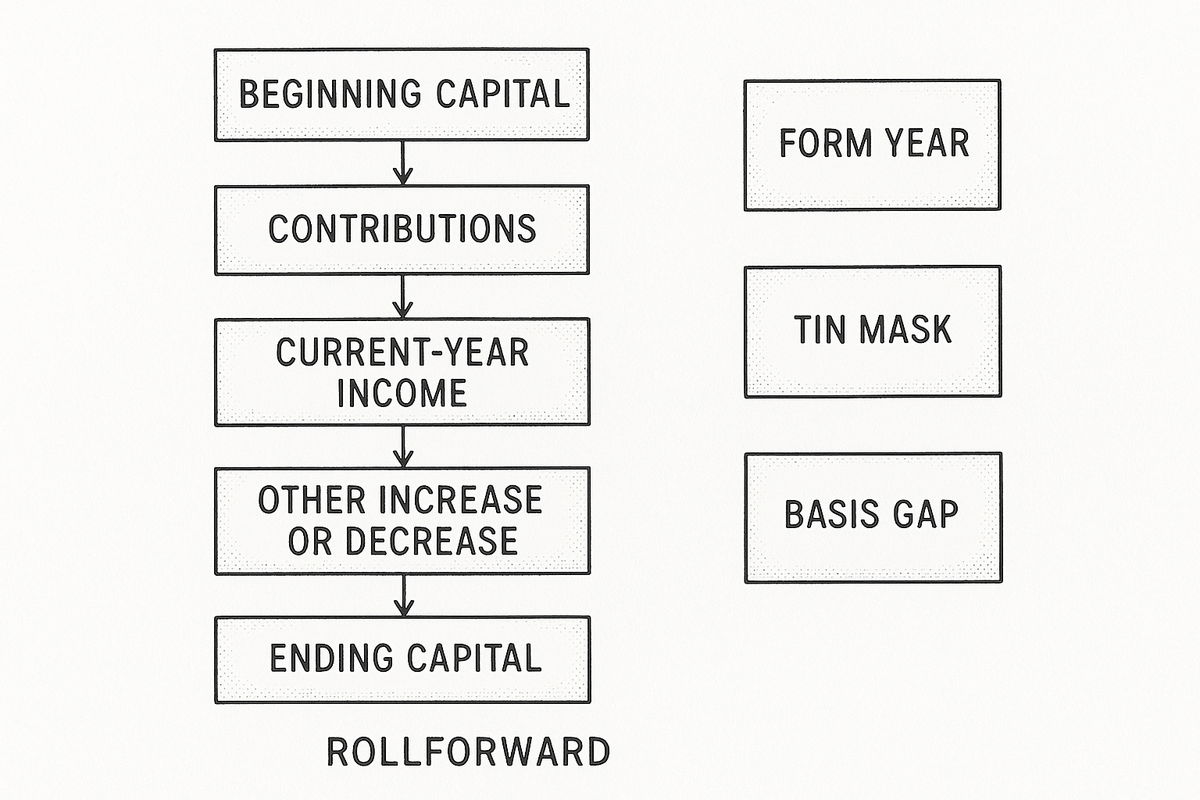
Item L still catches edits. The partner instructions require Item L on the tax-basis method. Beginning capital, plus contributions, plus current-year net income or loss, plus other increase or decrease, minus withdrawals and distributions, lands on ending capital. A schedule that does not close was changed in one line, or the partnership made an error. Hold the PDF for a corrected K-1 or an IRS record.
This year's beginning capital should equal last year's ending capital unless an amended K-1 explains the change. Two years generated together will agree, so a matching pair from the same applicant proves little. Form year catches an obsolete template. Current instructions describe that tax-basis rollforward, not a menu of tax basis, GAAP, section 704(b) book, and Other. A recent-year K-1 that still offers those checkboxes came from an old form.
Other screens produce false rejects. The IRS allows the partner copy to show only the last four digits of the identifying number, and it allows the full number. Ending capital need not equal outside basis: liabilities sit in the basis and stay out of the tax-basis capital account. Box 1, ordinary business income, need not equal Item L's current-year line, which can include rental and portfolio items. Box 19 distributions are coded by category and need not equal the withdrawals line as one number.
A font mismatch shows up on a clumsy edit. An IRS seal or a watermark does not, because the partner copy is software output. When the schedule is asked to prove ownership, that question belongs to KYB document fraud detection.
How Detection Actually Works
Reliable detection reads the file's story. Six classes of signal cover what the rollforward misses.
Production method asks how the PDF came into existence. Tax software, a preparer's export, the IRS blank, a consumer PDF editor, and a programmatic generator each leave a distinct fingerprint in fonts, object structure, and producer tags. An edited K-1 keeps the tax-software path and then shows a later tool. A generated K-1 never had that first path.
Timestamp trail compares creation and modification history with the tax year and the date the file showed up. Partners re-download their own schedules, so a fresh creation date on a prior-year K-1 is ordinary. A modification layered onto an older creation date is a different story. Missing history is lost evidence.
Issuer matching asks whether the file behaves like the schedule it claims to be. A partnership K-1 separates partnership identity, partner identity, Item J percentages, the capital-account analysis, and the numbered income boxes. An S corporation K-1 and a Form 1041 K-1 follow their own forms. A shareholder schedule carrying Item L, or a recent-year partnership K-1 still offering a GAAP or section 704(b) method, fails this check whatever the dollars say.
Consistency is the arithmetic inside the file and against the packet. Item L closes, or it does not. Beginning capital agrees with last year's ending capital, or an amended K-1 explains the difference. A partner at or above 50 percent of profit, loss, or capital is the kind of partner Schedule B-1 of Form 1065 lists, and that schedule lives on the partnership return. One K-1 cannot prove the percentages of every partner sum to 100 percent.
Model artifacts are computational traces of generative output, and no reviewer can be trained to see them on the page. Recycled patterns catch the same template, the same rounded percentages, or the same partnership block with only the partner line swapped. Edited schedules tend to fail production method, the timestamp trail, and consistency. Generated schedules tend to fail issuer matching, model artifacts, and recycled patterns, and they can pass the rollforward.
What to Do With a Suspect File
A single tell is a reason to look harder. A broken rollforward plus a non-issuer production path is a reason to stop relying on the page.
Escalate when Item L does not close, when beginning capital disagrees with last year's ending capital and no amended K-1 explains it, or when the form year and the capital method disagree. Ask for the prior-year K-1 and for the entity return. A partnership K-1 implies a Form 1065. An S corporation K-1 implies a Form 1120-S. The applicant's copy of that return can be edited too.
Break-test against the IRS. The IRS business transcript page states that a tax return transcript shows most line items from the original return as filed and does not show documents or statements attached to that return. A Form 1065 transcript can confirm the partnership filed. It will not come back as this partner's Schedule K-1. Hold the income figure and the ownership percentage until a record the applicant does not control agrees with the claim.
Reject the PDF as evidence of that income or that percentage when file history shows post-creation editing or non-issuer production and the IRS record does not corroborate it. In a credit file the same schedule sits inside loan document fraud detection. If the activity meets SAR criteria, file. When the transcript is not back, x-ray the file before another manual pass. The first file in the playground does not require an email.
Where Sphinx Fits
Sphinx Watchdoc scores the Schedule K-1 and shows an x-ray of why the score landed: production method, timestamp trail, issuer matching, consistency, model artifacts, and recycled patterns. Across more than 1 million documents processed, Sphinx reports a 94.3% correct verdict, 2.8x more forgeries caught, under 28 seconds to clear clean files, and a review that is 54% less expensive, at $0.45 per document with no seats and no platform fee. The Watchdoc playground is free.
Frequently Asked Questions
How do you spot a fake Schedule K-1?
Recompute Item L on the tax-basis lines, and compare this year's beginning capital with last year's ending capital. Check that a recent-year schedule uses the tax-basis method rather than an obsolete GAAP or section 704(b) checkbox, then read the file's production history. A generated K-1 can close every line and still name a partner the filed return does not include.
Is a Schedule K-1 the same as a partnership tax return?
No. Form 1065 is the partnership's information return. Schedule K-1 (Form 1065) is one partner's share of the items on that return. The partnership files a copy of each K-1 with the IRS, and the partner generally does not attach the partner copy. An S corporation shareholder receives Schedule K-1 (Form 1120-S), a different form.
What is the difference between an edited K-1 and a generated K-1?
An edited-after-creation K-1 started as a real schedule, a prior-year copy, or the IRS blank, and had the partner, the percentages, or a few dollar lines changed. The original software path often survives, and the capital account stops closing. A generated-from-scratch K-1 is built so every line agrees, including Item L, for a person who was never on the filed return.
Does a truncated TIN on a K-1 mean the form is fake?
No. The IRS partner instructions say the schedule may show only the last four digits of the identifying number, while the partnership reports the full number. A full number is also permitted. Masking is not a fraud signal, and a complete number is not one either.
Why can Item L differ from the partner's tax basis?
The IRS requires Item L on the tax-basis method and states that ending capital may still differ from the partner's adjusted tax basis. Outside basis includes the partner's share of partnership liabilities. The tax-basis capital account does not.


