

TL;DR: Community banks spend $400K-$700K per year on compliance at the $1B asset tier, staffing models borrowed from institutions fifty times their size. With 2,000 alerts per month, two analysts, and false positive rates above 90%, the math is structurally broken. FinCEN's April 2026 proposed rule now references AI and technology as evidence of program effectiveness. Community banks that move on compliance automation have a governance speed advantage that large banks cannot match.
The Staffing Model Was Never Designed for Community Banks
The compliance staffing model used by most community banks was not built for community banks. It was built for institutions with hundreds of compliance officers, dedicated model risk teams, and budgets that absorb inefficiency without existential consequences. Community banks inherited this model and tried to replicate it at one-fiftieth the scale.
The result is predictable. A $1B community bank spends $400,000 to $700,000 per year on BSA/AML compliance. That budget covers two, maybe three full-time compliance staff. Those staff members are responsible for alert review, case investigation, SAR drafting, quality assurance, regulatory reporting, audit preparation, and policy maintenance. They own the entire compliance lifecycle from alert to filing, plus everything else that lands on the BSA officer's desk.
At the top-50 banks, that workload is distributed across dozens of specialists. At a community bank, it sits on two people. This is not a staffing problem that hiring solves. At $400K-$700K total spend, there is no budget line for a third senior analyst, let alone the model risk team that large banks use to validate their monitoring systems. The staffing model was designed for a different institution. Community banks are running it anyway, because it is the only model the industry has offered them.
The Math at Community Bank Scale
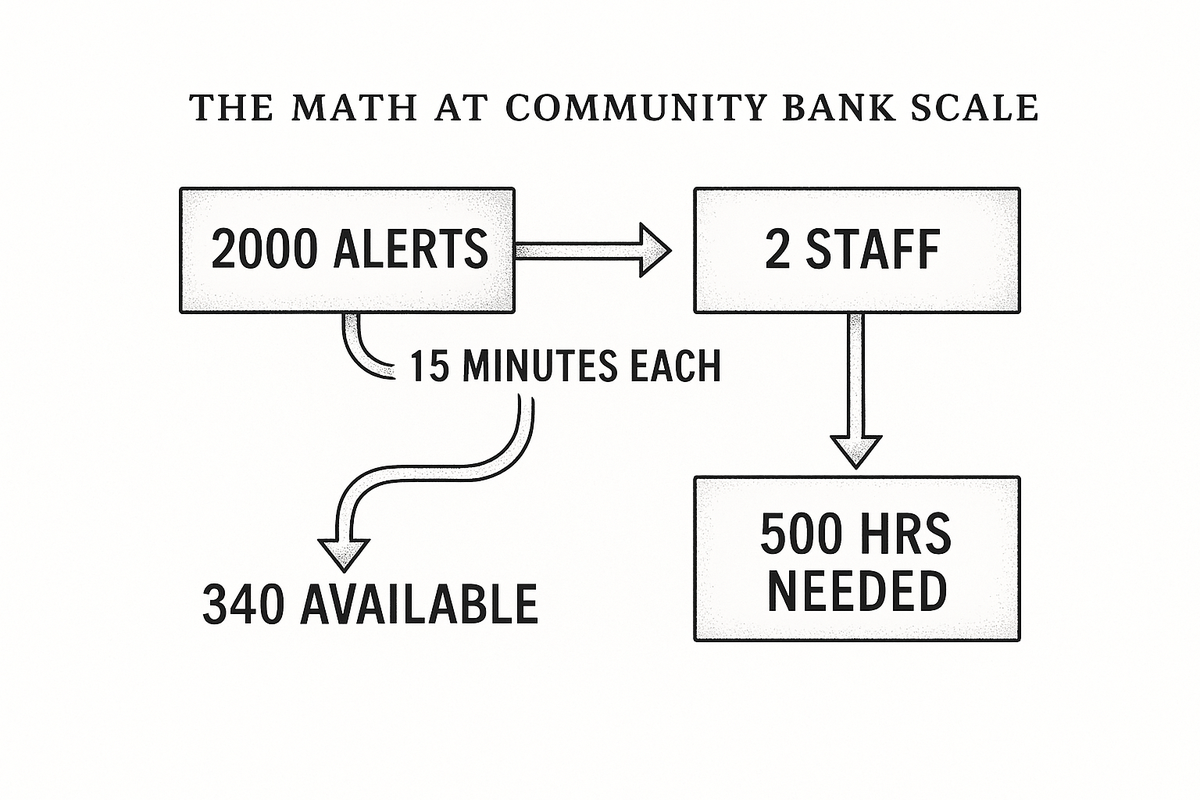
The numbers expose why this model fails. A community bank at the $1B-$3B asset tier generates roughly 2,000 transaction monitoring alerts per month. At 15 minutes per alert for initial triage, that is 500 hours of review work every month. Two full-time compliance analysts produce approximately 340 productive hours per month, accounting for meetings, training, leave, and the other responsibilities that consume their time.
The deficit is 160 hours. Every month. Before anyone investigates a case, drafts a SAR narrative, or prepares for an exam.
Now layer in the false positive rate. Community banks consistently report false positive rates between 90% and 98% on transaction monitoring alerts. At 95%, that means 1,900 of those 2,000 monthly alerts lead nowhere. The compliance team spends 475 hours per month — well beyond their capacity — reviewing alerts that do not result in a filing or meaningful risk identification. SAR filings reached 2.6 million in FY 2024, up 18.5% year over year, which means the volume pressure is increasing, not stabilizing.
The traditional response is to hire. But a third analyst at $85K-$120K fully loaded does not close a 160-hour monthly gap when the underlying signal-to-noise ratio remains at 2-10%. You cannot staff your way out of a 95% false positive rate. Every new hire inherits the same broken ratio and spends the same percentage of their time on noise.
What Regulators Are Actually Saying
The regulatory environment has shifted in ways that most community banks have not fully internalized. FinCEN's April 2026 proposed rule to reform AML/CFT program requirements does something that previous guidance carefully avoided: it explicitly references technology. The proposed enforcement factors ask whether an institution employs "innovative tools such as artificial intelligence" that demonstrate program effectiveness.
This is not a mandate to deploy AI. It is something more consequential for community banks — it is a signal that regulators will evaluate outcomes, and that technology adoption is now relevant evidence of whether a program produces those outcomes. For a community bank running two analysts against 2,000 monthly alerts, the question is no longer whether automation is appropriate. It is whether continuing without it is defensible.
The OCC's February 2026 community bank BSA examination procedures reinforce this direction. The updated procedures do not prescribe specific tools, but they assess whether the bank's program produces results proportionate to its risk profile. An examiner who sees a two-person team processing 2,000 alerts per month at a 95% false positive rate is not looking at a well-resourced program making careful judgments. They are looking at a structural capacity problem.
The regulatory message is consistent: show us your outcomes. For community banks, the path to demonstrating outcomes runs through automation that improves signal quality, not through adding headcount to review the same noise.
The Community Bank Advantage
Here is what most compliance automation conversations miss: community banks are actually better positioned to deploy AI-assisted triage than large banks. This sounds counterintuitive, but the governance advantage is real.
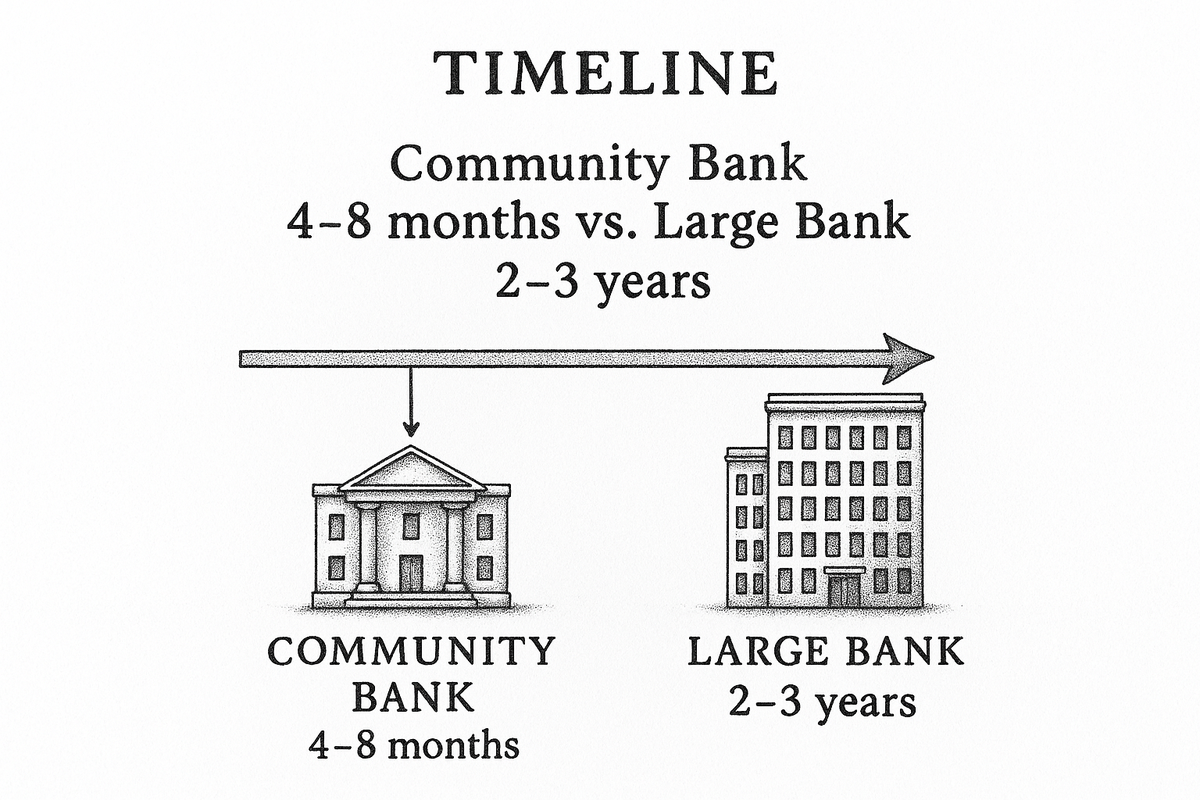
A community bank at $1B-$3B in assets can deploy AI-assisted alert triage in 4 to 8 months. The governance approval process involves a BSA officer, a compliance committee, and a board that meets monthly. A new tool can be evaluated, piloted, validated, and approved through existing governance structures without creating new ones.
At a $50B+ institution, the same deployment takes 2 to 3 years. Model risk management requires independent validation teams. Change management routes through regional committees, legal review, IT security assessment, and enterprise architecture approval. A pilot that works in one business line requires re-validation before it can be deployed in another. The governance infrastructure that large banks built to manage complexity becomes the primary obstacle to modernization.
Community banks do not have this problem. The BSA officer who identifies the need is often the same person who evaluates the solution, runs the pilot, and presents the results to the board. A change that requires a Tuesday committee meeting at a community bank requires a six-month governance cycle at a large bank. This is the governance speed advantage, and it is structural.
We see this play out consistently. The institutions that deploy solutions that reduce false positives fastest are not the ones with the largest budgets. They are the ones with the shortest distance between identifying a problem and approving a solution. Community banks have that advantage, but most of them do not realize it because the industry narrative has conditioned them to see their size as a limitation rather than a structural benefit.
The compliance automation opportunity for community banks is not about catching up to large banks. It is about exploiting an advantage that large banks cannot replicate — the ability to move from broken process to working solution in months, not years. The community banks that recognize this will not just solve their staffing problem. They will build compliance programs that meet the effectiveness standard that regulators are now explicitly demanding.
Frequently Asked Questions
How much does compliance automation cost a community bank?
Compliance automation costs for community banks vary by scope, but most institutions at the $1B-$3B asset tier deploy AI-assisted alert triage for a fraction of what a single additional compliance analyst costs. Given that community banks spend $400K-$700K per year on total BSA/AML compliance, automation that reduces false positive review time by 60-80% delivers measurable ROI within the first year while improving outcomes that regulators now explicitly evaluate.
Does FinCEN require community banks to use AI for compliance?
No. FinCEN's April 2026 proposed rule does not mandate AI adoption. However, the proposed enforcement factors explicitly reference whether an institution employs "innovative tools such as artificial intelligence" as evidence of program effectiveness. For community banks, this means AI adoption is not required but is increasingly relevant to how examiners evaluate whether a compliance program produces adequate outcomes.
How long does it take a community bank to deploy compliance automation?
Community banks at the $1B-$3B tier typically deploy AI-assisted alert triage in 4 to 8 months. This timeline includes evaluation, pilot testing, governance approval, and production deployment. Community banks have a governance speed advantage over larger institutions, where the same deployment can take 2 to 3 years due to multi-layered model risk management and enterprise change management processes.
Can a community bank reduce its compliance team with automation?
Compliance automation at community banks is not about reducing headcount. It is about redirecting existing staff from low-value noise review to high-value risk investigation. A two-person team spending 95% of their time on false positives is structurally incapable of performing the judgment-intensive work that regulators expect. Automation that reduces the false positive burden lets the same team spend their time on genuine risk identification, case quality, and program improvement.
What false positive rate should a community bank target with automation?
Community banks typically report transaction monitoring false positive rates between 90% and 98%. Effective AI-assisted triage can reduce actionable false positive review rates to 20-40%, depending on the monitoring system and risk profile. The goal is not zero false positives — it is a signal-to-noise ratio that allows existing compliance staff to investigate genuine risk within their available capacity, which for most community banks means processing the 100-200 alerts per month that actually warrant human judgment.
.png)