

TL;DR: AI-powered AML solutions use machine learning, behavioral analytics, and agentic automation to detect financial crime patterns that rule-based systems miss. The AML software market is projected to grow at 18.01% CAGR through 2031, driven by regulatory pressure and the operational limits of manual compliance. This guide covers what AI actually changes in AML workflows, how to evaluate platforms, and what fintechs should prioritize.
What AI Changes in AML Compliance
Rule-based AML systems fire alerts when transactions cross defined thresholds. Financial crime is designed to stay below those thresholds. Layering, smurfing, and shell entity structures exist specifically to evade static rules. This is not a configuration problem — it is an architectural limitation.
AI-powered AML platforms address this by establishing behavioral baselines for each customer and flagging deviations from those baselines. Instead of asking "did this transaction exceed $10,000?" the system asks "is this transaction consistent with how this customer normally behaves?" That is a fundamentally different detection model, and it produces fundamentally different results.
The practical impact shows up in false positive rates. Rule-based systems routinely generate false positive rates above 90%, meaning compliance teams spend the vast majority of their time investigating alerts that turn out to be benign. AI-driven platforms report 60-85% reductions in false positive rates by incorporating contextual matching, behavioral scoring, and entity resolution into the detection logic. According to Mordor Intelligence, the AML solutions market is growing at 18.01% CAGR — and that growth is concentrated in AI-native platforms replacing legacy rule engines.
Five Capabilities That Define AI-Powered AML
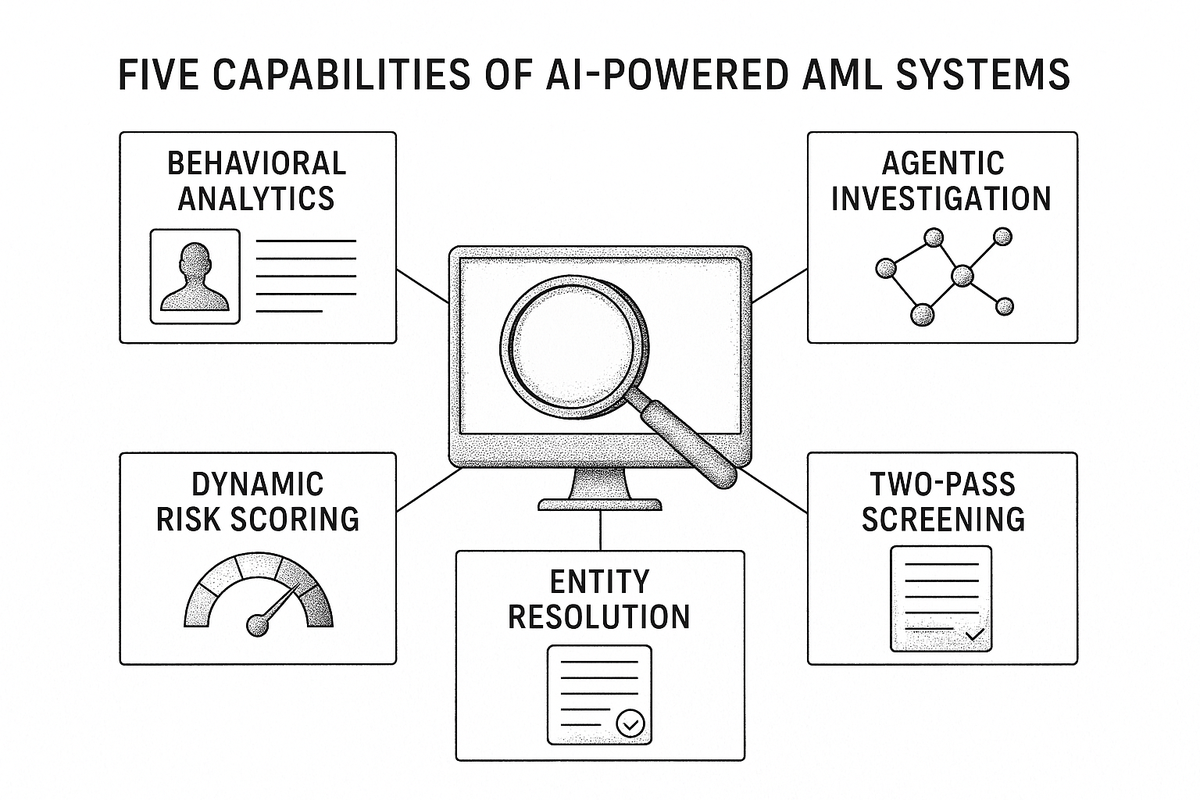
Not every platform that claims "AI-powered" delivers meaningful differentiation from rule-based systems. These five capabilities separate genuine AI-driven AML from marketing labels.
Behavioral analytics and anomaly detection. The core AI capability in AML is establishing individual customer behavioral profiles and detecting anomalies against those profiles. This goes beyond simple threshold rules. A $9,500 cash deposit is unremarkable for a retail business that regularly handles cash. The same deposit from a software company with no prior cash activity is a signal worth investigating. AI systems learn these distinctions from transaction history — rule-based systems cannot.
Entity resolution and network intelligence. Financial crime rarely involves isolated actors. AI-powered platforms use graph analytics to resolve entity relationships across data sources — linking individuals, businesses, and accounts through shared addresses, phone numbers, beneficial ownership structures, and transaction patterns. This surfaces networks of related entities that rule-based transaction monitoring treats as independent.
Agentic investigation automation. The newest category of AI in AML goes beyond detection into operational execution. Agentic systems autonomously triage alerts, gather evidence, check entities against watchlists, draft investigation narratives, and produce disposition recommendations — before a human analyst opens the case. This is different from copilot-style assistance. The agent does the work; the analyst reviews and approves. The Interpretable Agentic Framework describes how this works with full audit traceability.
Dynamic risk scoring. Static risk scores assigned at onboarding decay as customer behavior evolves. AI-powered platforms update risk ratings continuously based on transaction patterns, profile changes, and external signals. A customer whose risk profile shifts significantly after onboarding receives proportionate monitoring adjustments without waiting for a periodic review cycle. The FATF and FinCEN both support this approach — perpetual KYC is the regulatory direction.
Two-pass screening architecture. Modern AI screening runs a two-pass process: AI-enhanced fuzzy matching on the first pass handles name variants, transliterations, and aliases. Multi-attribute entity resolution on the second pass evaluates name, date of birth, nationality, address, and aliases together. This produces a holistic similarity score rather than a name-only match confidence. According to Tookitaki, this architecture delivers 60-70% fewer false positives than keyword-only screening without reducing coverage of genuine matches.
How to Evaluate AI AML Platforms
Six evaluation criteria determine whether a platform will hold up under genuine compliance pressure.
Detection accuracy in production, not demos. Ask for false positive rates from production deployments at institutions similar to yours in size, geography, and customer profile. Sandbox demo results are meaningless — they are tuned for the demo. Production performance on your customer mix is what matters.
Explainability for regulators. Every AI-assisted decision must produce reasoning that an examiner can follow. If the platform cannot explain why it cleared an alert or escalated a case in terms a regulator understands, it creates compliance risk regardless of accuracy. FinCEN's effectiveness-based AML rule makes this explicit: effective outcomes require defensible reasoning.
Data coverage and update frequency. Sanctions lists, PEP databases, and adverse media sources change daily. A platform screening against stale data creates a compliance gap that no amount of AI sophistication can close. Evaluate refresh cadence: 15-minute updates are the current standard for leading platforms. Weekly batch updates are inadequate for institutions processing real-time payments.
Integration model. The practical test is whether your KYC onboarding, transaction monitoring, and screening share a single audit trail or require reconciliation across disconnected systems. API-first platforms with pre-built connectors to core banking and payment systems reduce integration cost and audit complexity.
Scalability under load. A screening call that takes 800ms at low volume and eight seconds at peak breaks your onboarding flow. Confirm throughput at your projected peak, with specific latency numbers per payment rail. Sub-250ms decisioning across every payment rail is the standard to hold vendors to.
Model governance and auditability. AI models need governance: version control, four-eyes activation, kill switches, bias monitoring, and drift detection. Platforms that treat the model as a black box cannot satisfy SR 11-7 model risk requirements or the emerging EU AI Act obligations for high-risk AI systems in financial services.
Where Sphinx Fits
Sphinx deploys AI agents that handle the operational layer of AML compliance — alert triage, case investigation, and SAR filing — inside the tools compliance teams already use. Agents log into screening platforms, review alerts using the same data analysts see, and document every decision for audit. Customers report 87% fewer false positives and 80% reduction in case review time. Alviere automates 86% of compliance cases. The approach works alongside existing AML platforms rather than replacing them — addressing the investigation bottleneck without requiring a detection engine migration.
Frequently Asked Questions
What makes an AML solution "AI-powered" versus rule-based?
AI-powered AML solutions use machine learning to establish behavioral baselines for each customer and detect deviations from those baselines. Rule-based systems apply fixed thresholds and static logic. The practical difference is detection coverage — AI systems catch layering, smurfing, and behavioral anomalies that threshold-based rules miss by design.
How much do AI-powered AML platforms reduce false positives?
Leading platforms report 60-85% reductions in false positive rates compared to rule-based systems. The reduction comes from contextual matching (evaluating transactions against individual behavioral baselines), multi-attribute entity resolution (scoring matches on more than just name similarity), and dynamic risk scoring (adjusting monitoring sensitivity based on actual customer behavior).
Are AI-powered AML solutions accepted by regulators?
Yes. FinCEN, the FATF, and multiple national regulators explicitly support technology adoption for AML compliance. FinCEN's April 2026 proposed rule encourages risk-based, effectiveness-driven programs. The FATF found that 85% of surveyed stakeholders view new technologies as delivering the greatest benefit to AML/CFT. The requirement is explainability — AI decisions must be auditable and defensible.
What is agentic AI in AML compliance?
Agentic AI in AML refers to AI systems that take operational actions autonomously — triaging alerts, gathering evidence, drafting investigation narratives, and producing disposition recommendations — rather than just surfacing information for human review. The agent does the investigation work; the analyst reviews and approves. This shifts the analyst's role from evidence gathering to quality assurance.
Should fintechs replace their existing AML tools with AI-powered platforms?
Not necessarily. Overlay solutions can add AI-powered triage and investigation on top of existing detection systems without requiring a platform migration. This avoids the cost, risk, and disruption of replacing a monitoring engine while addressing the investigation bottleneck — which is typically the larger operational cost. Full platform replacement makes sense when the existing detection engine is fundamentally inadequate.
.png)