
The Reality of US Banking Infrastructure with Peter Hazlehurst, CEO of Synctera
July 8, 2026
57
min
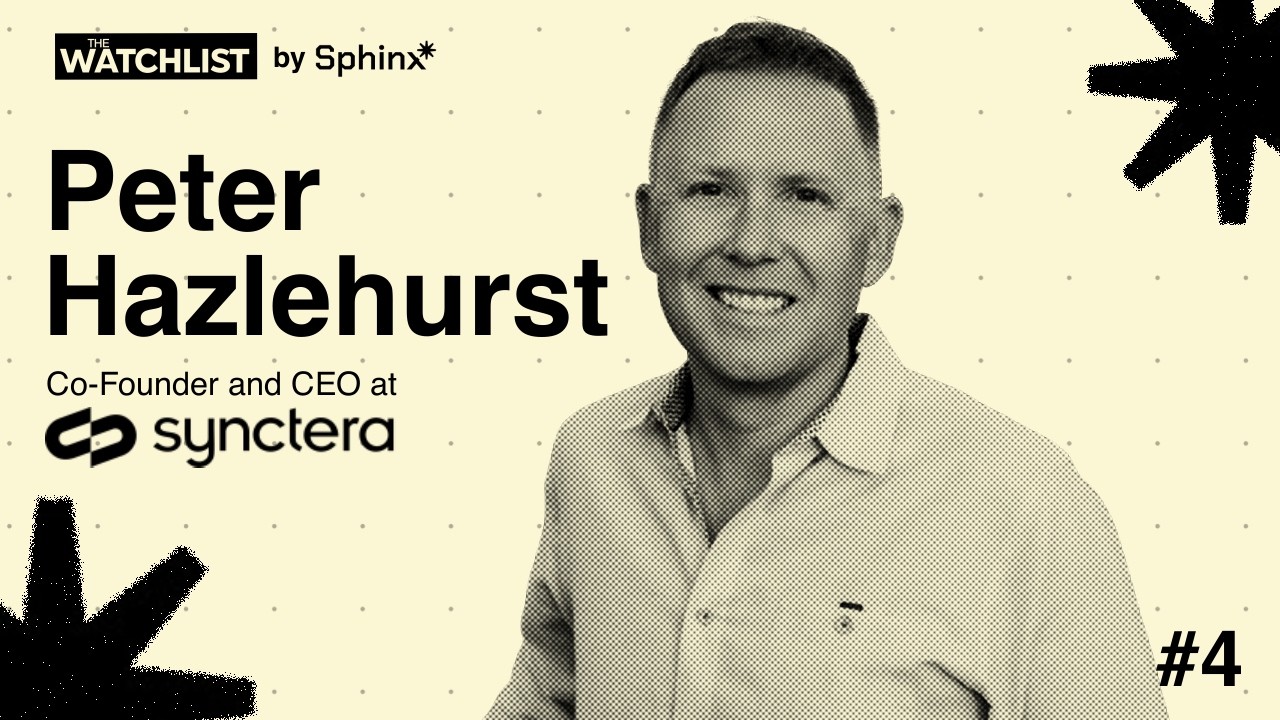


TL;DR: Peter Hazlehurst has spent 30 years building banking infrastructure — from writing a core banking system on Windows in 1993 to launching Google Wallet to running Synctera, a BaaS platform that aggregates 12+ vendor integrations so fintechs do not have to. He explains why US regulatory fragmentation across 48 states creates both a commercial moat and a near-insurmountable barrier for startups going it alone, and lays out a vision for the "bank of one" where AI personalizes every financial interaction down to the individual.
What This Episode Covers
Peter Hazlehurst has built financial infrastructure before the industry had a name for it. He coded a core banking system at 22, pioneered mobile payments at Google, tried to build a digital bank for Uber drivers, and now runs Synctera — a BaaS platform connecting fintechs to a marketplace of partner banks. This conversation traces the full arc: why 30-year-old code still powers US community banks, how Google invented proto-tokenization to bypass carrier restrictions, what makes US state-by-state regulation so punishing for builders, and where AI compliance analysts fit into the future of banking infrastructure.
Peter also talks about the Nokia onboarding moment that shifted his identity from coder to company builder, why he sold his mother's car and replaced it with Uber, and the tall-poppy humility that comes with being an Australian founder in Silicon Valley for three decades.
Who Is Peter Hazlehurst
Peter Hazlehurst is the CEO and co-founder of Synctera, a Banking as a Service platform that enables fintechs and brands to embed banking products through a marketplace of partner banks. Peter was the first engineer at Phoenix International, a core banking company that went public in 1996. He led mobile payments at Google as CEO of Google Payments during the Google Wallet era, held engineering leadership roles at Nokia and Yodlee, and helped Uber explore building a digital bank for its driver network. Across 30 years in financial infrastructure, Peter has launched products at every layer of the stack — from mainframe-replacement core systems to NFC-powered mobile wallets to the multi-bank compliance architecture that underpins Synctera today. He hit break-even at Synctera in mid-2025 after navigating the 2022-2024 fintech downturn with multiple Series A extensions.
Why 30-Year-Old Banking Code Still Runs American Banks
Banking infrastructure looks simple at the API layer. Underneath sits three decades of edge-case handling that no greenfield rewrite can replicate. Peter built his first core banking system in 1993 on SQL Windows, went live with a one-branch bank in Osage, Iowa, in mid-1994 — and that codebase still runs community banks across the US today. The lesson is counterintuitive: the value in banking software is not the logic, it is the accumulated scar tissue from every overnight batch failure, every state-specific interest calculation, every reconciliation exception that surfaced over years of production use. Peter has turned down multiple opportunities to build another core banking system because, as he puts it, "you can't just code it — you have to experience the problems." That institutional memory is what Francis Forde from Paystand describes as the hidden cost of regulated infrastructure.
How Google Invented Tokenization Before Tokenization Existed
Google Wallet launched in 2012 requiring an impossible confluence: a Nexus 4S phone, T-Mobile network, Citi Bank account, and Mastercard. Peter's team at Google Payments hit a wall — carriers controlled the SIM card's secure enclave, limited storage to four or five credentials, and charged issuers for access. Provisioning a single card meant encoding it, routing through SS7 (the low-bandwidth protocol behind SMS), and hoping the payload survived a round trip through First Data and back to the handset. By 2013, Google moved the NFC chip into the phone hardware and opened the secure enclave in Android 4.4 — a step Apple only matched in 2024 under EU pressure. Then came the real hack: Google acquired processor TxVia and turned every tap-to-pay into a Discover card that routed back to Google, which executed the actual charge as a card-not-present transaction against the user's real card. Tokenization before the industry had a word for it.
48 States, 48 Rule Books, and the BaaS Moat That Creates
US banking regulation is not federal in the way most outsiders assume. Each of the 48 states with money transmission laws defines its own KYC requirements, licensing rules, and consumer protections — and some go further. Peter describes a prop-tech use case where state regulations require security deposits to be held in a bank branch located in the renter's city. That means a rent-management startup needs 50 separate bank accounts, state-by-state interest rate compliance, and annual capitalization rules that vary by jurisdiction. Synctera's response was to build a multi-bank marketplace rather than hardcode to a single partner, aggregating 12+ vendors into one platform. The minimum vendor fees alone for a fintech going direct would exceed $50,000 to $60,000 per month — before integration and data normalization. That fragmentation is the moat. Understanding KYB requirements across jurisdictions is table stakes; the real cost is maintaining compliance at scale across all of them, a challenge Hamza Siddiqui covers from the operator's perspective.
Who This Episode Is For
Frequently Asked Questions
What is Banking as a Service and how does Synctera's model differ from competitors?
Banking as a Service allows fintechs and brands to embed banking products — accounts, cards, payments — into their own applications without obtaining a bank charter. Synctera differentiates through a multi-bank marketplace model rather than hardcoding to a single partner bank. That architecture provides redundancy and flexibility but requires significantly more compliance infrastructure upfront, including embedded KYC, KYB, and fraud monitoring across every bank in the marketplace.
Why is US banking regulation so fragmented compared to other countries?
The US grants each state independent authority over money transmission, KYC definitions, and consumer protection rules. Unlike India (UPI), Brazil (Pix), or the EU (PSD2), there is no federal mandate that standardizes banking rules across all states. Peter Hazlehurst points to prop-tech as an example: some states require security deposits to be held in a bank branch in the renter's city, forcing startups to open 50 separate bank accounts with state-specific interest rate and capitalization rules.
What caused Synapse to fail and how did Synctera avoid the same outcome?
Peter describes Synapse as fundamentally built on quicksand — designed to work around compliance rules rather than within them. When the company scaled, regulators found structural holes that could not be patched. Synctera anticipated this risk by investing heavily in compliance infrastructure from day one, building embedded KYC and KYB systems, partnering with fraud monitoring vendors like Hawk AI, and structuring bank partnerships as 50/50 profit-sharing arrangements that aligned incentives between the platform and its banking partners.
What is Peter Hazlehurst's "bank of one" vision?
The bank of one is a fully personalized financial experience powered by AI that dynamically adjusts to an individual's needs — automatically selling secondary-market shares to cover upcoming property taxes, for example, without the user initiating anything. Peter contrasts this with how traditional banks operate today: forcing consumers into rigid product buckets like regular checking, premier checking, or private banking. Reaching a true bank of one requires global identity portability and harmonized banking rules, changes Peter estimates are 5 to 10 years away.
How does AI change compliance operations for BaaS platforms?
AI compliance analysts can ingest an organization's specific procedures, policies, and risk thresholds, then apply those standards consistently across every case — matching how human analysts would work but at significantly higher throughput. For BaaS platforms operating across multiple banks, each with distinct compliance requirements, AI enables the platform to maintain bank-specific review standards without scaling analyst headcount linearly. Sphinx's compliance automation platform addresses this exact use case.
Episode Transcript
Alex: Peter, great having you here.
Peter Hazlehurst: Thanks.
Alex: I'll set the stage a little bit. You've been building in fintech for about 30 years, which is older than I am.
Peter Hazlehurst: Sad. Sad.
Alex: It was long before fintech was even a buzz word. You went from coding a core banking system on Windows in 93 to pioneering account aggregation on Yodi. You launched Google's early mobile payments and you even helped Uber build a digital bank for drivers. Your journey spans startups, big tech, and now you own a BAS venture. Today, rather than just talk about buzzwords or funding rounds, I want to go behind the scenes into the judgment calls, design trade-offs, and hardworn lessons that come with building banking as a service and fintech platforms over a decade. I'll just start -- you moved from studying law in Australia to writing a core banking system in the US at age 22 in 1993. I'm curious to understand what pulled you from law to going into banking infrastructure so early.
Peter Hazlehurst: Look, I graduated high school in 1990. I went to a conservative, prestigious, whatever you want to call it, British styled public private school. It's called Camber Grammar. And a big cohort, at least a third of my class take a gap year cuz you burn out. You've done your exams. You're done. And I did that in '91.
And at the start of 91, my dad said he's moving to Brisbane. I was living in CRA and you're basically on your own. You have no money. I didn't have anything. And I needed to get a job to pay for rent because I needed to live somewhere.
And I got a job as a typist literally typing in quarantine inspection reports. Imagine coming to work every day and this is a stack of filled-in forms and I had this IBM mainframe dumb terminal connected with a 75 board modem. Not 75 kilobits, not even 75 megabits, 75 characters per second.
Alex: Oh wow.
Peter Hazlehurst: And the way it worked, you just type type tab tab tab and everything's great. And it was fairly mind-numbing, but the department I worked for, quarantine, was the first government department that was fee for service. It actually had to break even so it could charge fees. And as a result, it embraced technology. In early 91, they got the first Windows network. And as part of that they got PCs.
Windows 3.1 had just come out. This is a long time ago. And there was this language called toolbook. If you go back in the eons of time at the time on the Mac, there was this thing called HyperCard.
Alex: Yeah.
Peter Hazlehurst: Which was a modern-day app builder and it didn't do very much. And Bill Gates and Paul Allen had had a falling out. Paul Allen left Microsoft after being diagnosed with long non-hodkkins lymphoma. And he built this new app called Toolbook which was basically a ripoff of HyperCard but for Windows. And Toolbook was nice in that you could paint regions of the screen.
And one of the things I did was I wrapped the main frames UI with an explainer. What does each field? I was helping new people, didn't have to learn the main frame. On the back of that, my boss at the time, this guy Robin Salvage, super nice guy, he's like, "You look bored shitless." And I was like, "Yes, I am." And he's like, "Would you like to go down to Melbourne for a one-week training course and become a programmer?" I was like, "Sure, that sounds cool." I go down to Melbourne for this programming course and I learned how to program SQL and this new language called SQL Windows that was started by this guy Gupta and to put things -- everything's got layers to it. Many people may not remember that Larry Ellison used to be a salesperson at IBM and at IBM he used to sell DB2 which was the old mainframe database and he's like hey these Unix computers and stuff are coming up mini computers IBM we should build a database for many computers and they said no and he said all right I'm going to start my own company and he started Oracle and he started with this guy Bruce Scott and Bruce Anumang who was a salesperson at Oracle came to Larry a little while later and said, "Hey, these PCs are a thing. We should build a database for PCs." And he said, "No." So they left and created Gupta Corporation, which created a database called SQL Base, which was semantically exactly the same as Oracle. Same tables, names, same columns, everything, but it ran on Novel Netware, which was the big prevailing up-and-coming LAN operating system at the time. And that's what we built on. Anyway, I learned this programming from this guy Tony who was working at KPMG. Tony and I have stayed friends ever since.
He lives in New Jersey now. And on the back of that started to build apps for the Australian government. Did that for 6 months. And then school started and I started university doing a double degree law and accounting, commerce law as we call it in Australia. And in the middle of that, I went to the US for a developer conference here in San Francisco.
I'm 19, 18, I don't even know. And at this developer conference, they had an opportunity to ask questions and they had an open mic. And I got up to the open mic and I said, "Look, mate, it's broken." And he's like, "What are you talking about?" And I asked them to type in a query on the screen and in front of a thousand nerds, the database blew up. And at that conference, I basically got three job offers. One to work on the database for the trip 7 Boeing.
And I knew what Boeing was. That's cool. And the second was to go work at Goldman Sachs as a DBA, but I didn't know what Goldman Sachs was. I'm 19 from Australia. Remember, there's no internet.
Alex: True.
Peter Hazlehurst: There's no concept of that. And then the third was this dude who literally said, "Let's do lunch." And I giggled cuz in Australia, typical American -- Let's do lunch. But he was the only person in a khaki shirt and khaki pants and an open collar shirt. He was from Florida.
And I had lunch with him and he's like, I'm building a banking system. Do you want to join? It's a startup. And I didn't know what a startup was. 19, 20 years old in Australia in the middle of nowhere.
And then I didn't hear anything from him. Typical American, no follow through. And Australians and Americans have a love-hate relationship. Let's put it that way. Anyway, 3 or 4 months later, I get a fax at the office and it's this long contract offering me a job to be the head of the first developer head of engineering at this new startup. And at the time, I was making 25,384 Australian dollars a year.
Alex: Very precise.
Peter Hazlehurst: Oh yeah. As an ASO3, which is the lowest of the low public servants. But I was working full-time and going to school full-time and the job offer was for 55,000. I was like, "All right, double sounds good." And then I thought about it for a second.
I said, "Oh, it's in US dollars." It's four times my salary. I was like, "Screw school. I'm out." And moved to the US when I was 20. That was 1993. I had my 21st birthday 3 months in.
I landed March 12th, 1993. And we built a core banking system and I didn't know what a core banking system was. I didn't know what banking was. But from a place of ignorance, we had a couple of people on the team that were product -- what you would call a product manager now, then was a business analyst type of person. And we built the system and it was cool.
And I distinctly remember we got to the end of 93. We were still based in Wilmington, North Carolina at the time. We had our first organizational meeting. We flew down to Orlando and I spent some time with the CEO. He's like, "Well, how's it going?" And I was like, "Oh, we finished." Thinking we were done.
And he's like, "Well, how's the performance of the overnight?" I was like, "What's an overnight?" And then I realized all we had was a CRM system and an account opening system, but we didn't actually have any accounting or business or banking or any of that stuff. And on the basis of telling him that we'd finished, they went and signed the first bank, which was a bank in Osage, Iowa, one branch bank. Wasn't very complicated. We had seven months to write a back-end accounting billing system, whatever you want to call it, a core banking system that actually did the math and calculated interest. And then we went live mid 1994, about 15 16 months after getting started.
It's funny in retrospect -- there's been multiple opportunities to go build another core banking system. And I've always said no because it's too hard, too complicated, too much legacy work you need to do. And then if you look back in time, the code that we wrote 30 plus years ago still runs lots and lots of banks in the US. And that just shows you that banking and payments and fintech and all that stuff peripherally and at the surface looks really simple. Those simple APIs, but it's 30 years of crud
Alex: And gunk that deals with all the weird edge cases.
Peter Hazlehurst: That is actually what banking and payments is. And it's almost impossible to replicate. You can't just code it. You actually have to experience the problems and
Alex: The edge cases
Peter Hazlehurst: And all the edge cases because they're always different. It was one of these weird things. The first company I worked on went public small IPO 196.
Alex: Phoenix, right?
Peter Hazlehurst: Phoenix. Exactly. And then we were on our way and we started to take it globally and grow.
Alex: Phoenix was that company. And you were very early employee there.
Peter Hazlehurst: Yeah. First engineer, first coder
Alex: And head of engineering and then after that you went to Yodi or was that
Peter Hazlehurst: Oh, there were multiple companies in between. Yodi was the next real fintechy type of company, but that was not until after having worked at Nokia and worked on email and building phones with keyboards and stuff. And then I had done a supply chain company in between and then done my own startup called Bayport from 99 to 2001 which was when everyone was doing them and then do killed everybody. But that was Bayport was really interesting. We built CRM, we built full QuickBooks replacement, all web-based back in the day when we were on dialup modems at 336 and we had 5-second response time. We built a whole bunch of cool technology jointly built with a bunch of the folks at Microsoft on the Windows 2000 team because we got stuff hooked in.
Internet Explorer 4 had just come out which had the ability to send XML as an asynchronous payload along with your HTML requests and we were just building stuff from scratch that no one had really done before. And I remember when we landed the deal with Dell and Dell was selling these computers called Dell EWorks which were PCs designed for small business people. You'd come online and say, "Well, I need accounting and I need payroll." And we created an icon that landed on everyone's desktop, which was cool. Hardware physically arrives at your house. You turn it on, Windows boots, you go through Windows setup, which is painful and ugly, and then you land on your home screen or your desktop, and up in the top corner was Robbie, which was the icon for our QuickBooks killer.
And that's how we started getting distribution. And it was crazy back in 99-2000 selling SAS software before SAS was a thing. And we had people paying monthly subscriptions for it and so on.
Alex: You've done a lot of things before they were even things. Fintech and now SAS and
Peter Hazlehurst: Well, look, if you go back in time to when I was in Australia, it was really pre-internet, 91-92. There was the well and there were dialup bulletin boards and things like that. And I connected to one of those bulletin boards here in San Francisco. And the school that I was at, ANU, was unique in that it was connected to what was called the global supercomputer network, which was a supercomputer from Hitachi that was at our computer science school at ANU, supercomputer at Berkeley from also from Hitachi and a supercomputer in Tokyo and they were all connected underground by a 10 megabit connection.
Imagine doing nuclear bomb simulations and a 10 megabits back in those days was infinity bandwidth you couldn't imagine
Alex: And these supercomputers would talk to each other and calculate I can't imagine right now
Peter Hazlehurst: Well you can't imagine going so slowly but back in those days it was off the charts. But it was nice because you'd have all these engineers coding in SQL Windows and Gupta posting questions to the bulletin board and because I had this time zone advantage -- I'm in Australia -- I could answer all the questions. Everyone just assumed I was some 35-year-old coder based in Australia. And the famous New Yorker quote about the internet was on the internet no one knows you're a dog and it's this seminal picture and that was me.
I was the dog. Nobody knew that I wasn't
Alex: The Aussie dog.
Peter Hazlehurst: Well, that no one knew that I hadn't been to school to study computer science. And it was funny because I coded. I wasn't an engineer. I coded intuitively. I figured stuff out. There's no math or science to how I thought about it. And I'm envious of those folks that have been to computer science and actually understand the math behind the science of computer science.
But it's back to the future. Back in those days, people were excited because you could paint a table on a screen and you could say connect it to this database and it would just work. And that was this incredible innovation that you could see tables and rows on a screen. And we're back to the future now. If you think what vibe coding is and playing with OpenAI and Gemini and stuff like that, it's just an evolution of screen painting. And I remember in the Windows world, the world changed when Microsoft Access 1.0 shipped out because suddenly non-technical people could build simple database applications.
And here we are today doing exactly the same thing all over again.
Alex: A little bit more advanced for sure, but very similar. And it's incredible the amount of capabilities that it is allowing us to build.
Peter Hazlehurst: Yeah, it's super cool. I got my Mac Mini on its way behind my clawbot/maltbot. I haven't used it yet. Open claw is the new name.
Alex: Open claw is the new name.
Peter Hazlehurst: As of today I think or yesterday.
Alex: It's crazy. It's been the most starred repo. I think there's 100
Peter Hazlehurst: In commits already or something.
Alex: Stars in a day or two. It's weeks. Insane.
Peter Hazlehurst: And then I think Cloudflare launched a
Alex: Lawsuit against them.
Peter Hazlehurst: Claude definitely did. They had to rename, but Cloudflare has launched a containerized version, so you don't even have to have the Mac Mini anymore.
Alex: Oh, wow. I didn't see that.
Peter Hazlehurst: Maybe I'll return it before 30 days are up.
Alex: And one thing I'm super curious about, before going into the whole entrepreneurship aspect of things, you were an entrepreneur within big corporations by heading some very specific products. I'm particularly curious about both Google Payments -- you were CEO of Google Payments in the early days which really led the whole fintech wave -- and you also tried to build a bank for drivers at Uber which to be honest before doing the research I didn't even know was something. The question I have is what are the lessons you have trying to marry Silicon Valley and tech companies to actual financial institutions?
Peter Hazlehurst: It depends on the geo and depends on the market and the timing at Google. One of the things that was challenging about what we were doing is we were very clearly a tech company and we had payments obviously to facilitate people paying for Adwords and AdSense. That was the genesis of it all. And then Andy came out with Android and suddenly we had to take this infrastructure that was optimized for 70 million line monthly statements to some big advertiser and turn it into a real-time purchasing system.
You and me buying a game and that was hard. But Googlers being first person principled built everything from scratch. And you never made an assumption that anybody built anything ever before in a good way. You just started again. Google was really interesting because we were trying to do that while trying to solve a technical problem which was we wanted to have this idea of pay with your phone.
The problem was at the time the operators wanted to control the SIM card. And the operators therefore controlled access to the SIM card and on the SIM card was the secure enclave where your digital credentials, your cards would be stored. The problem was there's no storage. It was very limited storage and maybe you could store four or five cards, but you could only store one or two brands. You could either store Visa cards or Mastercard and maybe a Discover or something like that.
And the challenge was at Google a technical challenge which was the only way to get to update that was delivered over SS7. SS7 is the underlying protocol for SMS and it's a tower tower configuration protocol and it's designed for lossless transmission and retry and it's super low bandwidth because it's going over the text channel like literally SMS's being sent. Imagine encoding a digital representation of an American Express card, sending it to the cloud, sending it to First Data, sending it back to Verizon and hoping that it lands on the phone.
Alex: It was a [\h__\h] show.
Peter Hazlehurst: Yeah, it's a [\h__\h] show. Half the time didn't work. And then you ran out of storage because we already had customers in
Alex: How many customers were at least in the trial, the Google payments?
Peter Hazlehurst: The original Google Wallet, because it required this triple unicorn of impossibility, was very limited distribution. It required a specific phone, the Nexus 4S. It required a specific network, T-Mobile. It required a specific bank, City Bank, a specific network, Mastercard. The number of people that had that confluence of things was pretty small, but if you had them, we could maybe a card to you.
Alex: And that was in what year?
Peter Hazlehurst: This is 2012.
Alex: Okay.
Peter Hazlehurst: That was a while ago.
Alex: That was a while ago.
Peter Hazlehurst: And in 2013, we realized we didn't want to play ball with the operators anymore because they wanted to tax putting a card on the thing
Alex: And we're like, this is silly.
Peter Hazlehurst: We then got the hardware guys to move the NFC chip into the phone natively rather than in the SIM card. And the secure enclave, which everyone uses on their iPhone and doesn't really think about, now lived in the phone. And we decided to let it be open.
Alex: Interesting.
Peter Hazlehurst: Anyone could play with it. In Android 4.4, we unlocked NFC, something that Apple has only recently done in the last year as a result of the European Union,
Alex: 15 years ago.
Peter Hazlehurst: Yeah. But then we realized we didn't want to have to go and talk issuer by issuer to get you enrolled. And there was no concept of tokenization back then. We bought a company called TXV in New York that was a payment card processor. And we came up with this sneaky idea of the phone itself being a discover card.
When you tapped and paid, the discover card would come back to the processor and then based on what you thought you were doing as a user -- you said, "I want to pay with my American Express card or my City Chase card or whatever" -- we would then do an e-commerce purchase. We turn a card present transaction into a card not present transaction, synchronously, validate that the transaction went through, and then approve it at the network. And it was basically tokenization. It worked. It solved the problem, but then you can imagine the issuers like AMX and others not being thrilled about being front-ended by a Discover card.
And now back to the future, Capital One buys Discover to do this all over again. It's interesting how these things go in circles.
Alex: Yeah, 100%. There's something I'm curious about. From the beginning of the conversation, you're obviously a big builder. You love building and you've been building since
Peter Hazlehurst: 18 basically. Oh, my first coding job I was 15 16
Alex: Right on. You've been at it really since the beginning and you've had a couple of companies. Synctera is the biggest one so far and it's doing incredibly well. I'm super curious to understand when the job stopped being about building the product and was more about leading people, setting vision and what was maybe the hardest adjustment to that for you.
Peter Hazlehurst: In any early stage company, it's always this combination of build product, build team irrespective of your role. And the best people at startups know that. And the best leaders of startups hire people that are always looking for how does what I'm doing make the company more of a company rather than I just did my coding and I did my job and I walked away.
And not everyone's good at that. Some people really like the safety net of working at a big company where I can do my thing and it's probably safe. I think generally speaking, people's belief that the company will keep them a job has deteriorated over time. And the premise that you're owed a career is not a thing. You have to own your career. But I would say the first time I really felt it was at the end of Phoenix in the start of Bayport where I became a co-founder. It was this transition from realizing you could have the best product ever, but if you can't afford to distribute it, it doesn't matter.
If you don't have the right relationships, it doesn't matter. If you don't have the right funding, it doesn't matter. In Bayport's case, the hard part for us was we had a great product. People were paying us and in the early days of dotcom but we faced this existential threat which was one of our co-founders was 100% exposed to .com and when do blew up he's like I don't want to fund the company anymore I'm going to go back to doing whatever else I did and that's when I realized that the job of investors and VCs and stuff like that is not just money. It's also a discipline of feeling that you have to give your information of how's the company doing to somebody else.
You can't just keep it to yourself. And that validation and also invalidation, Peter, I think your idea is great, but it's never going to work type of stuff is a feedback curve that is no longer a product question. It's critical for the company question. It took a long time to realize right product wrong timing doesn't work, right timing wrong product doesn't work either. And I would say there was no one seminal event but when we sold this company to Nokia we went through this amazing experience and the onboarding inside Nokia was amazing. At the time Nokia was bigger than Apple, king of the world and we did this onboarding and we didn't know what onboarding was.
We were three people. The whole company was 20 people. But they said come to Dallas and we're like great. We came to get us and back in those days Nokia's headquarters was off the end of the Dallas runway, the FW, because they had factories and they'd put 10 million phones or a million phones in a plane and send them across the world and stuff. They were making phones in the US.
We went to the onboarding and this big Finnish guy gets up on stage, Ole Pekka, and he's like, "Everybody stand up." And it's like we're at a big stadium. I don't know, 10,000 people stood up or whatever. He's like, "Sit down if you've been here for more than 10 years." And half the audience sits down and we're like, "Cool." And then, "Sit down if you've been here for more than a year." And two thirds. Sit down if you've been here for 6 months and there's less and less people standing. Stay standing if this is your first day at Nokia.
And it was me, the CEO of my company and the head of marketing. And then all the lights went on us and they said, "Welcome to the newest employees of Nokia."
And the music came on and it was the most amazing onboarding of my entire career. And that's when I knew that being a nerd is interesting, but being a builder of things and places and times and creations actually creates a lot of value for a lot of people
Alex: And it was fun to be recognized. Great culture, great onboarding culture. Nokia must have been incredible. We both to some extent work in unsexy businesses. Nokia at the time must have been -- well if it's like Apple it must have been one of the most sexy
Peter Hazlehurst: Amazing. People must have flooded their gaze to get in to try and get in.
Alex: How do you create a mission-driven culture around an unsexy problem and still attract incredible talent?
Peter Hazlehurst: Look, I think no end consumer is ever going to know Synctera exists, and that's okay with me.
Alex: Yeah, same for us.
Peter Hazlehurst: But what I rally around is products that you can see and touch either that you build yourself or that someone builds on what you build. And I anchor it on my mom who is in her 80s and trying to explain to her what I do. And if she gets it, then we're okay. And it took a long time for her to get what Synctera was to be fair.
Alex: That's impressive already.
Peter Hazlehurst: She understood Uber. Uber was straightforward. And the sell on Uber was I sold her car and she was really mad at me. And I was like, you can't have a car. It's not safe.
And the solution to that was proving that the liquidity of her pushing the button in the app saying, "I would like a lift to go to church, whatever," was faster than the time it took for her to go to the basement of the apartment building, get the car out. Thank god Camber liquidity for Uber was really really good. But now I can track her and I know where she is and she gets it and she's cool. When I explained to her, well, Synctera helps people build the next Venmo. Nothing.
I was like, well, we help you build the next Brex. Mom, when someone says, hey, can I have 10 bucks for your contribution for a coffee? Then you give them the 10 bucks. She's like, "Yep, we help you do that with your phone." And she's like, "Oh, so I can put money in my phone." I was like, "Yep, you can." And I didn't have to explain, "No, you can't." But she got it.
And suddenly I was explaining to my mom, who is very non-technical, didn't know how to turn off her iPhone to restart it. But I got her into that headspace of understanding what we do. Finance and money is in everybody's lives. It's almost impossible. My son this morning's like, "Dad, I need a gift card for his buddy. I'm going to his party." And I'm like, "How much?" And we negotiated from bid ask of 100 to 25. And we settled on 50 bucks. And then it was the form of payment. Is it a virtual gift card, physical gift card? And he gets it.
He understands the trade-offs. But helping him understand why Synctera is interesting. He actually got it really fast. He's 14, he's 15. And their awareness of how things work is so much higher.
And for tech people wanting to join companies like ours, it's not about necessarily the core of what you're building per se. It's about all the potential of the people to build things on top of you. And we talk about potential a lot at Synctera of unlocking people's potential in finance and in their financial lives and stuff. And I sincerely believe that -- if you take a company like Maslo which is Brex for nonprofits, everyone needs an analogy but call it Brex for nonprofits. The potential we unlock is for people to donate money to their nonprofit and know that the money gets spent the way they expected it to be delivered, which conceptually shouldn't be that hard, but it's actually quite difficult.
And there's lots of layers of build and stuff like that that make it happen. And if we continue to create products that help people do that, it's great. And then the next day, this morning, I was talking to a company that built a rewards platform for travel. And I spoke to him three years ago and he's like, and Alex calls me up. He's like, "Took us three years to build it. We're now ready to add banking." I was like, "Great. Let's go." And what does he want? A digital wallet, spending card, pay with your phone, but integrated into what he's doing. And that's fun when you've got a general purpose product that can be woven into lots of different use cases.
Alex: Yeah. And I do think that's one of the incredible use cases of AI. We've been working together for a couple of months now and we're doing those AI compliance analysts and now with AI it's possible to take in all your procedures, your policies, your risk thresholds, anything that's very specific to Synctera and make sure that our analysts our AI analysts work just like your human analysts would and at faster speed and whatnot. And to that extent where do you think banking is in 10 20 years with now that one you've got a bank as a service you're able to embed a general product into anyone's stack basically. And then AI is allowing workers to be more and more specific to every organization they work from. How does that intertwine?
Peter Hazlehurst: I think we get to the holy grail -- a bank of one. Completely personalized, works for me, does whatever I need, which could be different than my girlfriend or my wife or my partner's needs, and it's dynamically adjusting what I need every day based on what it sees as financial needs, life needs, and stuff like that. And I don't think you're thinking about money anymore. And the thing is, most people think of money and are ashamed.
And most people don't look at their online banking because they're worried, what is it going to say? Do I have enough money for this? I know I should have saved. I should have been planning for the future and that. And I've been in this game for quite some time.
And it's been an oscillation between big company and little company. I do my time at the Google, Nokia, Ubers of the world in order to fund the lack of income lifestyle of building a startup. And hopefully the startup works and sometimes it doesn't and sometimes it doesn't. But it allows me this flexibility of lifestyle. Not everyone has that.
And a bank of one for me would be knowing that sometime in the future my cash position gets very low and it's planning ahead and maybe it's going out there and selling my shares automatically on the secondary market because it knew I needed money to pay property taxes or something like this. And it's so personal and so aware of what I need. And if you think about Bank of America and Chase and all these guys, they fundamentally succeed by telling consumers, fit a box that I've put you in. We have regular checking, premier checking, private banking, and you're in one of those three buckets. And all of them would like to have a personalized solution, something that's adapted to you.
But in the absence of that they commoditize everything. Banking in the future with full AI deployed it's yours. It's individual.
Alex: What is that layer? Cuz what I was thinking -- and again I don't know as much -- but with all that personalization I think that the older banks that might not adapt as much will become the back end the infrastructure layer and we won't interface so much with them. But is it a new breed of fintechs? Is it a layer of fintechs that is going to work even on top of the existing fintechs that we have today? How do you envision it?
Peter Hazlehurst: I think a couple of things are going to happen. I think if we're lucky some global body call it the United Nations, call it whatever harmonizes banking rules across the globe.
Meaning that KYC is portable, that identity, this concept of an identity card, whatever you want to call it, works everywhere. And when you do that, then you start to unlock my money doesn't have to sit in a certain physical place. And when you do that, then the banks themselves start to say, well, what's the value that I create? And the biggest of the banks, the GIBs and ultimately the national network banks like the Fed and the EU and stuff like that, EMA, devolve into this concept that the cell phone operators have evolved into, which is a network of connectivity and pipes and infrastructure that's tollgated and taxed along the way, but fundamentally isn't what you think of. When I use my iPhone, I don't think to myself, I'm so glad I'm a Verizon customer.
I am glad that I'm a Verizon customer because it generally works, but I have no connection to the network. We have a forced connection, if you will, with our bank today. And FinTechs right now, particularly in the US, are dependent on banks. The second order of improvement will be anybody that can demonstrate that they can meet some level of qualification should be able to do banking in some way, shape or form. And right now you've got variations of that in Europe with EMI and the ability to become a EUR e-money issuer.
US has nothing like that. But five years from now, 10 years for sure, you'll have global identity. You'll have transparency that any person can be a fintech if they want to be.
Alex: And then the world changes quite quickly. I wonder how quickly that's going to happen in the US. As a European, it's insane how fragmented the US is, within the different states, and that you need Zelle, which doesn't really work with all the banks. I've used Revolut since it's come out basically, and it's the most practical thing ever. And here it seems like it doesn't even work. And even in India, you've got unified payments infrastructure called UPI. And the US is still very very far away. We also have clients in APAC and although a small country Singapore has been incredible at doing their KYC which is regulated and they have this digital KYC basically and in the Middle East it's starting to happen as well.
Peter Hazlehurst: Even Nigeria does it.
Alex: Even Nigeria does it. How does that fragmentation impact you?
Peter Hazlehurst: Commercially fragmentation is good because the more difficult something is the bigger the moat of if you can solve it. In some ways I'm like please don't make it any easier cuz I'll get more competitors. But in other ways if you're a builder and you don't have a platform like Synctera you realize 48 states have different money transmission rules. You realize that every state has a different sense of what's an appropriate KYC definition. Some states preempt what the rules are.
We're doing a couple of prop tech fintech and many of the states in the US have state regulations that say if you're doing a security deposit, say you rent a house and you put $5,000, the money for that security deposit has to be stored in a bank account in a branch in a city where you live. And it's obvious protectionism. Some local person influenced the regulator to say well we don't want money leaving the state.
And now think about the fragmentation. If you're doing a prop tech startup and you offer rent management now you have to open 50 bank accounts in every state. Sometimes city by city to keep track of the money that's being rented. Then you have to agree to pay interest on it. The rates vary by state.
The interest rate may or may not need to be capitalized every year. It may be rent controlled and so forth. And all of that local regulation in most other countries is federally organized. The reason why banking works in India or with UPI or Pix with Brazil is the federal government came along and said these are the rules you all must comply and they put various penalties on the banks if they chose not to comply. EU did the same thing with PSD2 very lax enforcement.
It took a long time for a roll out but it's there now. Then there was this nonsense of open banking which no one really takes much value out of but it's a hypothetically interesting space and but they were all done federally and the US is relatively unique in that the union of the states is in fact real so each state has local provenance of this
And as a builder knowing that domain knowledge is actually really unique and special and that's what people pay for. And I see this all the time. People say, "I'm just going to build it myself, Peter. Your stuff's too expensive." I'm like, "Look, if all you did was pay the minimums to the 12 vendors that we aggregate for you, you'd be paying 50 $60,000 a month just in minimums. Why would you do that?" And they're like, "Well, I don't want to pay your 20,000 a month minimums." I'm like, "But remember, if you do it yourself, it's probably 60."
Alex: Yeah. And then you have to integrate and then you have to normalize everyone's definition of what a customer is and so on and so forth.
Peter Hazlehurst: You're way ahead of us obviously, but what we do right now, we have a lot of people saying the same thing. We could build those AI agents. Not that hard. And I'm like, you could and you'd probably get good results. With GPT, Anthropic, and whatever, you get 80% of the way there, but you could onboard people for sure. And what I do now is I just tell them, we'll help you. We'll work with you. We'll get a weekly call. When they realize they can't do it, it snatches them in. And that works quite well.
Alex: But I'm curious -- your product, there's incredible amount of complexities in building what you've built, the aggregation, the different states and whatnot. It seems well today at least seems like an obvious idea to build but a very complicated idea to execute. We both run financial services and I know how hard it is to get your first clients. How did you even get the first community bank to be behind Synctera?
Peter Hazlehurst: Ah, that was really interesting. When I first started in banking back in the 90s, de novo banks were actually a thing, meaning anybody and their best friend with a little bit of funding could start a community bank and they were popping up like wild. Building a new community banking software platform which was Phoenix was perfect timing. We got lucky. It was great.
And you had this conversion from the mainframe which was hosted banking to desktop and client server banking. We were at the early stages of don't bank in the cloud which was what hosted banking was. Bank local. And we would go and do our demos with this Sun1 server which was a pizza box shaped thing and a Toshiba Techra laptop and that was the whole bank and the bank was used to big mainframes and stuff like this AS400s and their brains exploded but you got them hooked on this idea that I could run a bank in a box which was this concept and that became this big unlock for the future. Fast forward to Synctera and effectively fintech banks are like de novo banks, meaning that it's an uncharted space.
The rules aren't super clear and if you get lucky, you find innovators that were nerds in some other life and said, "Hey, I'm going to go build a bank or I'm going to partner with some bankers and do that." And our first real partnership was with a bank called Lineage, which was just that. It was a bunch of old school bankers that had been successful in Nashville for 30, 40 years doing community banks that had somehow come into touch with these three or four nerds said what if we build a digital bank and it just was interesting alignment. We were lucky that that then parlayed into a bunch of PR about in the early 2021 time frame how can you build a digital presence and we were super lucky in the fact that FIS and all Jack Henry's of the world their core infrastructure nobody wanted to code to and there was an opportunity but it was a leap it was a value creation together and the best way to do that is to align outcomes. And we basically started the company saying we'll share every profit with you 50/50. When you win -- which was giving away a lot of the value that our competitors weren't giving away, but it allowed us to have deeply connected partners on the banking side.
Alex: I guess compliance must have been one of the early big requirements. You partnered with Wolf at the very beginning.
Peter Hazlehurst: Yeah, that's right.
Alex: How do you see it today? From partnering with companies like Wolf, having your internal compliance team, having potentially BPOs sometimes and having companies like Sphinx help automate on the AI side of things. How do you think about risk and compliance for such an important -- it's an essential part of your business?
Peter Hazlehurst: I think it's just layers of defense. There's the simple basic stuff is there are a bunch of federal and statewide rules that you have to follow, regulations. Strangely enough some people choose not to follow those regulations and there was a period of time where people got away with it the Synapses of the world. But then when the problem with that is if you actually get successful people will come and try and find the holes in what you do.
And if fundamentally you're built on quicksand, you're doomed. And that's what happened to Synapse which was fundamentally at its core, it wasn't designed in a compliant fashion. And in many ways, it was designed to work around the rules. We've always been long game playing this knowing that things would break and things would get -- every bank eventually gets an audit of some sort. And it's almost a right of passage.
Some banks get multiple of them and then you might wonder if they need new management teams. But it's not necessarily a bad thing to have the regulators come in and say, "Hey, you're pushing a little too hard over here. Tone it back a little bit and put more effort." Anticipating that we started with this concept of do it as a marketplace. Everyone else was hardcoded to one particular bank Synapse to Evolve as an example.
And the problem with that is if anything goes wrong not even with the stuff that you control you're dead. We built this marketplace model but that meant we needed to build a lot more infrastructure on the compliance side that others didn't have to do. If you're hardcoded to one bank, tell the bank go use Optimize or go use Sardine or something else for compliance. But when you're bifurcating across multiple banks, you don't want to have 100 different vendors you have to integrate with and partner with. Then we put a lot of the compliance stuff on our side.
We built an embedded KYC and embedded KYB. We built our own fraud monitoring initially partnering with Feedzai and then migrating over to Hawk AI because we knew that most buyers of our tech wouldn't want to stitch it all together. But we also knew that the banks would require it all to be safe and sound. And it was this constant push and pull of making sure that what we were doing would be safe would be compliant first but also thinking about how can you reduce the time to market. Yeah it's important to be compliant but if you can build automation and tooling and partner with you guys on monitoring and observation then you can actually get the best of both worlds.
Alex: No 100%. And yeah, I know we're close to time and I want to go into -- there is big companies, smaller companies, now your company 30 years. What does success look like and where do you think the next 10 years will take you?
Peter Hazlehurst: For us at Synctera, I would say my dream state is a combination of Stripe and Shopify for banking. Meaning that the vision quest that I have in my head is -- and you don't even know what a Facebook group is because see the bit where you're younger than I've been working but if you were on Facebook
Alex: I am still on Facebook.
Peter Hazlehurst: Oh my god. Yes.
Alex: It stopped at my sister's. My sister's 19. She's never been on Facebook, but I was last generation of
Peter Hazlehurst: Fair enough. All right. Facebook groups.
Alex: I'll take it.
Peter Hazlehurst: But anybody that creates a Facebook group or a Reddit sub thread should be able to create a digital wallet that represents who they are. That's the Shopify for banking type of model.
Alex: The Libra a little bit that you were
Peter Hazlehurst: Libra. Exactly. Yeah, I know David as well. That was a crazy story. We'll save that for another day.
But that's on one end of the spectrum. And then if you think about Stripe's origin story, it was letting everybody build commerce into whatever else they're doing. I sincerely believe that it's a big part of it. But on the other side, where Stripe succeeds is they also have the bespoke custom advanced mode. And we're more on the advanced mode because banking is harder.
And every generation of our product is trying to get us down further and further so that we can onboard more and more clients and let them experiment and try. The worst thing, the thing I hate the most is meeting a great founder and saying, "Look, go hack it on Stripe for the first 6 months. Get into YC, raise 2 million bucks, and then call us back." And I don't want to lose that two-year gap or one year gap of YC. And the next phase for Synctera is building products that are relevant to the earliest stage while also being scalable and flexible enough for the biggest of the big fintechs and brands.
Alex: Personal question, are you proud of yourself?
Peter Hazlehurst: I think we've done some pretty cool stuff. Australians are pretty anti-ego on this stuff.
Alex: The same as you.
Peter Hazlehurst: We have this concept of tall poppies. I'm really really proud of what Synctera has become despite all the crazy [\h__\h] that's happened over the last 3 four years in fintech. It's been a grind. We like everyone else raised a really early seed led by Lightspeed. It was fantastic. We moved really quickly.
We raised a series A led by Finn Capital. We have all the glitterati of Silicon Valley fintech nerds as angel investors and all that. And then we went into this doom universe of 21 to 24, 22 to 24 where it was hard to raise. And the most valuable thing that you can have as a fintech or a tech company in general is persistence and resilience. And I don't know, we've done four or five extensions to our series A and I'm desperate to get a series B this year where we introduce a new person to the board, a new strategic investor.
And I'll be really proud when we pull that off. We hit break even mid year this year and we're in a place where we're now really controlling our destiny. We're not quite there yet. I feel like we're almost a real company, but we've got a little bit more to go and we're really close.
Alex: If you could go right now, talk to Peter, 18-year-old Peter, going from that typewriting job to the US. What would you tell him? What's an advice you'd give him?
Peter Hazlehurst: Ironically, it's the advice I give to a lot of younger kids and stuff. I have a scholarship for kids to be nerds at my old high school. And every year I get to meet five or six nerds, kids, great and pick the winner.
And it's really amazing to see how advanced they are in their thinking. And they all ask me what should I do in college? And I'm like the first thing you have to decide is are you actually going to learn anything in college? And I will say the huge advantage that I have is that even though I'm perceptively old, I have a five or a seven-year head start on everyone's career cuz I just didn't spend time in university. That's not for everyone.
There are a lot of people that need that framework of growth and learning. But I would say 18-year-old Peter -- the risky move of jumping out of university in and the obviously prescribed cushy job as a lawyer in Australia type of thing was worth it and you shouldn't do what your parents say just because they say it. You should actually fundamentally want to do it. And retrospectively I would say the big learning is we do best at the things we want to and love doing and we will achieve the things that are grungy but we won't want to do them and we work two-thirds of our time and live the other third if that makes sense. And you'd be much more life enjoying if the thing you're working on actually creates pleasure as opposed to drudgery.
Alex: I couldn't agree more. Right now I was in the office at 7:00 a.m. yesterday left at 11:30 and people would think that sometimes you're crazy. Why do you do that to yourself? Couldn't do any other thing. I think it's very enjoyable -- building a company, building a team, building the culture, the product, selling, raising, all the raising is not the most fun part.
Peter Hazlehurst: It's not the most fun.
Alex: But there's an exited founder that recently tweeted he's like sometimes while it's happening you hate it.
Peter Hazlehurst: Yeah.
Alex: But in retrospect it's always the moment that you enjoy the most actually.
Peter Hazlehurst: I would say look Jensen had this funny thing. He's like what do you do in your free time? Work. What do you do when you're sleeping? Work. And what's fun for you? Work. And founders and early folks in companies, even if they're not in an office or sitting in front of a keyboard, are always in the back of the mind running scenarios and games and stuff like this. Having kids changes that equation a little bit because you realize you can't actually control the outcomes as much as you would like.
And my analogy is when you do rock climbing, if you think about anything else, you just fall off. It's as simple as that. You have to stay focused. But being a founder is this constant balance of trying to be present with the people you care about and love and want to be with while persistently sitting in the back of your head, if I just fix that thing, I'll get another customer. And I'm so mad that I lost this trade or I lost this deal.
And it's always there.
Alex: Always.
Peter Hazlehurst: There's no 996 for
Alex: No, it's 24/7
Peter Hazlehurst: 7247 or something. I don't know. It's
Alex: No, it is. It is. It is draining sometimes even on the holidays.
Peter Hazlehurst: Oh, I agree. But don't be a founder if you're not energized by challenge.
Alex: 100%. I wouldn't do it any other way. What's an advice you'd give me? We're pre-series A so hopefully this year maybe same time as your series B. What's an advice you give us?
Peter Hazlehurst: I would say the number one thing early stage companies can do is stay on target. If you think you have a space, own it and really go after it hard. Don't try and be everything to everyone. The coolest founders say no to customers.
You're not my space. I'm not ready for you. I said no to a customer yesterday. And he was like, "You're saying no to me?" I'm like, "Yes." And he's like, "But why?" And I'm like, "Cuz you're too different from what I do."
You'll be ready for me and you'll boomerang back, which is a very good Australian term. But I'll see you in two years. Be focused on that. And above all, do things that have fun as a component. If it becomes unfun, change how you're doing it or change who you do it with. But going into battle every day at a startup is something that only works if people around you know that that's your commitment.
They honor that commitment and you honor it back by doing what you said you would do.
Alex: Well, listen, on those notes, that's a great way to end the podcast. I really enjoyed the conversation. I thought it was great. Thank you. Very, very interesting, incredible career, incredible advice, and incredible clients.
Peter Hazlehurst: Thank you. And I would be remiss of saying working with you hasn't been really, really good. We've dabbled in AI ourselves, and it's clearly a skill set we need to grow into. And working with really smart partners and helping us do things quicker and better is super great for us. Thank you.
Alex: Lovely. Thank you so much, Peter.
View full transcript
Subscribe to the Podcast