
Judgment, Trust, and Building Compliance at the Frontier with Jennifer Lee from Savvy Labs
July 8, 2026
42
min
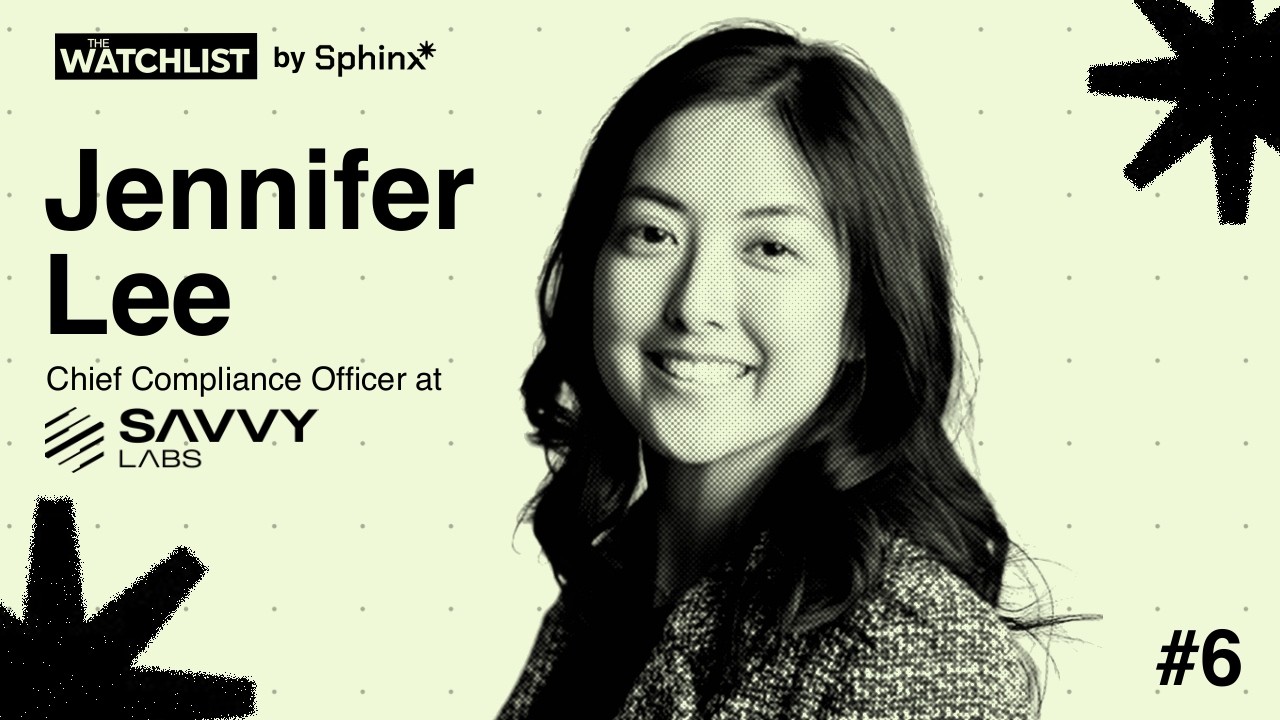


TL;DR: Jennifer Lee spent 10 years at Goldman Sachs running entity-level regulatory reporting across North America, then built the compliance program from scratch at Anchorage Digital — the only operating OCC-chartered crypto bank. Now serving as both CCO and COO at Savvy Labs, she explains why compliance is the most commercial function a company can invest in, and how her team governs AI adoption through a dedicated committee that evaluates privacy, data usage, and fiduciary obligations before any tool is deployed.
What This Episode Covers
Jennifer Lee has built compliance programs across every stage of financial services. She started at a retail brokerage, spent a decade at Goldman Sachs managing regulatory reporting across a constellation of regulated entities, then left for a crypto startup where she helped secure a federal bank charter. That trajectory — from the most established bank on Wall Street to the frontier of digital assets — gives her a vantage point few compliance leaders share. In this conversation, she explains what changes and what stays the same when you strip risk down to fundamentals, why building a compliance program from scratch forces you to justify every control you implement, and how holding both the CCO and COO title at a 16-person startup reshapes the way compliance gets embedded into operations.
Jennifer also shares why her parents were not thrilled about art school, how studying psychology at UC Berkeley gave her an edge in designing policies that people actually follow, and what it felt like to resign from Goldman Sachs and hear colleagues quietly wonder if she had gone rogue. She would rather be a travel blogger.
Who Is Jennifer Lee
Jennifer Lee is the Chief Operating Officer and Chief Compliance Officer at Savvy Labs, an SEC-registered investment advisor that provides a technology platform helping asset managers and wealth managers deliver customized portfolio solutions to institutional clients. Before Savvy Labs, Jennifer spent three years at Anchorage Digital, where she built the compliance program and team from scratch and helped the company secure its federal bank charter from the OCC. Jennifer began her career as a sales trader at a retail brokerage before pivoting to compliance, then spent 10 years at Goldman Sachs in roles that included entity-level regulatory reporting across all of Goldman's North American regulated entities, with significant time working across both the US and APAC regions. She holds a BA in psychology from UC Berkeley.
Why a Psychology Degree Makes You a Better Compliance Officer
Compliance architecture is people architecture. Jennifer Lee studied psychology at UC Berkeley with no plan to enter finance — her parents vetoed art school, and a summer job at a retail brokerage pulled her into the industry. That background turned into a career advantage she did not anticipate. Understanding human behavior sharpens two sides of compliance work: designing policies and training programs that people can actually interpret and follow, and anticipating how bad actors exploit loopholes in those same systems. Jennifer applies the same lens to team management, using it to keep compliance professionals motivated in a function that rarely gets credit. At Goldman Sachs, she refined that skill across US and APAC teams, learning to tailor communication to different cultural audiences without changing the substance of what compliance required. Hamza Siddiqui covers a parallel challenge — scaling compliance communication as teams and transaction volumes grow.
Compliance Is the Most Commercial Thing a Company Can Do
Jennifer Lee spent the first phase of her career viewing compliance as a control function — a team that keeps the firm and its employees out of trouble. The shift came gradually. At Goldman Sachs, she realized that compliance does not just prevent bad outcomes; it delivers direct value to clients and creates competitive separation. That reframing — from defense to commercial advantage — carried over when she moved to Anchorage Digital and later to Savvy Labs, where the compliance team was hired right after engineering, before operations or finance. Savvy Labs embedded a compliance-first mindset into company culture from day one, and that decision is what led leadership to offer Jennifer the expanded COO role. When the two titles conflict, the CCO wins. Jennifer made that explicit when she accepted the position: between operational speed and regulatory control, fiduciary obligations come first. Sphinx has mapped out the compliance software landscape for teams building this kind of infrastructure.
Governing AI Adoption Without Stifling It
As COO, Jennifer Lee faces constant pressure to adopt AI tools that cut operational cost and satisfy client expectations. As CCO, she has to ensure those same tools meet fiduciary standards before they touch client data. Savvy Labs resolved the tension by creating a dedicated AI review committee that evaluates every proposed tool for privacy risk, data usage, and compliance with the firm's obligations as an SEC-registered investment advisor. The process slows adoption — Jennifer acknowledges that openly — but the alternative is deploying technology that creates liability the firm cannot unwind. Her approach mirrors a pattern across regulated fintech: structured governance that clears a path to yes rather than defaulting to no. Auditable AI decision-making is the technical foundation that makes this kind of governance enforceable. Nick Passarelli from Melio describes the operational mechanics of running AI in production compliance workflows.
Who This Episode Is For
- Compliance officers and CCOs weighing a move from traditional finance to crypto, fintech, or early-stage startups who want to understand what actually changes and what stays the same.
- Startup founders and CEOs building a compliance-first culture who need a practical model for when to hire compliance relative to engineering, operations, and finance.
- Operations leaders evaluating how a dual COO/CCO structure works in practice, including where the roles conflict and how to resolve those conflicts without ambiguity.
- Fintech compliance teams designing AI governance frameworks who need a concrete example of committee-based review for privacy, data usage, and fiduciary risk.
Frequently Asked Questions
What does a dual CCO and COO role look like at a fintech startup?
At Savvy Labs, Jennifer Lee started as CCO and expanded into the COO role after leadership recognized that building operational processes with a compliance-first mindset was more efficient than retrofitting controls later. The two roles create natural tension — the COO pushes for speed and cost efficiency while the CCO enforces regulatory control — but Jennifer established a clear hierarchy: when the titles conflict, the CCO takes priority. Fiduciary obligations to clients override operational convenience.
How does Savvy Labs govern AI tool adoption?
Savvy Labs created a dedicated review committee that evaluates every proposed AI tool before deployment. The committee assesses privacy risk, data usage policies, and whether the tool is compatible with the firm's fiduciary obligations as an SEC-registered investment advisor. The process slows adoption intentionally, ensuring that no technology is deployed until the compliance team has cleared it through a structured governance framework.
Are the compliance risks in crypto fundamentally different from traditional finance?
Jennifer Lee argues the divide is largely a misperception. The core risks — fraud, money laundering, operational failure — are the same across asset classes. What differs are the tools and technology used to identify and mitigate those risks, such as blockchain analytics for transaction monitoring. Jennifer applied the same compliance principles she learned over 10 years at Goldman Sachs when she built the program at Anchorage Digital, the only operating OCC-chartered crypto bank.
Why should startups hire compliance before operations and finance?
Savvy Labs hired its compliance team right after engineering, before building out operations or finance. Jennifer Lee explains that this sequencing allows operational processes to be built with compliance embedded from the start, rather than constructing workflows and then needing to walk them back or rebuild them when regulatory requirements surface. Building it right the first time eliminates the cost of retrofitting controls into processes that were not designed to accommodate them.
What skills do compliance officers need to develop for the next five to ten years?
Jennifer Lee identifies technology fluency as the single biggest gap. Compliance officers still need strong regulatory foundations — understanding products, clients, and business models — but the application of that knowledge now spans DeFi protocols, AI-powered tools, blockchain analytics, and emerging asset classes that did not exist a decade ago. The role demands broader knowledge, not deeper specialization, and compliance leaders who treat technology as someone else's domain will fall behind.
Episode Transcript
Alex: Jenny, your career bridges traditional finance and the crypto frontier from 10 years at Goldman Sachs to heading compliance at Anchorage Digital and taking on a dual leadership role, CCO and COO at Savvy Labs. You've helped crypto startup obtain a federal bank charter and even navigated regulatory storms. I don't want to go over the resume. I want to explore really the inflection points, your personal choices and everything that motivated it. I would love to start with the beginning. That's quite interesting. You didn't start out as a typical finance major or lawyer. You actually studied psychology at UC Berkeley. What pulled you into the finance world?
Jennifer Lee: Great question. Usually when I introduce myself, we don't start that early on, all the way back.
Alex: I went a couple of years back, did I?
Jennifer Lee: But great question. I'd love to share that story. I fell into the finance industry really. Taking even a few years even before prior to that, going into college I wasn't sure what I wanted to do. Really appreciated art, was thinking about maybe art school, but being a first generation Chinese American that was not something my parents wanted to sponsor. The deal was, get a four-year degree and then you're free to do whatever you want to do. I figured love talking to people, meeting people. Okay.
Psychology seems cool. As he mentioned, got my BAS at Berkeley in psychology and that was amazing. But I realized, close to graduation, that that wasn't necessarily what I wanted to do. Without aging myself, I did graduate in 2003, so it was probably not the best time to graduate and the world was really coming out of a recession.
Not getting a grad degree as a psych major, job prospects were bleak. I really had to consider what made sense for me. And through my college career, during the summers, I had worked at a retail brokerage and I thought that that world was very fascinating for me. I decided to give it a try.
Coming right out of college I was still in tip-top shape to take exams, so I took a few FINRA exams. Started off my career as a sales trader at the retail brokerage. And then a year later I had the opportunity to transition into trading compliance. And that's really how I got into finance, into compliance. I realized that compliance is really the field I wanted to develop my career in.
Alex: For someone that wanted to do art, decided that they liked people and wanted to do psychology and then going into finance and compliance feels like not a stretch but it's interesting. But do you think that this background that you had in understanding people and their behaviors changed the way or informed the way you've been doing compliance for the past two decades now?
Jennifer Lee: Yes. Without aging myself again. But yes, I can't believe it. Two decades. Definitely. At the end of the day we're working with people, and understanding human psychology, human behavior has been very instrumental in my journey as a compliance professional. From how we design processes, design compliance architecture, all of that, systems, to understanding from two sides: what is the easiest way for people to understand and interpret policies, procedures, trainings, all of that; to understanding potentially how if someone wanted to conduct nefarious activities, what are potential loopholes and how to mitigate all of that. I do think that having a psychology background helped me to really become a better compliance professional.
It also helped me to be able to look at data and really understand and interpret that as well. That has really helped. It even helped me as a compliance manager and leader as well, to really understand the needs of the team and how to really keep people motivated and encouraged.
Alex: I want to dig into the Chinese American background. You then went to Goldman Sachs and you spent 10 years at Goldman and during that there was quite a bit of an APAC stint where you were in APAC and in the US. What is it like building your compliance career across those two different markets and I'm especially curious on the people side of things? Those are two very different cultures. How do you do it and how do you think about it?
Jennifer Lee: I think building my career across these two regions has been really interesting for me. At a high level, one thing I became really good at was learning about how to communicate and observing who the audience was.
Potentially, I think we can all agree there are cultural differences between how people think, how they react across the two different regions from a cultural perspective. The way we speak, the way we engage may be interpreted differently with one group versus another. Although I think working at a global American investment bank, even in Asia we were pretty Americanized. But in terms of how we spoke to our stakeholders, how we wanted to present things, you always had to somewhat tailor it a little bit.
And that's something I quickly learned how to do and I became, I would say, really good at over the 10 years I was there.
Alex: Nice. As though you were running entity level regulatory reporting for all of Goldman North America, which does sound like an incredibly big scope. What is the hardest thing about that role and what did it teach you that you couldn't have learned any other way?
Jennifer Lee: I think that role was interesting because it was across several different types of entities within the US. Goldman has a constellation of regulated entities just in the US and North America would add a tremendous number there as well. And understanding what the regulatory requirements were for each of those entities, the regulators — they're all a little bit different. The definitions of how you would report to one regulator for one set of data would be different for another one. All those intricacies was something we had to really build out and define. But that was something that my team was really great at, really digging in deep, understanding the differences and setting up a process which helped us become more efficient and effective as we built out that program.
Alex: When you think about those first years at Goldman versus the last years at Goldman, what do you think compliance was about? And in hindsight, what did you get wrong or right about your initial perceptions of what it would be?
Jennifer Lee: I always thought we had the gold standard in terms of compliance across many of the larger institutions. And it was interesting the training we got there. We understood where compliance as an organization fit in terms of the overall firm.
We understood the remit, about how we're using these tools such as training, policies, procedures, regulatory interactions, testing, monitoring, all of that as tools to help us to keep the firm and its employees out of trouble. And that is 100% absolutely true. But as I've taken on different roles, even within Goldman, but also after I left Goldman, I've come to see that compliance is so much more than that. I think that one of the most commercial things that a company can do, big or small, is to be compliant.
Before, I had this mindset that we were not so much playing defense, but we're keeping people out of trouble. But it's so much more than that. And as we do that, keeping everyone out of trouble, we are actually also being commercial. We're offering a very special value add to our clients. And that is a shift in mentality that I've come to realize later on in my career. And I think it's 100% absolutely true.
Alex: After that, you've gone rogue. I didn't say that, but a lot of your friends apparently said, "Hey, you went rogue." All right. 10 years in at Goldman Sachs. Literally the pinnacle of finance. And in 2019, you decided to go to Anchorage Digital. What was going through your mind when you went from this 10-year stint of leading one of the biggest departments of the biggest bank in the world to joining Anchorage, which obviously is an incredible company but maybe at the time a less obvious choice?
Jennifer Lee: At that moment in time, that was 2019, I had literally just crossed my 10 year mark, got this beautiful cube which they give to all employees who've celebrated their 10 year anniversary. I definitely still have it on my desk at home. And I was at a great point in my career. Team was great, loved the leadership, loved the culture at the firm as well.
But I think at the same time, I could really see how my career would be for the next 5 to 10 years. And that's a great thing and that would have been a wonderful thing and it would have been a wonderful career. However, I wanted to try something a little bit different. And when the Anchorage opportunity came, now when I look back, I think what I did was I took a calculated risk. I thought, okay, looking at the risk and rewards, and also laying everything out on the table, at that time in 2019 crypto was hot, exciting, but less mainstream as it is today.
As we're sitting here in 2026. And I wasn't even sure, well, is crypto a thing here to stay or not? I wasn't sure. And Anchorage was a double whammy. Great startup, but also it hasn't been around as long as Goldman.
Alex: Very few companies have.
Jennifer Lee: Exactly. Exactly. But I figured I was being offered an opportunity to build not only a compliance program from scratch, but the entire team from scratch, and able to apply everything I've learned to a new digital asset class, which I thought was just so enticing.
And I felt all the steps leading up to that point had been really preparing me for that opportunity. And that was really exciting for me. And I told myself, hey, if it doesn't work out or if I don't like it, my previous experience doesn't go away just because I tried something. And I decided to take a leap. And I remember when I resigned and I was making my rounds saying goodbye to people.
They didn't say it out loud but potentially some people thought I was going rogue going to the crypto realm. But in hindsight, it was a great decision. It really helped me to really expand on my knowledge and practice in general.
Alex: Also building the first OCC regulated crypto company and I think it still is the only OCC regulated crypto company?
Jennifer Lee: Operating.
Alex: Operating. Well, yeah. Big change indeed.
Jennifer Lee: Yes.
Alex: In interviews, you've argued the divide between traditional finance and crypto is mostly a misperception.
Jennifer Lee: Saying that at a fundamental level, it's all the same in terms of risk.
Alex: It is at the time probably a bold stance considering that for a lot of people crypto is considered as being the wild west. How did you come to see digital assets and traditional assets as fundamentally similar in terms of risk?
Jennifer Lee: When I look at situations or complicated problems, I always like to boil it down to the basics, the foundation. And I look at the concerns regulators may have on the digital asset space at that time and compared it to what I've known leading up to that point in the tradfi space, what regulators were expecting, what they were concerned with, and I realized hey these are all very similar problems — fraud, money laundering, operational failures, all of that. And I realized that at the end of the day the goals are always the same across asset classes, across the regulators.
And in many ways I feel that, and I continue to feel that way, that there are more similarities than differences between tradfi and crypto. It's just the applications are different. The tools, the technology you have to help mitigate the risk, control for it, identify risk may be different, but the fundamentals are very similar.
Alex: Would you say that your experience at Goldman was one of the key factors in helping the team get an OCC charter and you knowing really how to get into the weeds and know regulators and whatnot?
Jennifer Lee: For me personally, definitely. What I brought to the table would be my set of experience from Goldman and even earlier on. But I think it's the whole team, the leadership team. It's not any one person, any one team that's really helped us to be able to get that charter.
Alex: You're really vocal about the TRUST initiative, for people that don't know, Travel Rule Universal Solution Technology. And you called it the clearest sign yet that digital assets players as an industry truly care about compliance. What made that moment feel significant to you? And do you think that's really something specific to crypto that's helping compliance in general?
Jennifer Lee: I think that was a very good example of the crypto industry coming together to structure and build the infrastructure needed to meet the regulatory expectations and also the process in order to push the digital asset space to become more mainstream. It was a very needed step, because in tradfi for many years you have the fed rails, you have the infrastructure that's already been there, but that's something that's been built on for many years in order for us to get to that point. And I think the crypto industry had done an amazing job coming together quickly and in a very united way to really meet those needs and work together.
Alex: What's the biggest cultural shock? 10 years in tradfi, then swinging to crypto. Especially from a centuries old bank. At Goldman, I imagine that you had structures and formal processes. Anchorage was more of a tech start vibe. What was the biggest cultural shock, the most surprising thing when landing there?
Jennifer Lee: Being at a well-established bank, as you mentioned, you're used to meeting people who've come from other well-established banks on the street and it's like, "Oh, hi." When you introduce each other, it's like, "I'm from this bank. Oh, you're from another bank." It's a revolving door within these different banks. And what that also means is that everyone starts off with a similar set of understanding of risk and compliance and understanding fiduciary obligations, conduct risk, all of that. That's something I had started off my career being used to, where when you're training people, talking to people, everyone has basically started from a very similar place and understanding. And it did make my job a lot easier as a compliance officer when you're talking to them and trying to influence or communicate different policies, procedures.
But coming into crypto, you realize that you have people who've never been in the financial industry. They've come from other fintechs or a pure big tech company. And going back to basics again, having that communication to have people understand — not assuming that everyone understands what you're talking about when you're talking about conflicts of interest or personal account trading, all of that.
And really boiling it down again back to the basic fundamentals to help people understand was such a fun process because after a while you just think everyone's speaking the same language, same jargon. But then coming back and being like, okay, well why did we have these policies? What risk are we trying to mitigate? Boiling that down even for myself was just fun.
And then regurgitating and helping to communicate that back out to everyone else was a very fun process and actually made me a better compliance officer.
Alex: Before we go deeper, I'd love to help our audience understand what Savvy Labs is building. I don't think everyone here knows necessarily about them. I'll give the one-liner that I understand. SEC registered investment advisor focused on institutional investors. But what problem is it solving and why was this the opportunity you chose after Anchorage?
Jennifer Lee: Savvy Labs, as you mentioned, SEC registered investment advisor. We're really trying to solve for a couple of problems, but mainly helping to provide a tech layer for asset managers, for wealth managers to help them provide more customization to their clients. We probably all have seen and read somewhere at some point about the generational wealth transfer. And there definitely is a lot of focus on wealth being transferred across different generations.
The generation now who is inheriting and receiving a lot of that wealth are now demanding more technology and have more expectations around customization. And our platform really helps to achieve that and helps asset managers who are not one of the few handful large asset managers in the industry have that technology to provide that service to their clients.
Alex: How many people are at Savvy Labs right now?
Jennifer Lee: We're at 16.
Alex: 16 people. We're at 12. It's a fast-moving startup. I know the gist. Compliance can feel sometimes like the brakes on a race car. Not for everyone, but just putting it out there. Have you ever had to put the kibosh on an existing product or partnership because it didn't meet compliance standards?
Jennifer Lee: No joke. But that has not happened in that sense. It has, of course, we have said no. I'm not saying we say yes to everything, but the conversation quickly shifts from no and then talking about it, helping them understand why it's a no, but then the conversation quickly transitions to, well if not now, how do we get there? And it becomes a very productive conversation. And all of the assumptions about how that becomes a horrible conversation actually is not true because I've been fortunate enough to be working with a lot of thought leaders who have a compliance first mindset and quickly the next question is, okay, well then how do we get there? And then we work together to formulate the steps.
Alex: That's great. That's exactly the way. It's funny. I've had a conversation with the chief compliance officer of Melio, Nick, who had exactly the same way of seeing things. 100% agree with you. One of the things that's probably the most unique about what I've seen in your profile. I've seen people go from tradfi to crypto and even though your tenure was quite impressive there, you have two C-suite titles. You're chief operating officer and chief compliance officer, which is quite an unusual combination because I'll have to say, as someone who's selling regtech, these are my two ICPs and you embody both of them. How does it come about?
Jennifer Lee: I'm glad someone's asked me that because it's a story which I think is great and now I think about it, it was quite brilliant on part of the leadership team at Savvy. I started off as a CCO and did what CCOs do: build up the compliance team and controls, policies, trainings, all the fun stuff. And as compliance's touch points across the firm are expansive, quickly leadership thought, and I realized, that it would be not only most beneficial for the company but also for our clients for us to be building out the processes in the first instance with a compliance first mindset instead of building it up a different way and then later needing to walk back, or if something were to happen, needing to rebuild processes.
It's better to build operational processes right the first time with a compliance first mindset.
Alex: But do you ever feel like you're wearing two different hats that tug in opposite directions?
Jennifer Lee: That was definitely something I wondered about at first as well. But when this opportunity did come about, when I was asked to take on a more expanded role, my response was, thank you very much for considering me for this expanded role, and I'm happy to do it, but just so you know, between the two, when push comes to shove, I'm the CCO first before I'm the COO.
Alex: Because the COO in you wants to drive growth and speed and reduce cost and the CCO, very different, wants to ensure control, compliance and whatnot. I don't know if you can even tell us, but is there a specific example that comes to mind where the CCO had to push the COO out of the way?
Jennifer Lee: I'll give you a real life example, a recent one. As we all know, AI is a hot topic. And as a COO that is always something top of mind for me, to have more efficient processes operationally and from a business perspective throughout the organization. And that's definitely something that our clients want to see, we want to see from a management perspective, investors want to see as well. There is that commercial need and drive. But as a CCO, we don't want to stifle innovation, we don't want to stifle tech advancements, but at the same time we have to be very thoughtful about what we implement and what measures we take. There have been times where we had to — I wouldn't say halt but more slow things down until we've gone through and, at first, created the process to review and governed this review and analysis for AI tools. Creating a committee that reviews for privacy, for data usage through these AI tools, and helping to streamline that process but making sure that we're thoughtful and careful and still being able to provide our fiduciary obligations to our clients.
That's a good example of where we had to slow things down. But we eventually still got there.
Alex: It's one thing to be the expert rule keeper, but now you're also running much of the business. Were there areas of the COO role that you initially felt less prepared for and how did you quickly get up to speed?
Jennifer Lee: I would say similarly, I think technology. As a compliance professional previously, we are more doing reviewing and assessing and people are presenting the tools or the technology to you to see, can we use this, is it safe, and then it's someone coming to you with already a set of options and choices for you to pick out. And then as the COO you have to go explore and look for that universe of options or tool set to present to the committee. That's a different mindset. And I think as a CCO nowadays, understanding technology and keeping abreast not only of regulatory changes but technology advancements and changes is a more expanded and new area which I think maybe even a couple decades ago was less relevant, but more and more so now.
Alex: I do feel sometimes when I have my sales conversations and I have to talk to ops and I have to talk to compliance — the thing where there's sometimes resentment from ops because it feels like compliance doesn't understand enough the business needs, and resentment from compliance because it seems like they don't understand enough the compliance needs. But you were and you still are, as you said, mostly a CCO and that's a role that you embody more. Would you say that now being in the day-to-day operations has made you a better CCO?
Jennifer Lee: Definitely. Although I would like to think I've always been very good at my job.
Alex: I'm sure you have.
Jennifer Lee: Thank you. No, but definitely as the COO I can understand even more fundamentally the needs of the business, and a lot of the commercial drive, looking at and hearing directly from our clients firsthand what their needs are and then creating solutions that make sense. Now going through that part of the process definitely helps me understand the front end before the request comes to compliance, where it comes from, and it actually both ways helps me become a good COO as well because we're able to create solutions more efficiently.
Alex: My last question on the dual role because I find it very interesting by the way. How has it shaped or influenced Savvy's culture?
Jennifer Lee: I would look at this a different way. I would say that because Savvy's culture has always been a compliance first culture and the leadership team has been of a compliance first mindset, that's why they presented me with this opportunity. And another good example would be that the compliance team was actually built out, hired, and built out even before any of the other operations or finance teams. After engineering, I was brought on two plus years ago. Really embodying that compliance first mindset has always been in the culture of this company.
Alex: Road ahead, fin compliance legacy. I want to go into the future of compliance. All right. Having straddled the old and new financial worlds, what do you see coming in the next 5 to 10 years that today's compliance leaders need to be ready for?
Jennifer Lee: I touched on this earlier as well, but technology. Having a good handle of technology and how quickly it's changing, AI as well. All of these things are demands which compliance officers need to fully understand. Which again was not a thing 10 years ago, for example. I think for a compliance officer, your foundation now requires you to have a good grasp of regulations, understand your product, understand your business, your clients, all of that — that still holds true — but the application may look different. You may be applying your knowledge to crypto, for example, or to the wealth management space, and using different tools such as blockchain analytics or AI tools.
Having a very broad breadth of knowledge is I think foundational and is a must-have for a compliance officer to be successful.
Alex: How do you think emerging trends — there's been DeFi, AI and finance and ever tightening regulations — how do you think that's going to change the role of the CCO in five years?
Jennifer Lee: I think with all of these changes, all the areas you've mentioned, all of them are a little bit different — DeFi is different, AI for compliance, all of that is different. Again, I think all of these things is going to force compliance as a function to be more broad and more knowledgeable. Become more savvy in terms of our knowledge.
And it's not about just focusing on one thing that you're doing in your vertical and that's all you're focused on. It's really becoming — not a generalist but always being up to speed in terms of the latest developments. There are different risks. DeFi has different risks, AI on business and compliance have different risks as well. Making sure that your foundations are strong so you know how to mitigate the risk and identify it — that's going to be a new challenge for compliance officers because there are a lot of new kinds of technology.
Alex: You've been a pioneer in a lot of ways, let's say. You've taken unconventional career risks. You've shaped the first crypto bank. You're currently wearing multiple hats. When you think big picture, what impact or legacy do you hope to have on fintech and compliance industry, if any?
Jennifer Lee: I don't know about legacy, but I hope that I can really set an example for others to see that innovation is really key. We see it all around us. And it is possible going from one industry to another. And being able to apply your knowledge to a new set of standards, to a new asset class, all of that is possible and it is the way of the future.
Because we're seeing this more and more frequently, how many different industries are evolving. There's consolidation, etc. And keeping an innovation first mindset and being thoughtful about that, obviously, I think is key and is going to be hopefully something I can demonstrate for others that's possible.
Alex: And is there any cultural shift you hope to contribute to in that space? It is a lot of male space as well, and there's always been that "hey, compliance is friction" and whatnot. I would love to understand if there's a change in the industry or cultural shift you'd like to be part of.
Jennifer Lee: I would like to see, and I am seeing this a lot already, but what I spoke about earlier on — seeing compliance not only as a control function but really a commercial function as well. I think that is a change of mentality which is needed, and I think is demonstrating to be more and more true across different industries.
Alex: Now I'm going to go back back back back back again. You said you wanted to be in the arts and then because of first generation Chinese immigrants in the US, your parents really wanted you to do something with a degree and you went ahead 10 years at Goldman, three years at Anchorage, now two and a half years at Savvy. Are you proud of yourself?
Jennifer Lee: Yes. But, being the Chinese American my parents raised, I always feel like I haven't done enough yet. Good so far, but I can do more. I should be doing more.
And I'm very happy and fortunate for all the opportunities I've had so far, the people I've met. I think because of all of these experiences, I've really been able to become the person that I am today and the professional that I am today. But yeah, I feel like I'm just getting started. After I left Anchorage, when I went from large bank like Goldman to Anchorage and then to even smaller startup, what brought me there?
It's really the team, it's the people, but more fundamentally, it's my interest and curiosity and want to build. I like to innovate and have change. And for at least — that may change 10 years down the line when we have another podcast recording.
Alex: But for now,
Jennifer Lee: You'll be the one hosting.
Alex: Okay.
Jennifer Lee: I would love that. You'll be my first guest. But yeah, that's where I am now. And people evolve too. And at least now I feel like I still have a lot more that I can do.
Alex: Cool. Maybe you'll start a company in a couple of years to complete the arc from the big to the small to the smaller to yourself.
Jennifer Lee: Yeah, maybe.
Alex: And for young professionals listening, maybe those starting in traditional finance but curious about crypto or the fintech space, what advice would you give?
Jennifer Lee: Two things come to mind. One, always try to identify mentors and teachers or people who can — whether it's taking a personal interest in your success or people who just want to share their experience. There's so much for you to gain from that and they're really going to be able to help you to either navigate your career better or to potentially avoid some mishaps so that you don't have to also experience it firsthand yourself, because I can think of many other productive ways you can use your time instead of needing to go through all of that but still understand what the challenges are. I think that's number one. And then number two, I would say don't be afraid to take risks. It needs to be calculated risk.
Alex: I'll quote that. I'll just put that extract in the video. Take risks from a compliance leader.
Jennifer Lee: Calculated risks. It's something to be thoughtful, to be intentional about the risks you're taking. But without taking any risk, I don't think it'll be — it'll be much slower for you to develop as an individual, as a professional, even as a business. The safest way is to take no risk, but that would be very hard and detrimental for an organization. Always be thoughtful, mindful, and take calculated risks.
Alex: Love it. Well it was a great podcast. I'd love to finish with a rapid fire. Does that work?
Jennifer Lee: Yes.
Alex: Lovely. One word that defines great compliance leadership.
Jennifer Lee: Honesty.
Alex: Most overrated compliance trend right now.
Jennifer Lee: Compliance theater.
Alex: Most underrated tool or control that actually works?
Jennifer Lee: Training.
Alex: A fintech mistake you've seen more than once and wish would stop.
Jennifer Lee: Overlooking compliance controls.
Alex: Hardest thing to explain to a non-compliance colleague.
Jennifer Lee: Including compliance early on helps to make things more efficient in the long run.
Alex: One compliance task you'd automate tomorrow if you could.
Jennifer Lee: Monitoring across different tools and consolidating into a risk rating.
Alex: Biggest red flag you spot instantly in early stage startups.
Jennifer Lee: Lack of communication.
Alex: Skill future CCOs must develop that's not in any textbook.
Jennifer Lee: Communication.
Alex: For anyone listening to that podcast, it's all about communication.
Jennifer Lee: Yes. Very important.
Alex: One hill you'll always die on. Compliance wise.
Jennifer Lee: Be truthful and credible.
Alex: I thought you were going to say communication.
Jennifer Lee: No, I should.
Alex: You should have. And last question. If you weren't in compliance or ops, what would you be doing instead? I feel like I have my answer, but I'll let you take it away.
Jennifer Lee: Well, actually, I'll throw you a curveball because I haven't mentioned this. I would want to be a travel blogger.
Alex: No way.
Jennifer Lee: Yeah, I love to travel and being a travel blogger just seems very fun. Would love to try it out.
Alex: Next company is a cross-border payments company.
Jennifer Lee: Yeah.
Alex: Jenny, it was a pleasure having you on the podcast. Thank you so much. And yeah, that's a wrap.
Jennifer Lee: Thank you.
View full transcript
Subscribe to the Podcast